
Emil Zátopek — Czech long-distance runner and Olympic champion
Czechoslovak long-distance runner Emil Zátopek (1922–2000) won three Olympic golds at Helsinki 1952, pioneered intense interval training, and earned the nickname “Czech Locomotive.”
Overview
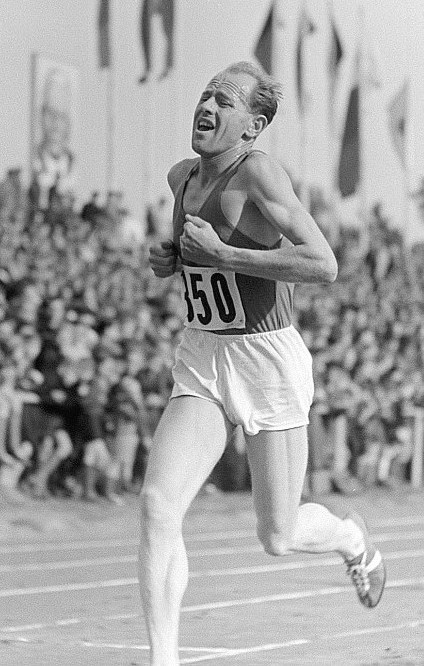
Emil Zátopek (19 September 1922 – 22 November 2000) was a Czechoslovak long-distance runner widely regarded as one of the sport's greatest competitors. He gained international fame for his relentless racing style, unusual training methods, and his performance at the 1952 Summer Games. Zátopek became a symbol of endurance and determination, celebrated both for his victories on the track and for his influence on modern training.
Image gallery
3 Images

Early life and development
Born in Kopřivnice in what was then Czechoslovakia, Zátopek began running after World War II and rapidly improved. He worked his way up through national competitions and attracted attention for both his results and the extreme intensity of his workouts. By the late 1940s he was competing internationally and had already begun to set national and world-class times at long distances.
Training, style and innovations
Zátopek was known for pioneering high-volume interval training: repeated fast efforts with short recoveries. His sessions often included many repetitions at race pace and above, sometimes described as sets of hundreds or long sequences of 400–1,000 metre repeats. This approach, coupled with a forthright competitive temperament, produced consistently fast finishing speed and remarkable stamina. His hard-training reputation earned him the nickname the "Czech Locomotive."
Major achievements
His international résumé combines Olympic medals and world records across multiple distances. Zátopek won the 10,000 metres at the 1948 Olympics and later achieved an extraordinary triple at the 1952 Helsinki Games: gold medals in the 5,000 metres, the 10,000 metres and the marathon. Remarkably, he had never run a competitive marathon before deciding shortly before the race to enter and then won, setting an Olympic mark of 2:23:03,2. He also set numerous world records during his career at distances ranging from 5,000 metres to longer road events.
- 1948: Olympic success on the track, establishing him internationally.
- 1952: Triple gold in Helsinki — 5,000 m, 10,000 m and marathon (1952 Olympics).
- Multiple world records and memorable championship performances.
Legacy and notable facts
Zátopek's influence extends beyond his medals. Coaches and athletes adopted elements of his interval-based training, and his example encouraged a more scientific approach to endurance preparation. He remained a popular figure in his home country and internationally, both for his sporting achievements and for his character. Anecdotes about his toughness and his willingness to experiment with training and racing continue to be cited in books and coaching manuals. For further reading about his races and methods see resources on the 5,000 metres (5,000 m) and accounts of Helsinki (Helsinki 1952).
Even decades after retiring from competition, Emil Zátopek is remembered as an innovator and one of the defining figures of mid-20th-century distance running.
Questions and answers
Q: Who was Emil Zátopek?
A: Emil Zátopek was a Czechoslovak runner from town Kopřivnice.
Q: What is Emil Zátopek most known for?
A: Emil Zátopek is most known for winning 3 gold medals at the 1952 Summer Olympic games in Helsinki.
Q: In which events did Emil Zátopek win gold medals in the 1952 Summer Olympic games?
A: Emil Zátopek won gold medals in the 5,000 metres, 10,000 metres runs, and marathon events in the 1952 Summer Olympic games.
Q: Did Emil Zátopek prepare for a marathon before competing in the 1952 Summer Olympic games?
A: No, Emil Zátopek never ran a marathon before competing in the 1952 Summer Olympic games.
Q: What was Emil Zátopek's time when he set the former record in the marathon event?
A: Emil Zátopek's time was 2:23:03,2 when he set the former record in the marathon event.
Q: When was Emil Zátopek born and when did he die?
A: Emil Zátopek was born on 19 September 1922 and died on 22 November 2000.
Q: What town did Emil Zátopek come from?
A: Emil Zátopek came from the town of Kopřivnice.
Related articles
Author
AlegsaOnline.com Emil Zátopek — Czech long-distance runner and Olympic champion Leandro Alegsa
URL: https://en.alegsaonline.com/art/31146
Sources
- independent.co.uk : "Emil Zátopek: The greatest Olympian vanished from public life after he defied Russian tanks in 1968"
- beh-roznov.koprivnice.org : "Běh rodným krajem Emila Zátopka"