
Ely Cathedral (Anglican cathedral in Ely, Cambridgeshire)
Major medieval cathedral in Ely, Cambridgeshire; diocesan seat known for its distinctive Octagon lantern, long history from a 7th‑century foundation, and its landmark silhouette across the Fenland.
Overview
Ely Cathedral stands in Ely, Cambridgeshire and serves as the principal church of the diocese of Ely. It is the seat of the Bishop of Ely and a focal point for worship, music and diocesan ceremonies. The cathedral occupies a prominent position in lowland England, around 20 km north of Cambridge, where it is visible across the surrounding countryside.
Image gallery
10 Images

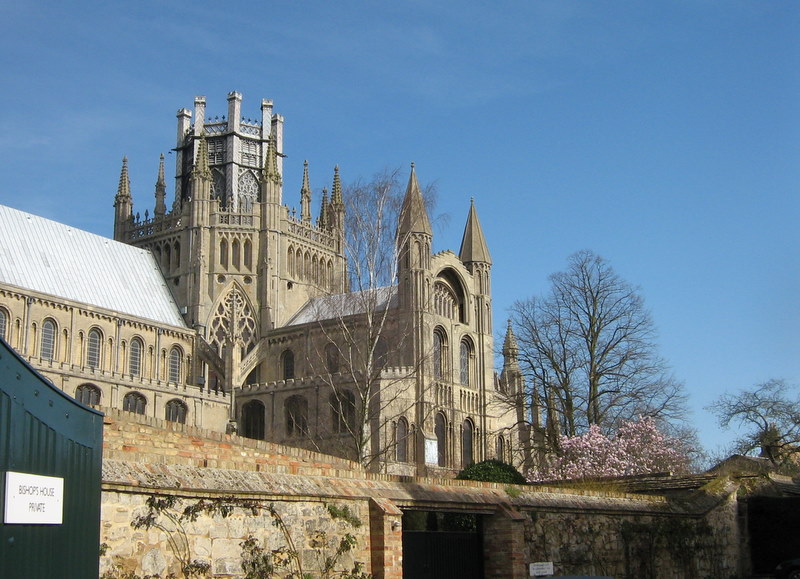


Architecture and principal features
The cathedral is notable for a mix of architectural styles and a number of distinctive elements. Visitors often point to the central Octagon lantern — an innovative medieval solution that tops the crossing and admits light into the interior. Other visible features include a long nave, a decorated west front and several chapels added over centuries. The building's scale and elevated roofline give it the appearance of a 'ship' floating above the flat landscape, a quality captured in its local nickname "the Ship of the Fens".
History and development
The foundation of Christian worship on this site dates back to the early medieval period, when a religious community was established by a prominent royal saint. The present cathedral evolved through Norman rebuilding and later Gothic additions, reflecting changing liturgical needs and artistic fashions. A major structural crisis in the medieval era led to the replacement of a collapsed central tower by the distinctive Octagon, an ambitious engineering and artistic response that shaped the cathedral's later appearance.
Uses, music and public role
Ely Cathedral functions as a living place of worship and a centre for diocesan life. Regular services, choral music, organ recitals and school partnerships are important parts of its daily programme. The cathedral is also a major visitor attraction, drawing people interested in architecture, history, and sacred art. Conservation and interpretation work help maintain the fabric and explain its story to the public.
Landscape and cultural significance
Its nickname reflects more than shape: the cathedral's tall silhouette historically served as a landmark across marshy ground that was once part of the Fens. Those wetlands — originally wet and marshy environments and a notable wetland habitat — have been extensively drained and converted to low-lying farmland, forming the wider Fenland in East Anglia. The contrast between the cathedral's solidity and the openness of the surrounding plain contributes to its strong visual identity.
Notable facts and distinctions
- The Octagon lantern is widely regarded as an uncommon medieval architectural achievement that blends structural ingenuity with decorative ambition.
- The cathedral's long history preserves layers of masonry, sculpture and stained glass spanning centuries.
- Beyond its religious function, Ely Cathedral remains an important cultural and educational resource for the region.
For visitors and scholars alike, Ely Cathedral offers an accessible example of how English cathedrals grew organically over time, adapting to new needs while retaining a distinctive regional character.
Questions and answers
Q: What is Ely Cathedral?
A: Ely Cathedral is an Anglican church in Ely, Cambridgeshire, which is the main church of the diocese of Ely and the seat of the Bishop of Ely.
Q: Why is Ely Cathedral known as "the Ship of the Fens"?
A: Ely Cathedral is known as "the Ship of the Fens" because of its prominent shape that towers above the surrounding flat landscape.
Q: Where is the city of Ely located?
A: The city of Ely is located about 20 km north of Cambridge.
Q: What were the fens?
A: The fens were once wet and marshy, a wetland habitat in East Anglia.
Q: Does the Fenland in East Anglia include Ely currently?
A: Yes, the Fenland in East Anglia includes Ely currently.
Q: Is the Fenland in East Anglia mainly drained today?
A: Yes, the Fenland in East Anglia is mainly drained today and is now a low-lying farmland.
Q: Who is the seat of the Bishop of Ely?
A: The Ely Cathedral is the seat of the Bishop of Ely.
Related articles
Author
AlegsaOnline.com Ely Cathedral (Anglican cathedral in Ely, Cambridgeshire) Leandro Alegsa
URL: https://en.alegsaonline.com/art/31048
Sources
- elycathedral.org : Cathedral web-site
- commons.wikimedia.org : Ely Cathedral