
Elliott Carter (1908–2012) — American modernist composer
Elliott Carter was a leading American modernist composer noted for rhythmic innovation, metric modulation, and a long, productive career that extended into his centenarian years.
Overview
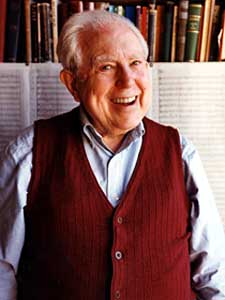
Elliott Carter (December 11, 1908 – November 5, 2012) was an American composer whose creative life spanned much of the 20th century and into the early 21st. He is widely regarded as one of the most important and influential American composers of his generation. Carter achieved international recognition for music that combined technical rigor with expressive intensity. He wrote for a broad range of forces — solo instruments, chamber ensembles, string quartets, concertos and full orchestra — and remained an active, composing presence well into his late nineties and beyond.
Image gallery
3 Images

Life and career
Carter was born in New York City and received early musical training that led to formal study in composition. He pursued advanced study and contacts abroad as well as in the United States, experiences that informed his early and middle-period stylistic developments. Over the decades he accepted commissions from major ensembles and soloists, and his works were premiered by leading orchestras and performers. He continued to write significant new music into his centenary year, and several high-profile performances marked milestones such as his 100th birthday.
Musical style and techniques
Carter is best known for a rigorous approach to rhythm and tempo. He developed and popularized metric modulation, a technique that makes a precise, audible transition from one pulse or tempo to another by reinterpreting note values. This device allowed Carter to juxtapose different tempos and rhythmic characters simultaneously while maintaining internal logical coherence. His music often features dense counterpoint, sharply delineated instrumental roles and an emphasis on timbre, register and motivic identity rather than traditional harmonic progression.
Ensemble thinking and textures
Rather than treating the orchestra as a single homogeneous mass, Carter frequently conceived ensembles as collections of individual voices or small groups with distinct characters. This approach gives many of his pieces the effect of chamber-like dialogue within larger forces: instruments act like autonomous players, each with its own tempo, rhythm or expressive profile. The resulting textures require careful coordination from performers and attentive listening from audiences, but they have been admired for their clarity and structural imagination.
Notable works and premieres
Carter’s output includes an extended series of string quartets that chart a trajectory of changing concerns and expressive range. He wrote concertos and orchestral works that pushed ensemble writing in new directions. A prominent late work, Interventions for Piano and Orchestra, received high-profile performances by the Boston Symphony Orchestra under James Levine with Daniel Barenboim as soloist in Symphony Hall, Boston, and was heard again at Carnegie Hall during celebrations of Carter’s 100th birthday. Throughout his career his pieces were commissioned and premiered by major soloists, chamber groups and orchestras.
Awards, recognition and legacy
Carter received numerous honors in recognition of his contributions to contemporary music. His influence extends through generations of composers and performers who study his approaches to rhythm, temporal design and ensemble writing. His works are widely recorded and remain in the repertory of contemporary music ensembles and orchestras. Scholars and performers continue to analyze and perform Carter’s music, drawn to its combination of intellectual complexity and expressive force.
Listening, scores and further resources
Listeners seeking to explore Carter’s music will find a range of recordings and published scores, from early chamber pieces to late orchestral commissions. Music libraries, conservatories and specialized contemporary-music festivals frequently program his works. For general biographical information, catalogs of works and thematic analysis, consult reputable music libraries and institutional pages linked below.
- Biographical overview and career summary
- Catalog of works and discography
- Analyses of Carter’s techniques, including metric modulation
- Boston Symphony Orchestra performance history and programs
- Information on performers associated with Carter
- Profiles of notable soloists who premiered his works
- Carnegie Hall archival performance notes
- Centennial celebrations, commissions and late-career premieres
Careful study of Carter’s scores rewards performers and analysts: his notation specifies precise rhythmic and temporal relationships, and his later works display an economy of gesture alongside subtle expressive detail. While his music can present an initial challenge to listeners unfamiliar with modernist idioms, repeated hearings often reveal a distinctive logic and emotional immediacy. As both a historical figure and an ongoing presence in concert life, Elliott Carter remains central to understanding developments in American and international contemporary music during the last century.
Questions and answers
Q: Who was Elliott Carter?
A: Elliott Carter was an American composer.
Q: What is Elliott Carter known for?
A: Elliott Carter is known for being one of the most important composers of classical music of his time and experimenting with new ideas of composition.
Q: How old was Elliott Carter when he passed away?
A: Elliott Carter lived to be 103 years old when he passed away.
Q: Did Elliott Carter stop composing at any point in his life?
A: No, Elliott Carter continued composing all his life.
Q: What was the title of Elliott Carter's recent piece?
A: The title of Elliott Carter's recent piece was Interventions for Piano and Orchestra.
Q: Where was Interventions for Piano and Orchestra first performed?
A: Interventions for Piano and Orchestra was first performed in the Symphony Hall, Boston.
Q: Who conducted the Boston Symphony Orchestra and played soloist in the performance of Interventions for Piano and Orchestra?
A: The Boston Symphony Orchestra was conducted by James Levine and the soloist in the performance of Interventions for Piano and Orchestra was pianist Daniel Barenboim.
Related articles
Author
AlegsaOnline.com Elliott Carter (1908–2012) — American modernist composer Leandro Alegsa
URL: https://en.alegsaonline.com/art/30956