
Elkhart, Kansas
County seat of Morton County in southwest Kansas near the Oklahoma and Colorado borders; a small Plains community with agricultural roots and regional services.
Overview
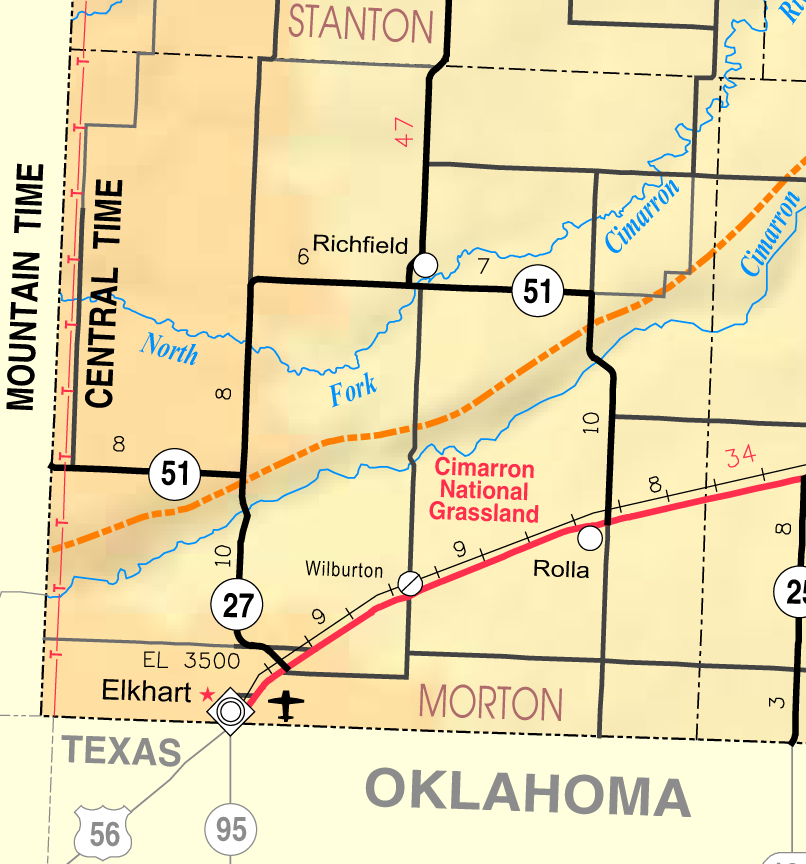
Elkhart is a small city in Morton County, in the southwestern corner of Kansas, United States. It serves as the county seat and functions as a local center for government, commerce, and services for surrounding rural areas. According to the 2010 census, the city had 2,205 residents. Elkhart is notable for its location near state lines: the southern edge of the city abuts the Kansas–Oklahoma border, and it lies roughly 8.5 miles from the Kansas–Colorado border.
Image gallery
3 Images

Geography and setting
Located on the High Plains, Elkhart sits in a largely flat, semi-arid landscape dominated by grasslands and farmland. The town’s proximity to two state borders places it at a crossroads of short regional travel and trade. The climate is typical of western Kansas, with hot summers, cold winters, and relatively low annual precipitation; these conditions influence local agriculture and water use.
History and development
Elkhart developed as a Plains community during the broader settlement and agricultural expansion of the late 19th and early 20th centuries. Over time it grew into the administrative center for Morton County. Its history is tied to ranching, dryland farming, and the patterns of small-town life on the Great Plains—serving ranchers, farmers, and travelers in the region.
Economy, services, and community life
The local economy is based largely on agriculture, supporting farms and ranches in the surrounding countryside. In addition to farming-related businesses, Elkhart provides essential public services, small retailers, schools, and institutions that serve county residents. Community life typically revolves around school events, local government, and seasonal agricultural activities.
Transportation and role
- Regional access: Elkhart’s position near state lines makes it a waypoint for travelers moving between Kansas, Oklahoma, and Colorado.
- Local services: As the county seat, it houses administrative offices and facilities important to Morton County residents.
Notable facts and distinctions
Elkhart’s border location and its small population make it representative of many rural county seats in the central United States—communities that maintain civic infrastructure and services despite modest size. Its landscape and economy reflect the broader characteristics of the High Plains and agricultural Kansas.
Questions and answers
Q: Where is Elkhart, Kansas located?
A: Elkhart, Kansas is located in Morton County, Kansas, United States.
Q: What is the county seat of Morton County?
A: Elkhart is the county seat of Morton County.
Q: Which state borders the southern part of Elkhart?
A: The southern part of Elkhart borders Oklahoma.
Q: How far is Elkhart from the Kansas-Colorado border?
A: Elkhart is 8.5 miles (13.7 km) from the Kansas-Colorado border.
Q: How many people lived in Elkhart in 2010?
A: In 2010, 2,205 people lived in Elkhart.
Q: Is Elkhart a big city?
A: No, Elkhart is not a big city.
Q: What is important to know about the location of Elkhart?
A: It is important to note that Elkhart is located near both the Kansas-Oklahoma and Kansas-Colorado borders.
Related articles
Author
AlegsaOnline.com Elkhart, Kansas Leandro Alegsa
URL: https://en.alegsaonline.com/art/30913
Sources
- census.gov : "US Gazetteer files 2010"
- factfinder2.census.gov : "American FactFinder"
- census.gov : "Population and Housing Unit Estimates"
- factfinder2.census.gov : "American FactFinder" · web.archive.org
- geonames.usgs.gov : "US Board on Geographic Names"
- naco.org : "Find a County" · web.archive.org
- factfinder2.census.gov : "2010 City Population and Housing Occupancy Status" · web.archive.org
- books.google.com : Biennial Report of the Board of Directors of the Kansas State Historical Society
- epodunk.com : "Profile for Elkhart, Kansas"
- mtcoks.com : Morton County Facts; mtcoks.com
- ncdc.noaa.gov : "Climatography of the United States No. 20: 1971-2000 – Elkhart, KS"