
Elizabeth Ann Seton
First native-born U.S. saint; founder of the American Sisters of Charity and a pioneer of Catholic education in the United States.
Overview
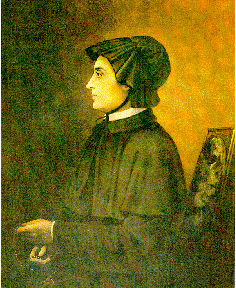
Elizabeth Ann Seton (August 28, 1774 – January 4, 1821) was an American educator and religious leader who became the first native-born citizen of the United States to be canonized by the Roman Catholic Church. Her life combined family responsibilities, deep personal loss, religious conversion and a commitment to education and charitable service that shaped Catholic institutions in early America. She was canonized on September 14, 1975 by the Catholic Church; further information about that recognition is available here.
Image gallery
10 Images


Early life and conversion
Born Elizabeth Ann Bayley in New York City into a prosperous Anglican family, she married William Seton and raised children while her husband pursued mercantile ventures. After his business failed and his health declined, the family traveled to Italy for care; William Seton died there. During that period Elizabeth encountered Catholic worship and pastoral care, and after returning to the United States she formally entered the Catholic Church. Her conversion was a significant step in a largely Protestant country and drew both criticism and support from different quarters.
Founding schools and a religious community
Facing financial hardship, Elizabeth turned to teaching to support her family. In 1809 she established a school at Emmitsburg, Maryland, where she opened St. Joseph's Academy and Free School for girls — one of the first Catholic schools in the United States. The community she gathered for this work evolved into the Sisters of Charity, a religious congregation dedicated to education, care of the poor and hospital work. The congregation she began in Emmitsburg later became part of a wider network of Sisters of Charity across the country; the Emmitsburg site is often associated with her earliest institutional efforts and is described here.
Work, methods and influence
Seton emphasized practical instruction, moral formation and attentive care for students from varied backgrounds. Her approach combined European models of religious life with adaptation to the realities of frontier and early republican America. The religious community she founded organized communal life, taught in parish schools, and staffed hospitals and orphanages, helping to lay groundwork for the Catholic parochial school system and social ministries that became central to American Catholicism.
Legacy and distinctions
- First native-born U.S. citizen canonized as a saint.
- Founder of the Sisters of Charity in the United States; this congregation is often referenced under slightly different titles but traces roots to her community — more on the congregation is available here.
- Pioneer of Catholic education in America, particularly for girls and the poor.
Elizabeth Ann Seton died in 1821 in Emmitsburg, leaving institutions and an example of faith-driven social service that continued to expand beyond her lifetime. Her story is frequently cited in discussions of American religious history, women's leadership in the church, and the development of parochial education.
Questions and answers
Q: Who was Elizabeth Ann Seton?
A: Elizabeth Ann Seton was the first native-born citizen of the United States to be made a saint by the Roman Catholic Church.
Q: When was Elizabeth Ann Seton canonized by the Roman Catholic Church?
A: Elizabeth Ann Seton was canonized on September 14, 1975.
Q: What was Elizabeth Ann Seton's contribution to education?
A: Elizabeth Ann Seton started the first Catholic school in the country, which was located in Emmitsburg, Maryland.
Q: What is the name of the religious sisterhood founded by Elizabeth Ann Seton?
A: The religious sisterhood founded by Elizabeth Ann Seton is called the Sisters of Charity.
Q: Where was Elizabeth Ann Seton's first Catholic school located?
A: Elizabeth Ann Seton's first Catholic school was located in Emmitsburg, Maryland.
Q: What is Elizabeth Ann Seton known for?
A: Elizabeth Ann Seton is known for being the first native-born citizen of the United States to be made a saint by the Roman Catholic Church, for starting the first Catholic school in the country and for founding the Sisters of Charity.
Q: What is the significance of Elizabeth Ann Seton's canonization by the Roman Catholic Church?
A: Elizabeth Ann Seton's canonization by the Roman Catholic Church is significant because she is the first native-born citizen of the United States to be made a saint.
Related articles
Author
AlegsaOnline.com Elizabeth Ann Seton Leandro Alegsa
URL: https://en.alegsaonline.com/art/30863
Sources
- catholiceducation.org : The Conversion of Elizabeth Ann Seton: First American-born Saint