
Eisenhower Executive Office Building
Historic Second Empire–style U.S. government office building next to the White House, built 1871–1888, home to executive branch offices and a National Historic Landmark.
Overview
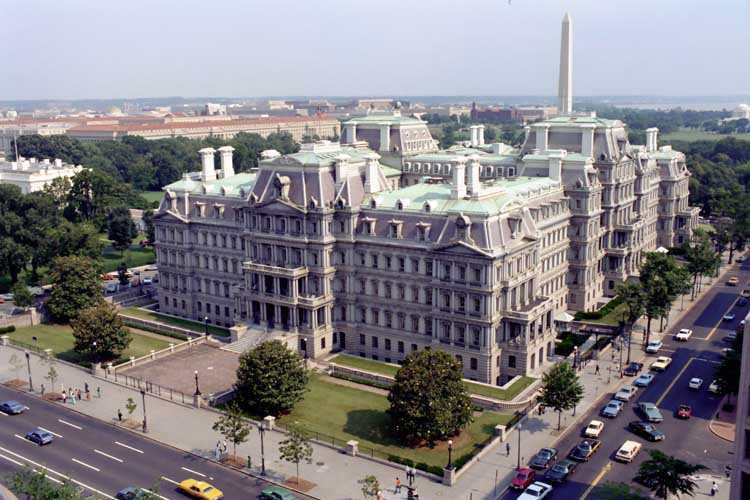
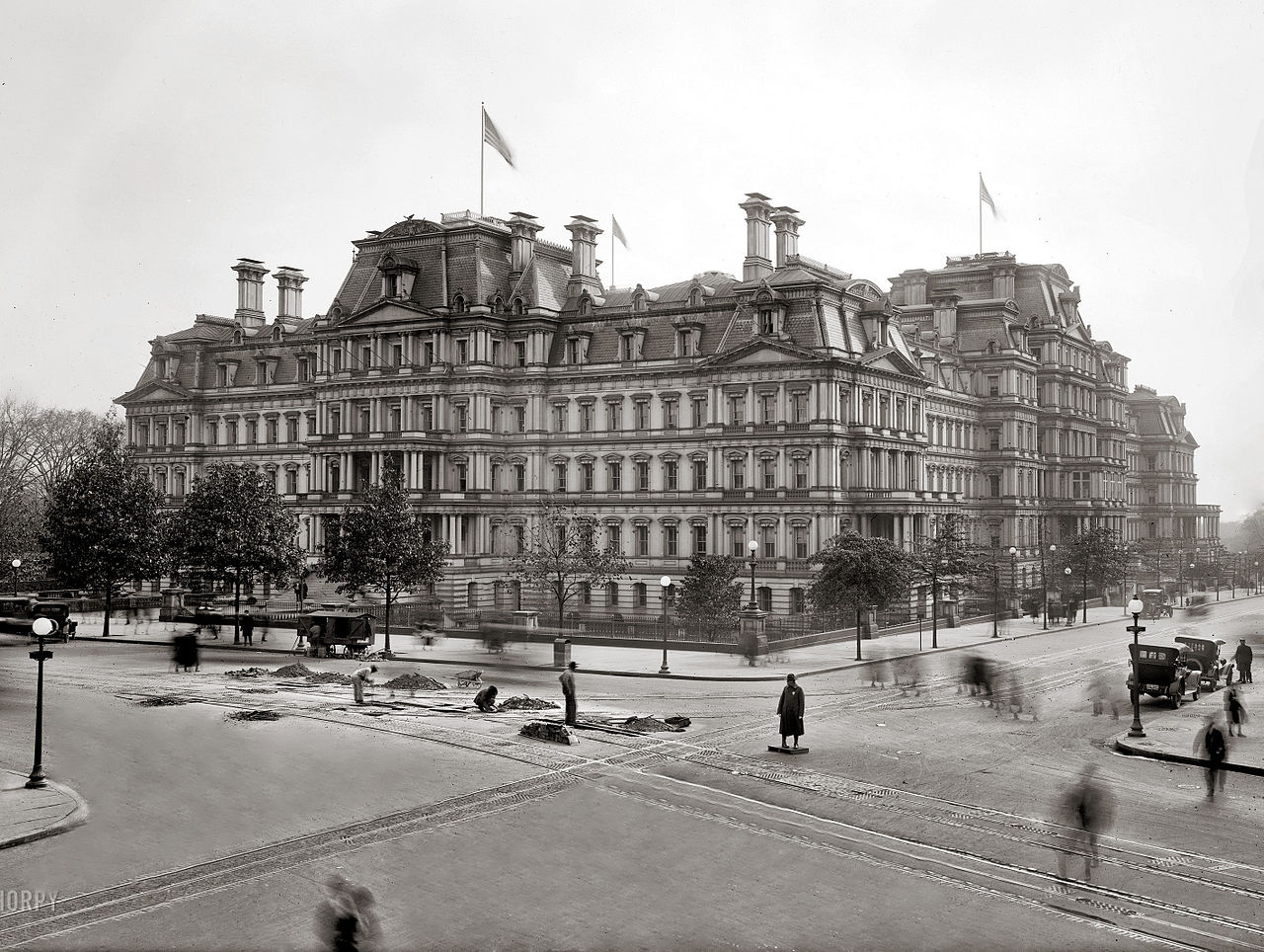
The Eisenhower Executive Office Building (EEOB), originally the State, War, and Navy Building and commonly called the Old Executive Office Building, is a large federal office building located immediately west of the White House in Washington, D.C. The nation’s capital. Designed in the French Second Empire manner, the structure is notable for its massive size, ornate exterior, and long public history as part of the presidential complex.
Image gallery
10 Images





Design and characteristics
The building was commissioned during the presidency of Ulysses S. Grant and constructed from 1871 to 1888. Architect Alfred B. Mullett, supervising architect of the Treasury Department, led the project and adopted the Second Empire vocabulary of mansard roofs, dormer windows, bracketed cornices, and richly patterned stone and cast-iron trim. Interior spaces historically included large corridors, ceremonial rooms, and an extensive network of offices; at one time the EEOB contained some 566 rooms and roughly ten acres of floor space, making it among the largest office buildings in the world of its era.
History and reception
From the start the building divided opinion. Its ornate French-derived style contrasted with the prevailing neoclassical government buildings in Washington, and critics from the late 19th century often attacked its appearance and scale. Writers and public figures of the period expressed strong views: for example, Mark Twain famously mocked its appearance (Mark Twain), and President Harry S. Truman later described it harshly as well (Harry S. Truman). Some contemporary historians and architects regarded the EEOB as an awkward but energetic expression of post–Civil War America’s ambition and taste for eclecticism.
Use, restoration, and status
Originally built to house the State, War, and Navy Departments, the building’s role evolved as the federal government expanded. It has long been part of the White House complex, accommodating a variety of executive offices and staff. A major conservation and renovation effort began in the early 1980s to correct aging systems, code deficiencies, and structural problems; restoration work on prominent ceremonial spaces, including the historic office of the Secretary of the Navy, was completed in the 1980s and the space now serves as a ceremonial office for the Vice President. The EEOB was designated a National Historic Landmark in recognition of its architectural significance and historical associations.
Notable facts and distinctions
- Alternate names: Old Executive Office Building; State, War, and Navy Building.
- Architect: Alfred B. Mullett (Supervising Architect of the U.S. Treasury).
- Architectural style: French Second Empire with distinctive mansard rooflines and elaborate ornament.
- Historical significance: once among the world’s largest office buildings and continuously associated with executive branch functions.
- Modern status: restored and preserved as part of the White House complex; houses executive offices and ceremonial rooms.
Importance and public access
Beyond its architectural quirks, the building is important as a witness to federal growth after the Civil War and to changing attitudes about architecture and preservation. It remains an active office building, and portions are sometimes accessible to the public on guided tours or during special events. For further historical context and visitor information, consult official resources and archives that document the EEOB’s construction, restoration, and ongoing role in the executive branch (historical commentary, presidential records, and local guides in Washington, D.C.).


Related articles
Author
AlegsaOnline.com Eisenhower Executive Office Building Leandro Alegsa
URL: https://en.alegsaonline.com/art/30502
Sources
- history.state.gov : "Buildings of the Department of State – Buildings – Department History – Office of the Historian"
- library.thinkquest.org : "The White House Area" · web.archive.org
- morningsun.net : "Call it ugly or a monstrosity; call it Eisenhower Building"
- worldcat.org : "Richard D. White Jr. Roosevelt the Reformer"
- npgallery.nps.gov : "National Register of Historic Places Inventory/Nomination: Executive Office Building/State, War, and Navy Building"
- npgallery.nps.gov : three photos from 1971