
Eel (Anguilliformes): appearance, life cycle, habitats, and human interactions
Long, snake-like teleost fishes (order Anguilliformes) with distinctive life cycles. Article covers anatomy, larval stages, habitats from shallow rivers to deep sea, uses, and notable facts.
Overview
Eels are elongated ray-finned fishes of the order Anguilliformes, often described simply as "true eels." They belong to the larger group of teleost fishes and are commonly referred to as fish with a snake-like form. Size varies widely across species: some adults measure only a few tens of centimetres while others may reach several metres in length and substantial body mass. Most species have a cylindrical, tapered body adapted for moving through tight spaces and for an ambush style of hunting.
Image gallery
10 Images




Anatomy and distinguishing features
Eels differ from many other fishes in their fin and skeletal anatomy. Pelvic fins are usually absent and pectoral fins may be reduced or missing; the long dorsal and anal fins often merge with the caudal (tail) fin to form a continuous fringe. These fins typically lack rigid spines, and external scales are often very small, embedded, or absent entirely, leaving a smooth, often slimy skin. The shoulder girdle is not fused to the skull, which is one of several skeletal adaptations that distinguish eels from other fishes. Key characteristics include:
- Elongated, serpentine body plan.
- Reduced or missing paired fins and continuous dorsal/anal/caudal fins.
- Small or absent scales and a mucous-covered skin.
- Adaptations for burrowing, crevice-dwelling, or sustained swimming in open water, depending on species.
Life cycle and development
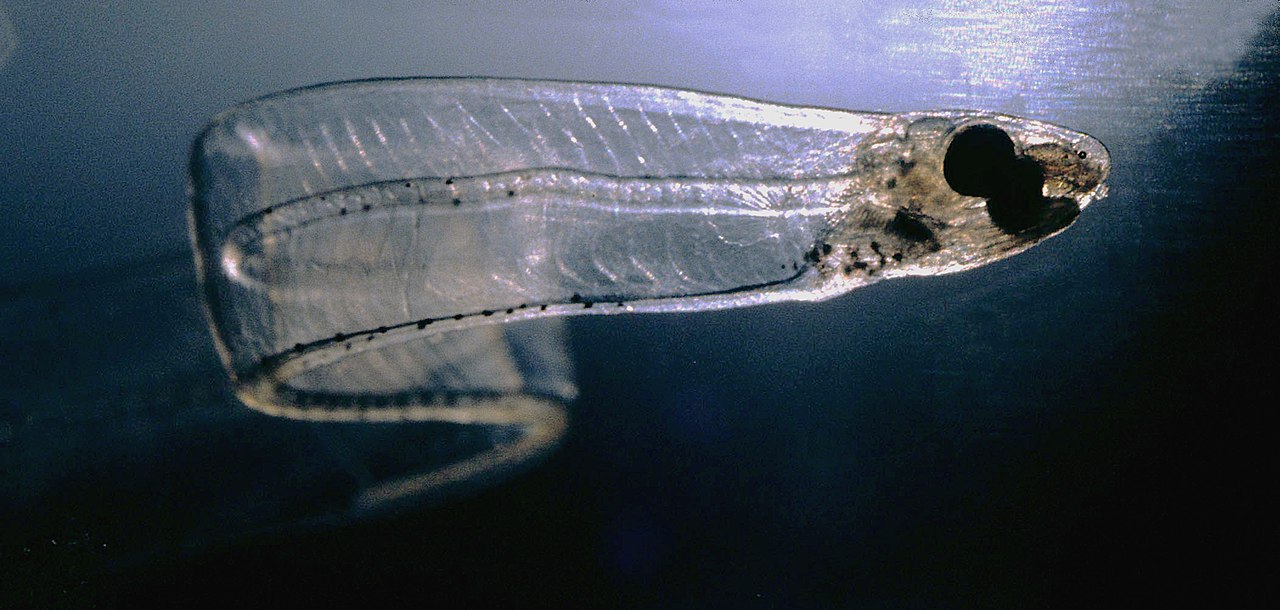
Eels hatch from eggs and undergo a remarkable transformation. The earliest larval stage is a flat, transparent form called a larval leptocephalus; the term derives from Greek roots meaning "thin head." These larvae drift in ocean currents and may look very different from adults, which historically led to confusion about their identity. As they metamorphose, many species pass through an intermediate juvenile stage called an elver before reaching adult shape. Several temperate freshwater species (notably in the family Anguillidae) are catadromous: adults live in rivers or estuaries and migrate to sea to spawn, while juveniles return inland.
Habitats, behavior and distribution
Eel species occupy a wide range of marine and freshwater environments. Many are found in coastal and benthic zones where they hide in holes, rock crevices, or burrows and hunt at night. Some families prefer deep-water habitats: members of the Nemichthyidae (snipe eels) are known from midwater depths, while certain Synaphobranchidae (cutthroat eels) inhabit bathyal zones thousands of metres down. Others, such as freshwater eels, spend a portion of their lives in fresh water before returning to the ocean to reproduce. Depth ranges and day–night activity patterns vary by species; many are principally nocturnal predators feeding on fish, crustaceans, and assorted invertebrates. Deep-sea eels may display different feeding strategies adapted to scarce resources at large depths (deep ocean habitats).
Human use, fishery practice and conservation
Eels have long been captured and consumed by humans; some species are important in regional cuisines and in aquaculture. Historical and modern fishing methods differ by country and regulation. For example, catch methods such as Hand netting have a long tradition and remain regulated; where legal, they can be a sustainable local practice. In parts of England, hand-net eel fisheries on rivers such as the River Parrett and the River Severn have been recorded for many centuries. Regulations vary widely by jurisdiction and some forms of harvest are prohibited or legal only under strict conditions to protect depleted populations.
Importance and notable facts
Beyond their culinary value, eels are ecologically significant as both predators and prey. Their unusual life histories—particularly long migrations and distinctive larval forms—have made them subjects of scientific interest and cultural significance. Several eel species face pressure from overfishing, habitat loss, barriers to migration, and changing ocean conditions; these concerns have prompted management measures, research into aquaculture and restocking, and international attention. For further reading on taxonomy, ecology, fisheries, and conservation, consult authoritative sources and regional fishery guidance via links provided above.
Related topics and further reading
- Teleost fishes — broader group containing eels.
- Fish anatomy — comparative fin and scale arrangements.
- Fins — structure and function in elongated fishes.
- Anal fin, spines, and scales — terms used in identification.
- Larval and juvenile stages in fishes; Greek names and etymology.
- Habitats: ocean, fresh water, and deep sea zones.
- Fisheries and methods: Hand netting, and legal frameworks in the United Kingdom including traditional rivers like the River Parrett and River Severn.
Questions and answers
Q: What is the size range of adult eels?
A: Adult eels can be as short as 10 cm or as long as 3 m, depending on their species.
Q: Do eels have spines in their fins?
A: No, the fins of eels do not have spines.
Q: How are baby (larval) eels described?
A: Baby (larval) eels are described as flat and transparent (clear). They are also called leptocephalus (Greek for "thin head").
Q: Where do most eels prefer to live?
A: Most eels prefer to live in the shallowest parts of the ocean, usually at the bottom. Some species come to fresh water to live there, while others swim about 500 m below the surface and some even live up to 4000 m below the surface.
Q: How long has hand netting been used for catching eels in England?
A: Hand netting (catching with nets) has been done for thousands of years on the River Parrett and River Severn in England.
Q: Are most eels predators?
A: Yes, most eels are predators and hunt their prey.
Related articles
Author
AlegsaOnline.com Eel (Anguilliformes): appearance, life cycle, habitats, and human interactions Leandro Alegsa
URL: https://en.alegsaonline.com/art/30328
Sources
- buber.net : "Basque food"
- ncbi.nlm.nih.gov : "A 'living fossil' eel (Anguilliformes: Protanguillidae, fam nov) from an undersea cave in Palau"
- doi.org : 10.1098/rspb.2011.1289
- fishbase.org : "Anguilliformes"