
EDVAC — early stored‑program electronic computer
EDVAC (Electronic Discrete Variable Automatic Computer) was an early binary, stored‑program electronic computer influential in the development of modern computer architecture.
Overview
EDVAC (Electronic Discrete Variable Automatic Computer) was one of the first electronic computers to combine binary arithmetic with internal program storage. Developed in the mid‑20th century as a successor to ENIAC, EDVAC introduced or popularized ideas that helped shape the design of later machines, especially the concept of storing instructions and data together in memory. For contemporary background and technical reports see early descriptions and comparisons with ENIAC at ENIAC references.
Image gallery
1 Image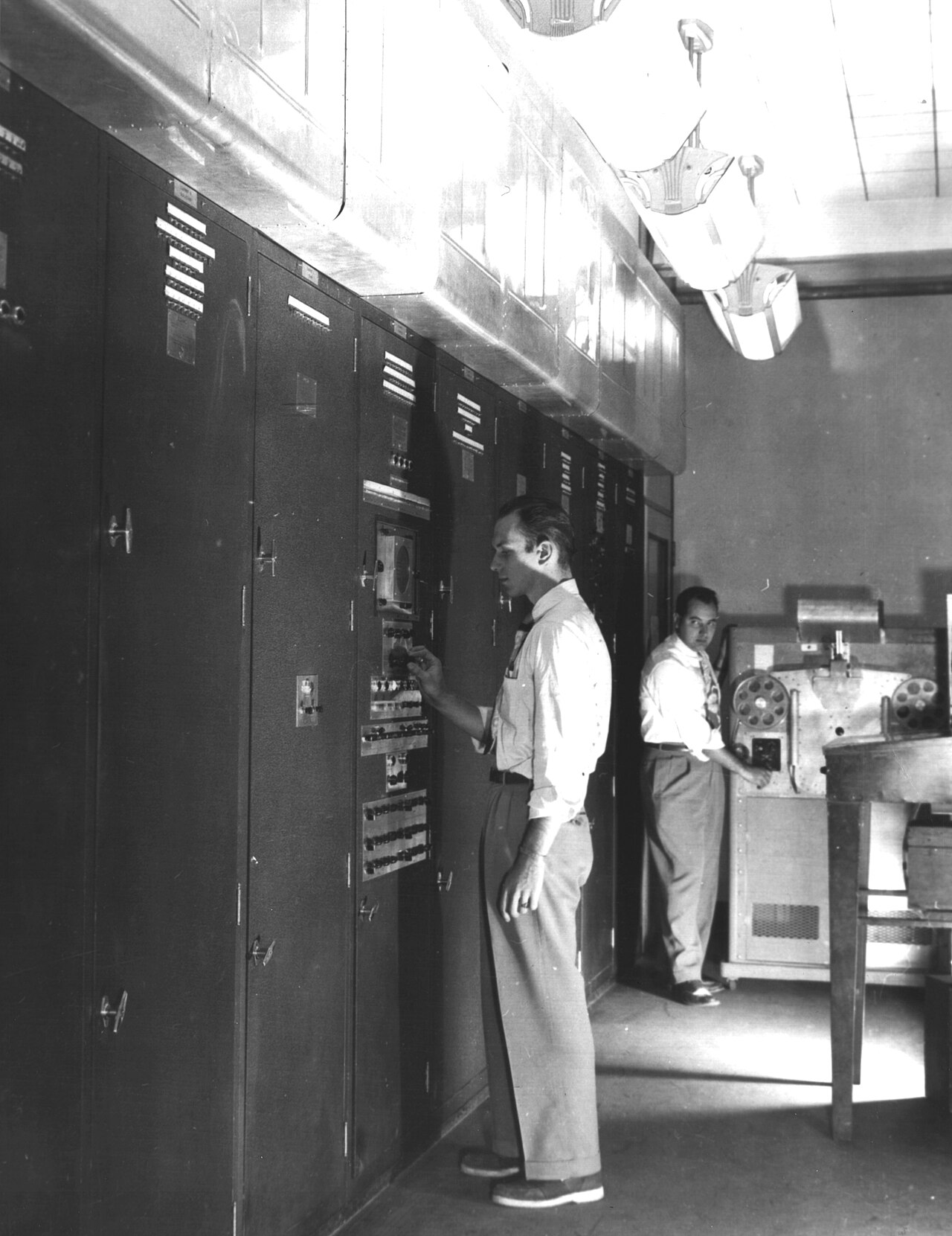
Design and main components
EDVAC was built as a binary, serial computer. Its design emphasized sequential arithmetic operations driven by a central control unit and a mercury delay‑line memory. The machine used word lengths of 44 bits and could hold roughly 1,000 such words in its primary memory. Common arithmetic capabilities included automatic addition, subtraction, multiplication and a form of programmed division; an automatic checking mechanism helped detect some calculation errors. For materials on binary operation and memory technology, see binary operation notes and arithmetic and addition.
Performance and operation
As a serial machine, EDVAC executed arithmetic operations over multiple cycles. Typical measured speeds from historical records indicate average addition times on the order of hundreds of microseconds and multiplication times in the low milliseconds. EDVAC's capacity of 1,000 44‑bit words constrained program size and data, but its stored‑program approach made programming more flexible than plugboard or rewiring methods. For details on subtraction and multiplication performance see subtraction and multiplication, and for programmed division see division routines.
Operational history
Work on EDVAC followed wartime computing projects and involved engineers and mathematicians at institutions that had built earlier machines. Completed and brought into routine use in the late 1940s and 1950s, EDVAC became a production resource for scientific and military calculation. By 1960 it was reported to be running over twenty hours per day with average error‑free runs lasting several hours, and the machine remained in service until 1961 when it was superseded by newer hardware. Contemporary operational summaries and service records can be found at performance reports and service summaries.
Uses and significance
EDVAC was used for ballistics tables, scientific computation and other tasks that benefited from automated, repeatable arithmetic procedures. Its stored‑program concept reduced the time and labor needed to change tasks compared with earlier machines that required manual rewiring. EDVAC therefore served as a proof of concept for many elements of what later became known as the von Neumann architecture; for historical analysis and archival material see historical analysis.
Notable facts and distinctions
- Stored program: Unlike ENIAC, EDVAC operated using programs kept in its internal memory rather than relying solely on physical reconfiguration.
- Binary arithmetic: EDVAC used binary (base‑2) representation for numbers, which simplified electronic implementation and error detection.
- Memory technology: The machine relied on delay‑line storage, a technology common before the advent of practical random‑access semiconductor memory.
- Legacy: EDVAC's architecture and operational experience influenced subsequent computer designs and the formalization of stored‑program concepts.
The historical significance of EDVAC is best appreciated in the context of early computing: it bridged experimental wartime calculators and the more standardized computer architectures that followed. For deeper reading and archival documents use the links provided above to consult technical reports, museum pages and scholarly retrospectives.
Questions and answers
Q: What is EDVAC?
A: EDVAC stands for Electronic Discrete Variable Automatic Computer and is one of the first electronic computers.
Q: What was different about EDVAC compared to ENIAC?
A: Unlike ENIAC, EDVAC operated in binary and was able to store programs.
Q: What were some of the functions of EDVAC?
A: EDVAC had automatic addition, subtraction, multiplication, programmed division, and automatic checking with a capacity of 1,000 44-bit words.
Q: What was the capacity of EDVAC?
A: EDVAC had a capacity of 1,000 44-bit words.
Q: What were the average addition and multiplication times for EDVAC?
A: The average addition time for EDVAC was 864 microseconds and the average multiplication time was 2,900 microseconds.
Q: How productive was EDVAC during its operational life?
A: During its operational life, EDVAC proved to be reliable and productive for its time, running error-free for eight hours a day with an overall runtime of over 20 hours per day.
Q: When was EDVAC replaced and by what?
A: EDVAC was replaced by BRLESC in 1961.
Related articles
Author
AlegsaOnline.com EDVAC — early stored‑program electronic computer Leandro Alegsa
URL: https://en.alegsaonline.com/art/30248