
Ediacaran biota: the earliest large multicellular organisms
Enigmatic assemblage of late Precambrian soft-bodied organisms (Ediacaran Period). Fossils show unusual body plans and provide clues to early animal evolution and pre-Cambrian ecosystems.
The Ediacaran biota denotes a diverse group of soft-bodied, mostly multicellular organisms known from sedimentary rocks of the late Precambrian. They are typically preserved as impressions and molds in very old strata deposited near the end of the Precambrian era, in what geologists call the Ediacaran period (roughly 635–541 million years ago). The body fossil record for the characteristic assemblages is concentrated in a narrower interval, commonly cited from around 575 to about 541 million years ago, after global glaciations and immediately prior to the Cambrian explosion of animals.
Image gallery
10 Images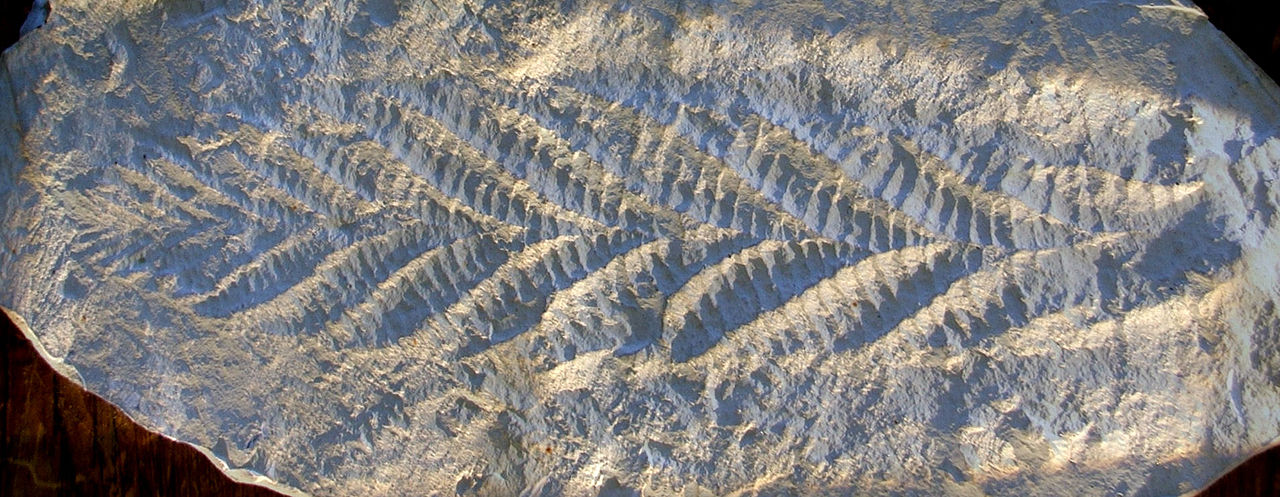




Overview and importance
These organisms represent the first-known globally distributed communities of comparatively large multicellular life. They are important because their appearances mark a transition from predominantly microbial ecosystems toward ones that include sizeable, morphologically complex organisms. Many taxa are unlike later animals and challenge simple classification. Because they left few or no mineralized parts, their preservation depends on specific conditions and often appears as impressions on bedding planes or as sediment-filled casts.
Characteristics and notable forms
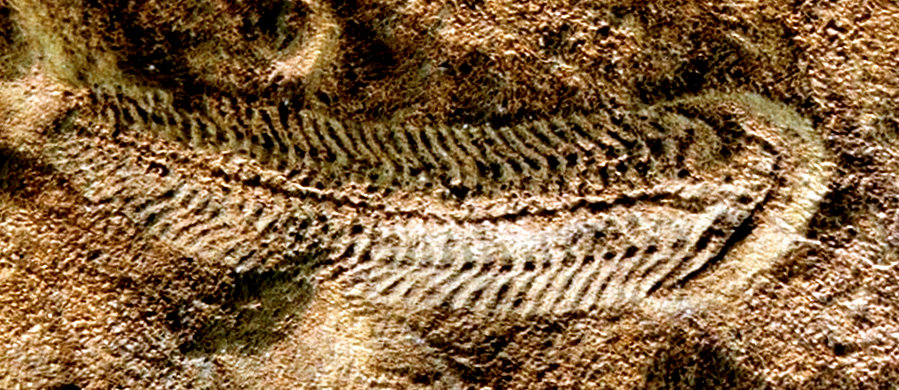
Typical features of the Ediacaran biota include flattened, soft bodies, modular or fractal-like growth, and a lack of hard skeletons. Common morphological groups are frondose and quilted organisms, disc-shaped forms, and segmented or bilaterally symmetrical types. Some well-known genera include Dickinsonia (a bilaterally organized, oval organism), Charnia (a feather-like frond), and Rangea (a fractal, branch-like form). Fossils sometimes occur with activity traces and impressions that record movement or feeding, interpreted as trace fossils or as body imprints. These impressions provide limited but valuable evidence for behavior, orientation, and interactions with sediment and microbes.
- Examples of characteristic taxa: Dickinsonia, Charnia, Kimberella, Rangea.
- Common preservational settings: gently sloping seafloors, microbial mat-covered substrates.
- Typical features: soft tissues preserved as impressions; unusual symmetry and body plans not always seen in later animals.
Many hypotheses exist about their biology: some Ediacaran forms are widely regarded as early animals (metazoans), others as giant protists, lichens, or members of an extinct group with no exact modern analogue. The term "vendobiont" has been used to denote the possibility that several forms belong to a distinct, extinct grade of life. Because hard parts are absent, affinities are assessed from growth patterns, inferred tissues, and ecological context.
Fossil record, timing and distribution
The Ediacaran assemblages appear after extensive late-Neoproterozoic glaciations — including events collectively referred to as the ice ages of the Cryogenian — but there is no evidence for the biota during the preceding Marinoan glaciation. Fossil localities are widespread: classic occurrences include the Ediacara Hills of South Australia, Mistaken Point in Newfoundland, the White Sea region of Russia, and the Nama Group in Namibia. These sites preserve a range of taxa and preservational styles and have been crucial for reconstructing Ediacaran ecosystems and their evolution.
The end of the Ediacaran interval is marked by a decline or replacement of many of these forms near the start of the Cambrian. Multiple lines of evidence suggest a substantial ecological turnover — sometimes described as an extinction or biotic replacement — as mobile, predatory, and skeletonized organisms became more common and seafloor conditions changed. A few Ediacaran-like morphologies may persist into the earliest Cambrian, but the overall character of marine communities shifted significantly.
Discovery, interpretation and continuing debates
Descriptions of these fossils began in the 20th century, notably after Reginald Sprigg reported impressions from the Ediacara Hills. Since then, paleontologists have debated their biological affinities, taphonomy (how they were preserved), ecological roles, and whether many represent early animals or an independent experiment in multicellularity. Key questions remain open: which lineages, if any, are ancestral to later animal phyla; how changes in ocean chemistry and oxygenation influenced their rise and fall; and how behavior can be inferred from surface impressions alone.
For further general reading and databases on fossil sites and taxa, see resources linked below: fauna overview, regional summaries at Ediacaran sites, studies on post-glacial recovery after the Cryogenian ice ages, reviews of early animal diversification around the Cambrian, compilations of behavioral evidence (trace fossil literature), and geological context for events such as the Marinoan glaciation.
Questions and answers
Q: What are the Ediacaran biota?
A: The Ediacaran biota are the fauna of the Ediacaran period, a geological period that lasted from 635–542 million years ago.
Q: When did the fossil biota of the Ediacaran period exist?
A: The fossil biota of the Ediacaran period existed only from 575-542 million years ago.
Q: What types of organisms were part of the Ediacaran biota?
A: The Ediacaran biota consisted of soft-bodied multicellular organisms, probably animals, which left trace fossils in rocks of Ediacaran age.
Q: When did the Ediacaran period occur?
A: The Ediacaran period occurred from 635–542 million years ago.
Q: What was the Ediacaran biota's relationship to the Cambrian period?
A: The Ediacaran biota appeared just before the Cambrian period and suffered a fairly severe extinction event at the boundary with the Cambrian.
Q: Was there any sign of the Ediacaran biota during the earlier Marinoan glaciation?
A: There was no sign of the Ediacaran biota during the earlier Marinoan glaciation.
Q: Did any of the Ediacaran biota survive into the early Cambrian?
A: Some of the Ediacaran biota may have survived into the early Cambrian period.
Related articles
Author
AlegsaOnline.com Ediacaran biota: the earliest large multicellular organisms Leandro Alegsa
URL: https://en.alegsaonline.com/art/30128
Sources
- geol.queensu.ca : "The Ediacaran period: a new addition to the geologic time scale"
- doi.org : 10.1080/00241160500409223
- stratigraphy.org : stratigraphy.org
- doi.org : 10.1111/j.1525-142X.2008.00234.x
- worldcat.org : 1520-541X
- pubmed.ncbi.nlm.nih.gov : 18460087
- geol.queensu.ca : "The Ediacara Biota: Neoproterozoic origin of animals and their ecosystems"
- doi.org : 10.1146/annurev.earth.33.092203.122519
- paleobiol.geoscienceworld.org : "Biogeographic analyses of the Ediacara biota: a conflict with paleotectonic reconstructions"
- doi.org : 10.1666/0094-8373(1999)025<0440:BAOTEB>2.3.CO;2
- doi.org : "Autecology and the filling of ecospace: key metazoan radiations"
- doi.org : 10.1111/j.1475-4983.2006.00611.x