
Ecological footprint
A metric that estimates human demand on Earth's ecosystems in global hectares, comparing consumption to the planet's biocapacity and indicating whether societies live within or beyond renewable limits.
Overview
The ecological footprint is a resource-accounting tool that estimates how much biologically productive land and water area a population requires to produce the goods it consumes and to absorb the wastes it generates, using prevailing technology and resource-management practices. Results are usually expressed in global hectares (gha) — a hectare of world-average productivity — and are compared with the planet's available biocapacity. When demand exceeds supply, the result is ecological "overshoot," signalling reliance on resource draws from stocks, carbon accumulation, or imported capacity.
Image gallery
5 Images


What the footprint measures
The metric aggregates several categories of human demand into an area-equivalent figure. Typical components include:
- Cropland — land needed to grow crops for food, feed and materials.
- Grazing land — pasture required for livestock.
- Forest land — productive forest area used for timber and for sequestering carbon emissions.
- Fishing grounds — aquatic area needed to support seafood catches.
- Built-up land — urban and infrastructure footprint that displaces productive ecosystems.
- Carbon footprint (land for sequestration) — the forest area required to absorb CO₂ emissions that are not otherwise sequestered.
How it is calculated
Calculation typically follows a consumption-based accounting approach: the goods and services consumed by a person, region or nation are traced back to the land and sea areas needed to supply them and to assimilate wastes. Footprint accounting converts diverse resource flows into area units by dividing energy, material or biomass quantities by a productivity factor (yields per hectare). The resulting area totals are normalized into global hectares to allow comparisons across regions. Analysts compare these footprints with measured biocapacity — the capacity of ecosystems to produce useful biological materials and to absorb waste — to assess sustainability.
History, development and uses
The ecological footprint concept emerged in the early 1990s as a way to summarize resource use in a single, communicable number. The method has been refined by researchers and organizations to cover national and city scales, corporate supply chains and individual lifestyles. Its primary uses include public communication of sustainability, national and subnational resource accounting, policy analysis, and tracking trends over time. One widely used output is the annual estimate of humanity's demand versus Earth's biocapacity — often summarized as the number of "planet Earths" required to support current consumption patterns and marked each year by events such as Earth Overshoot Day.
Key findings and examples
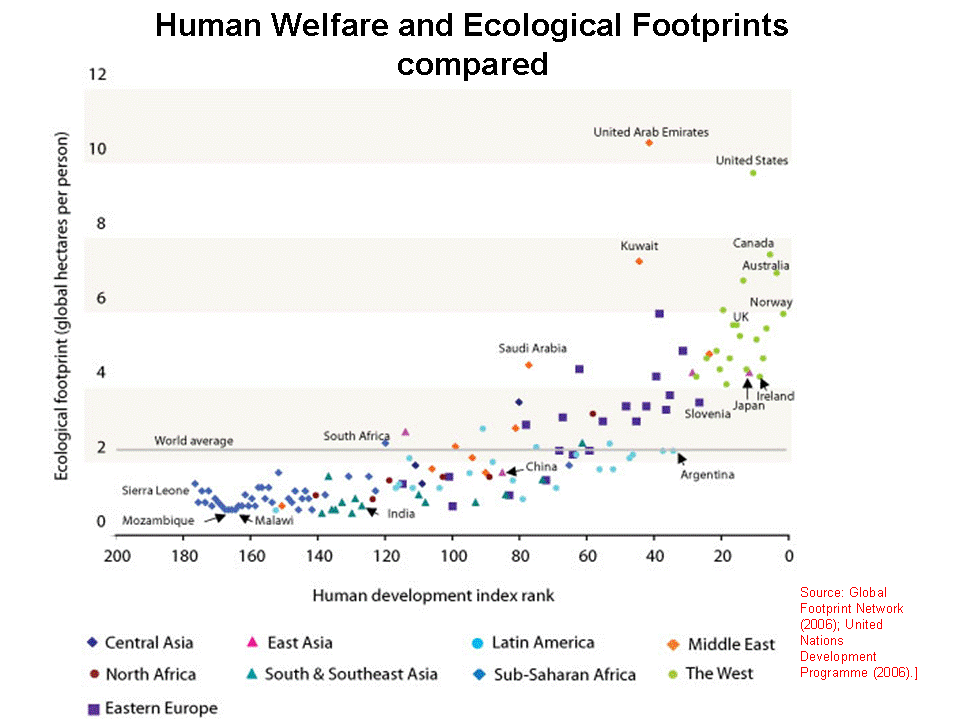
Aggregated assessments have repeatedly shown that humanity is using natural resources faster than ecosystems can regenerate. For example, an assessment published in 2020, using 2017 data, estimated that global demand exceeded biocapacity by a substantial margin: humanity required roughly 1.7 planet Earths to sustain its consumption at that time. Expressed per person, the global ecological footprint averaged about 2.8 global hectares while available biocapacity averaged about 1.6 gha per person — a gap often described as a 70% overshoot. Consumption patterns vary greatly by country: if everyone consumed at the rate of high-consuming nations, many times Earth's biocapacity would be required; estimates indicate that consumption like that of some industrialized countries could demand nearly three Earths.
Limitations and complementary approaches
While useful for communication and comparative analysis, the ecological footprint has recognized limitations. It simplifies diverse ecological functions into an area metric and can underrepresent biodiversity loss, freshwater depletion, soil degradation and toxic pollution. Trade, technological change, substitution, and variations in ecosystem quality complicate interpretation. Because of these limits, researchers often use the footprint alongside other indicators — such as greenhouse gas inventories, water footprints, material flow analysis, and the planetary boundaries framework — to form a broader picture of environmental sustainability.
Why it matters
The ecological footprint translates complex resource and waste flows into a tangible measure that helps policymakers, educators and the public grasp the scale of human impact on the biosphere. By highlighting overshoot and differences among lifestyles and nations, it supports conversations about conservation priorities, efficiency improvements, dietary and transport choices, and economic policies aimed at aligning human activity with the planet's regenerative capacities.
Questions and answers
Q: What is an ecological footprint?
A: An ecological footprint measures how much people take from nature, which is then compared to the amount of natural resources that nature can renew.
Q: What does the ecological footprint take into account?
A: The ecological footprint takes into account how much farm land, forest area, grazing land, and sea area it takes to provide everything people use.
Q: What questions do footprint calculations answer?
A: Footprint calculations answer the questions: how much nature do we have? And how much do we use?
Q: How fast is humanity using nature compared to how fast nature renews itself?
A: When analyzing the world as a whole, humanity is using nature about 1.7 times faster than nature renews itself.
Q: What would it take if everybody around the world consumed like a particular population?
A: It is possible to calculate how many planet it would take if everybody around the world consumed like a particular population. For instance, if everybody consumed like the Germans, it would take nearly 3 planet Earths.
Q: What is the ecological footprint per world citizen?
A: The ecological footprint per world citizen is about 2.8 global average hectares per person.
Q: How does humanity live in terms of global biocapacity?
A: Humanity has already overshot global biocapacity by 70% and now lives unsustainably by depleting stocks of "natural capital".
Related articles
Author
AlegsaOnline.com Ecological footprint Leandro Alegsa
URL: https://en.alegsaonline.com/art/29941
Sources
- link.springer.com : "Catechizing the Environmental-Impression of Urbanization, Financial Development, and Political Institutions: A Circumstance of Ecological Footprints in 110 Developed and Less-Developed Countries"
- doi.org : 10.1007/s11205-019-02163-3
- worldcat.org : 0303-8300
- footprintnetwork.org : footprintnetwork.org/our-work/ecological-footprint/
- postcarbon.org : "The Human Nature of Unsustainability"