
Echis — saw‑scaled vipers (venomous snakes of dry regions)
Echis is a genus of small to medium venomous vipers known as saw‑scaled or carpet vipers, widespread across Africa, the Middle East and South Asia and notable for their medically important bites.
Overview: Echis is a genus of venomous vipers commonly called saw‑scaled vipers or carpet vipers. Members of this genus are adapted to arid and semi‑arid landscapes and are among the snake groups most frequently implicated in human envenoming. For a general taxonomic summary see Echis (taxonomic overview).
Image gallery
5 Images



Appearance and distinctive features
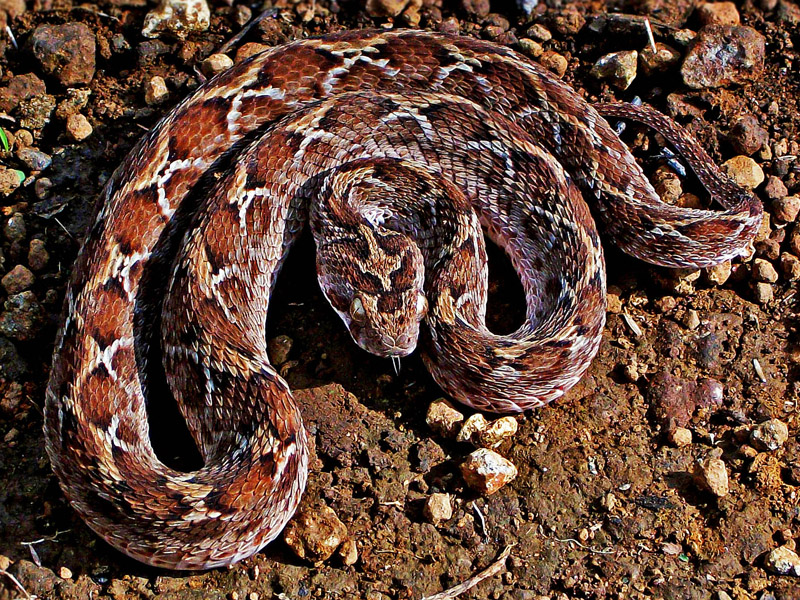
Saw‑scaled vipers are typically small to medium in size with stout bodies and keeled scales. A characteristic behavior that gives the group its common name is the rubbing together of the heavily keeled lateral scales to produce a dry rasping or "sizzling" sound when the snake is threatened. Their coloration often provides camouflage on rocky or sandy ground.
Distribution and habitat
Species of Echis occur across a broad belt of dry country. They are established in parts of Africa, ranges of the Middle East, and into South Asia, including Pakistan, India and Sri Lanka. Within these regions they occupy deserts, scrub, rocky hills and disturbed areas near human settlements where prey is available.
Venom and medical importance
Echis venoms are medically significant. Envenoming typically produces local pain and swelling and can cause systemic effects, notably coagulopathy (disruption of blood clotting), which may lead to severe bleeding and other complications. Because many encounters occur close to people and because some species are common in agricultural and peri‑urban areas, Echis bites account for a large proportion of snakebite morbidity and mortality in affected regions. Clinical management often requires timely antivenom and supportive care; venom composition varies between species and populations, which can affect treatment effectiveness.
Ecology, diet and reproduction
These vipers are generally nocturnal or crepuscular, feeding on small mammals, lizards, frogs and large arthropods. Activity patterns and diet may shift seasonally. Many saw‑scaled vipers lay eggs (oviparous), though reproductive modes and timing differ among species.
Taxonomy, species and name
The generic name comes from the Greek word for viper; for more on the name's origin see Etymology and naming. The number of recognized species has varied with research; there are commonly around eight recognized taxa, and regional revisions continue to refine species limits and relationships—see a species checklist at current species list. Two well‑known members are the Indian saw‑scaled viper (often referred to as Echis carinatus) and the West African carpet viper (often called Echis ocellatus).
Notable facts and further resources
- Defensive rasping with scales is a memorable field character; see detailed scale structure notes at scale morphology.
- Human–snake conflict and bite incidence make Echis an important focus for public‑health and herpetological work.
- Conservation status varies by species and locality; some populations are common in disturbed habitats while others face habitat pressures.
For regional distribution maps, treatment guidelines and conservation information consult specialist sources on taxonomy, regional herpetofauna portals (Africa, Middle East, Pakistan) and clinical reference sites for snakebite management (India, Sri Lanka, species lists).
Questions and answers
Q: What is Echis?
A: Echis is a genus of venomous vipers found in dry regions of Africa, Middle East, Pakistan, India, and Sri Lanka.
Q: What does the name "Echis" mean?
A: The name "Echis" is a Greek word which means "viper".
Q: What other names are Echis also known as?
A: Echis is also known as the "Saw-scaled Vipers", or the "Carpet Vipers".
Q: What is the impact of Echis vipers?
A: Echis vipers are responsible for most of the snakebites and deaths in the world.
Q: How many species of Echis are currently found?
A: There are currently eight species of Echis found.
Q: Where are Echis vipers found?
A: Echis vipers are found in dry regions of Africa, Middle East, Pakistan, India, and Sri Lanka.
Q: Is Echis a venomous snake?
A: Yes, Echis is a genus of venomous vipers.
Related articles
Author
AlegsaOnline.com Echis — saw‑scaled vipers (venomous snakes of dry regions) Leandro Alegsa
URL: https://en.alegsaonline.com/art/29883