
East Prussia — historical region and former Prussian province
East Prussia was a historical region in northeastern Europe centered on Königsberg. Long part of Prussia and later Germany, after WWII it was divided between the Soviet Union (Kaliningrad) and Poland.
Overview
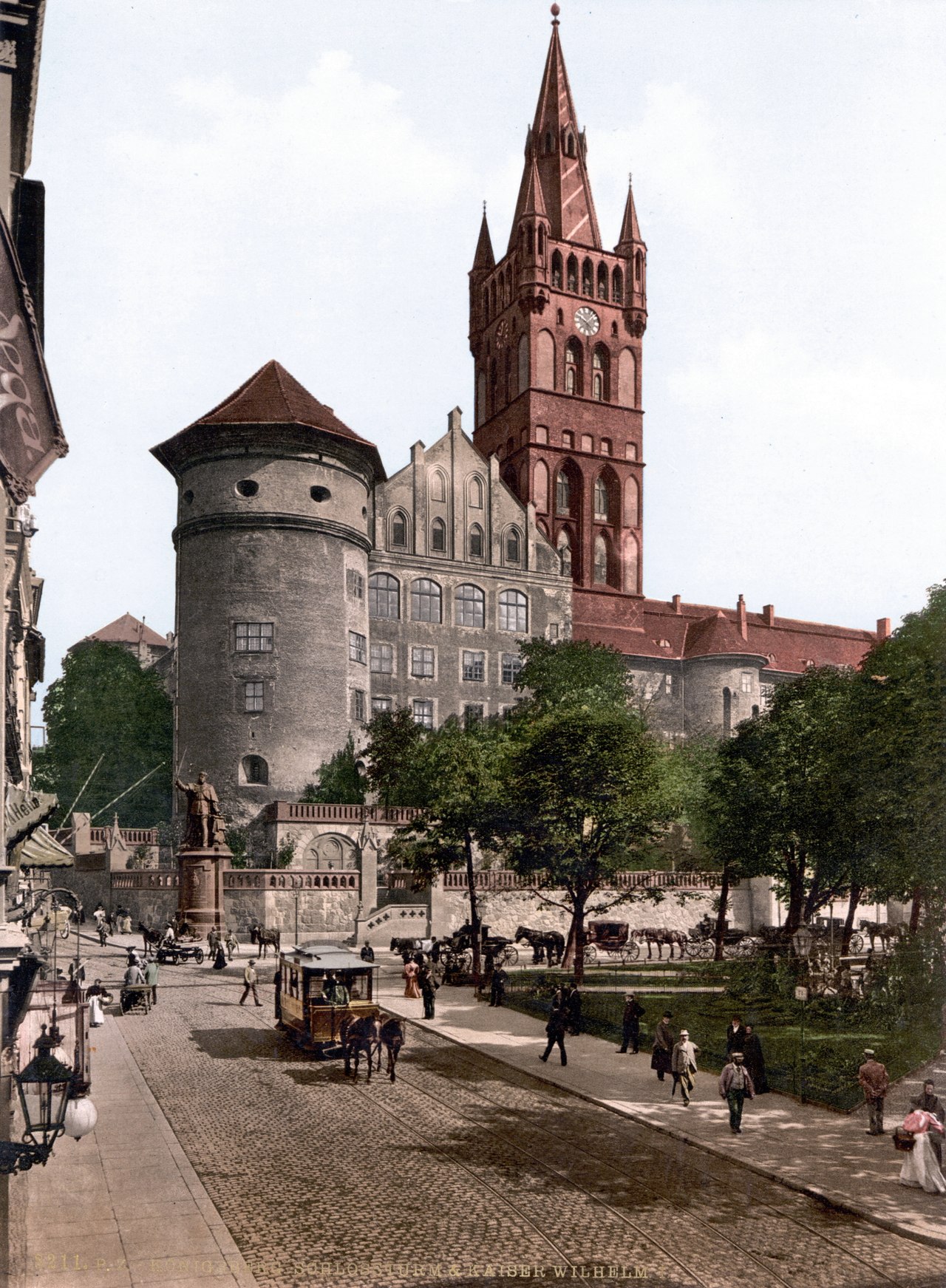
East Prussia (German: Ostpreußen) was a distinct territorial, cultural and administrative region in northeastern Europe that for centuries formed the eastern heartland of Prussian statehood. It developed from medieval territories ruled by the Teutonic Order into the Duchy of Prussia and later became a core province of the Kingdom of Prussia. Administratively it was long recognized as a province of Prussia and, after 1871, a provincial unit within the German Empire. Its historic capital was Königsberg, a major port, university town and intellectual centre.
Image gallery
10 Images




Geography and landscape
The region stretched along the southeastern Baltic coast and included the Samland peninsula, coastal dunes, and the lake-rich Masurian district inland. Its terrain combined sandy coasts, fertile river valleys, forests and many lakes. The regional position, on land routes between Central Europe and the Baltic, shaped its strategic and economic importance.
Population, language and religion
Historically the population was multiethnic and multilingual. German-speaking communities predominated in many towns and larger settlements, alongside Polish- and Lithuanian-speaking groups, indigenous Old Prussian remnants, and Jewish communities. Religious life was marked by Protestantism as the dominant confession after the Reformation, with significant Roman Catholic and Jewish minorities in parts of the region.
Political development and administration
Over the Early Modern and modern periods East Prussia served as a territorial base for Prussian expansion and state administration. After German unification it remained a province within the German state and, in the interwar years, formed part of the Free State of Prussia inside the Weimar Republic. The region was also affected by the rise of the Nazi regime in the 1930s and the policies of Nazi Germany leading into World War II.
World War II and aftermath
The wartime and immediate postwar periods brought sweeping changes. Military operations, aerial bombardment and ground fighting caused heavy damage to towns and infrastructure. In the closing months of the war many inhabitants fled westward; after the conflict the victorious powers agreed major territorial adjustments. The northern part of the province, including Königsberg, passed to the control of the Soviet Union and was later organised as Kaliningrad Oblast, while the southern and central territories were placed under Polish administration by the new postwar boundaries established for Poland. In 1946 Königsberg was officially renamed Kaliningrad. Large numbers of the prewar German population either left in the fighting or were later expelled or resettled; their places were taken by settlers from other parts of the Soviet Union, from Poland and from neighbouring areas.
Postwar status and present-day divisions
Today the former province's territory is split between the Russian exclave around Kaliningrad and Polish regions, notably the Warmian-Masurian Voivodeship. The Kaliningrad Oblast is geographically separated from the main territory of Russia, while the Polish portion was integrated into the postwar Polish state and administrative structures. The division of the region remains a key example of the wide-reaching effects of border changes in twentieth-century Europe.
Legacy and cultural heritage
Despite wartime destruction and postwar rebuilding, the area preserves architectural and cultural reminders of its layered past: medieval castles, town centres, churches and other monuments. Figures associated with the region, such as the philosopher Immanuel Kant, continue to be points of cultural reference. The history of East Prussia is often studied for what it reveals about shifting borders, population movements and the reshaping of regional identities.
Notable facts
- East Prussia served as an eastern frontier of German-speaking states for several centuries and played a central role in the development of the Prussian state.
- The city of Königsberg/Kaliningrad remains a focal point for discussions of heritage, memory and postwar change in the region.
- Postwar border changes divided a formerly contiguous province between two countries and produced long-term demographic and cultural transformations.
For more detailed study consult specialist histories, regional studies and archival materials available in multiple languages; museum collections and local research institutions also document the region's layered past and its continuing relevance in contemporary European history.
Questions and answers
Q: What is East Prussia?
A: East Prussia was a province in the Kingdom of Prussia from 1773 to 1829.
Q: When was East Prussia part of the German Empire?
A: From 1878 to 1918, East Prussia was part of the German Empire.
Q: What was the capital of East Prussia?
A: The capital of East Prussia was Königsberg.
Q: What happened to East Prussia after World War II?
A: After the defeat of Nazi Germany in World War II, the area was divided into the Soviet Union (Russian SFSR, and Lithuanian SSR) and Poland (Warmian-Masurian Voivodeship).
Q: What was Königsberg renamed to after the war?
A: Königsberg was renamed Kaliningrad in 1946.
Q: What happened to the German population of East Prussia after the war?
A: The German population either evacuated or was expelled.
Q: What are the different names of East Prussia in other languages?
A: East Prussia is called Ostpreußen in German, Prusy Wschodnie in Polish, Rytų Prūsija in Lithuanian, Borussia orientalis in Latin, and Восточная Пруссия (Vostochnaya Prussiya) in Russian.
Related articles
Author
AlegsaOnline.com East Prussia — historical region and former Prussian province Leandro Alegsa
URL: https://en.alegsaonline.com/art/29695
Sources
- ruf.rice.edu : "Sarmatian Review XV.1: Davies"
- britannica.com : "East Prussia"