
East Midlands (region of England)
Region in central-eastern England encompassing Derbyshire, Leicestershire, Lincolnshire, Nottinghamshire, Northamptonshire and Rutland; mix of cities, agriculture, industry and upland moors.
The East Midlands is a region in central-eastern England, forming the eastern portion of the broader Midlands. It combines a mixture of urban centres, former industrial towns, agricultural lowlands and upland areas. The region plays a varied economic and cultural role within England, with notable cities, market towns and university communities.
Image gallery
10 Images
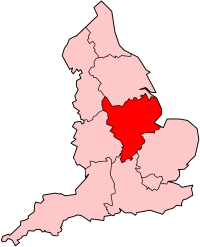
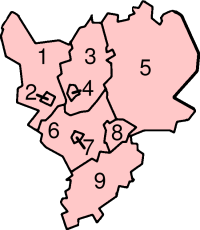



Counties and major places
The modern definition of the East Midlands usually includes the following administrative counties and areas. Major cities and towns within the region include Nottingham, Leicester, Derby and Lincoln:
- Derbyshire
- Staffordshire
- Leicestershire
- Rutland
- Northamptonshire
- Nottinghamshire
- Most of Lincolnshire
Landscape and natural features
The region includes low-lying agricultural plains, river valleys and the western fringes of upland country. Parts of the Peak District extend into the western side of the East Midlands, giving access to moorland and gritstone edges. The highest point commonly quoted in the region is Kinder Scout in Derbyshire, a well-known upland plateau and popular destination for hillwalking. Coastal and fenland landscapes lie to the east in Lincolnshire, contrasting with the more wooded and hilly west.
Economy, transport and culture
The East Midlands has a diverse economy: traditional manufacturing and engineering coexist with contemporary services, logistics and food production, while agriculture remains important in rural parts. Transport infrastructure includes arterial roads and rail links between major cities and regional airports that serve both domestic and international flights. Cultural life is underpinned by theatres, museums, historic sites and higher-education institutions that contribute to research and local identity.
History and administrative identity
The concept of the East Midlands as a distinct region has developed over recent decades for administrative, planning and statistical purposes. Its boundaries reflect a mix of historical counties, economic connections and geographic features rather than a single historical polity. This has produced a regional identity that varies between heavily urbanised centres and sparsely populated rural districts.
Notable facts
- The area contains important heritage sites, industrial monuments and market towns that chart the region's economic changes.
- Educational and research institutions in the region are influential locally and nationally.
- Landscape contrasts—from fens to upland moors—make the East Midlands geographically diverse within a relatively compact area.
Questions and answers
Q: What is the East Midlands?
A: The East Midlands is one of the regions in England that is positioned on the eastern half of the Midlands.
Q: Which counties belong to the East Midlands region?
A: The counties that belong to the East Midlands region include Derbyshire, Staffordshire, Leicestershire, Rutland, Northamptonshire, Nottinghamshire, and most of Lincolnshire.
Q: What is the highest point in the East Midlands region?
A: The highest point in the East Midlands region is the Kinder Scout, which is located in Derbyshire and has a height of 2,088 ft (636 m).
Q: Is the East Midlands region in the eastern or western side of the Midlands?
A: The East Midlands region is located on the eastern side of the Midlands.
Q: How many counties does the East Midlands region have?
A: The East Midlands region has a total of seven counties that belong to it.
Q: Does the East Midlands region include the entire Lincolnshire county?
A: No, the East Midlands region does not include the entire Lincolnshire county.
Q: What is the significance of Kinder Scout in Derbyshire?
A: The significance of Kinder Scout in Derbyshire is that it is the highest point in the East Midlands region with a height of 2,088 ft (636 m).
Related articles
Author
AlegsaOnline.com East Midlands (region of England) Leandro Alegsa
URL: https://en.alegsaonline.com/art/29681