
Eagle ray
Eagle rays are large, open-water cartilaginous fishes of the family Myliobatidae, known for diamond-shaped discs, long whip-like tails and shell-crushing teeth; they play roles in coastal ecosystems and ecotourism.
Overview
Eagle rays are a group of cartilaginous fishes in the family Myliobatidae, distinguished from bottom-dwelling rays by a more pelagic (open-water) habit. They are commonly referred to simply as "eagle rays" and are part of the broader order that includes skates, stingrays and related species (rays). These animals are notable for their strong swimming ability, often cruising near the surface and capable of spectacular breaches.
Image gallery
4 Images


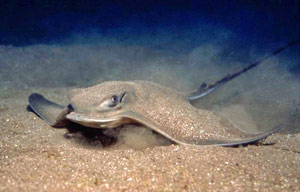
Characteristics
Eagle rays have a distinct flattened body formed by enlarged pectoral fins, creating a roughly diamond-shaped disc. Unlike many benthic rays, their tails are long and whip-like and may bear one or more venomous spines. Their teeth are flattened into pavement-like plates used for crushing hard-shelled prey rather than the filter-feeding apparatus seen in some relatives.
- Feeding: mainly feed on hard-shelled invertebrates such as molluscs and crustaceans, crushing shells with robust dental plates.
- Size and shape: disc width varies by species, commonly from under a metre to several metres across in larger species.
- Reproduction: ovoviviparous — embryos develop inside eggs retained in the female and she gives birth to a small number of live young.
Behavior and ecology
Eagle rays are more active swimmers than many bottom-associated rays and frequent coastal shelves, lagoons and open waters. They often forage by turning over sediment or locating buried prey, using strong jaws to crush shells. Their energetic swimming, schooling behavior in some species, and occasional leaping out of the water make them highly visible to divers and boaters. By contrast, related groups such as devil rays and manta rays (manta) feed by filtering plankton from the water rather than consuming hard prey.
Evolution and distribution
Eagle rays belong to a lineage of cartilaginous fishes (class Chondrichthyes) with a long evolutionary history; fossils indicate that ray-like forms have existed for many millions of years. Today they occur in tropical and temperate seas worldwide, most commonly along continental shelves and inshore waters but sometimes venturing into deeper areas. Some species show seasonal movements and return to shallow waters to feed or reproduce.
Human interactions and notable facts
These rays are often encountered by recreational divers and are valued in marine ecotourism for their graceful swimming and dramatic breaches. They may be taken incidentally in fisheries or targeted in some regions for meat and other products, and they can be vulnerable to habitat loss and overfishing. Important identification points include the diamond-shaped disc, flattened crushing teeth, and a long tail with a sting. For more general information on rays and related groups see ray overview and family summaries (Myliobatidae) or resources about their prey (molluscs, crustaceans), filter-feeding relatives (manta), or planktonic food sources (plankton).
Further notes
Because many common names overlap and some species are similar in appearance, careful attention to disc shape, dentition and tail structure helps distinguish eagle rays from other large rays. Field guides and taxonomic keys often use these characters; consult specialist literature or marine identification guides for regional differences and species-level information (morphology).
Questions and answers
Q: What are eagle rays?
A: Eagle rays are cartilaginous fish in the ray family Myliobatidae.
Q: Where do eagle rays mostly live?
A: Eagle rays mostly live in the open ocean rather than on the sea bottom.
Q: What do eagle rays feed on?
A: Eagle rays feed on molluscs and crustaceans, crushing their shells with their flattened teeth.
Q: How do devil rays and manta rays feed?
A: Devil rays and manta rays filter plankton from the water.
Q: How many young can an eagle ray give birth to at a time?
A: An eagle ray can give birth to up to six young at a time.
Q: Where are eagle rays commonly seen?
A: Eagle rays are commonly seen cruising along sandy beaches in very shallow waters.
Q: Do eagle rays have a sting?
A: Yes, the tail of an eagle ray is armed with a sting.
Related articles
Author
AlegsaOnline.com Eagle ray Leandro Alegsa
URL: https://en.alegsaonline.com/art/29509
Sources
- fishbase.org : FishBase online