
Düsseldorf International Airport
Major international airport serving Düsseldorf, Germany. Covers history, facilities, destinations, transport links (including SkyTrain), and notable events such as the 1996 terminal fire.
Overview
Düsseldorf International Airport (German: Flughafen Düsseldorf International) is the principal airport serving the city of Düsseldorf in western Germany. It operates under the IATA code DUS and the ICAO code EDDL. Located roughly eight kilometres from the city centre, the airport handles a mix of scheduled and charter services, regional traffic and business aviation, and provides connections to destinations across Europe, Asia, and North America.
Image gallery
10 Images


Facilities and layout
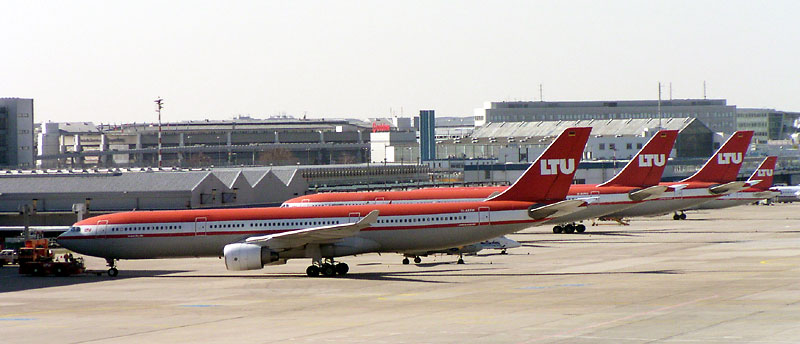
The airport consists of a terminal complex that accommodates check-in, security, retail and passenger processing, together with aircraft stands and apron areas. Passenger facilities include lounges, shops and restaurants, car rental services and business amenities. Airside gate areas serve both Schengen and non‑Schengen flights, while ground handling and cargo operations support freight as well as passenger services.
History and development
A first powered aircraft presence in the Düsseldorf area dates to an earlier era when the Zeppelin LZ‑III landed near the city in 1909 (Zeppelin LZ‑III). The present airport opened on 19 April 1927 after construction in the 1920s. Over the decades the facility expanded and modernised to meet growing demand, with major reconstructions and terminal upgrades occurring periodically to improve passenger flow and safety.
Airlines, destinations and traffic
Düsseldorf serves a wide network of destinations. The airport supports flights to many European and intercontinental points and is known for handling both scheduled services and seasonal routes. At times it has been served by dozens of airlines and offers connections to around 180 destinations on multiple continents. Daily aircraft movements can be substantial, reflecting the airport's role as a regional hub for business and leisure travel.
Ground transport and access
Access between the terminal and regional rail services is a notable feature of the airport. A suspended automated people mover, often referred to as the SkyTrain, links the passenger terminal to the airport rail station that serves InterCity and ICE high‑speed trains; this system covers roughly 2.5 kilometres and operates at speeds up to about 50 km/h. The SkyTrain began operation in the early 2000s and replaced earlier shuttle bus services; it is a dedicated, ticketed connection rather than a free transfer (SkyTrain). In addition to rail, passengers reach the airport by car, bus, taxi and organised coach services.
Notable events and safety
The airport's modern history includes a serious fire on 11 April 1996 that caused extensive damage to the terminal building and resulted in multiple fatalities, largely from smoke inhalation. The event prompted a prolonged rebuilding and refurbishment programme; the terminal complex was extensively reconstructed and progressively returned to service by the early 2000s. Lessons learned from that incident influenced subsequent improvements in fire protection and emergency procedures.
Regional context and distinctions
Although closely associated with the city of Düsseldorf, the airport sits within a wider metropolitan region served by smaller airfields. One nearby facility sometimes described as a secondary passenger airport is the so-called "Düsseldorf Express Airport" at Mönchengladbach, which operates a limited number of continental flights and private jet movements. Düsseldorf International remains the primary gateway for international and long‑haul travel in the region, distinguished by its passenger volumes, range of destinations and surface transport connections.
Practical information
- Codes: IATA DUS, ICAO EDDL.
- Distance: about eight kilometres from Düsseldorf city centre (city link).
- Interchange: rail station connects to national high‑speed services; SkyTrain connects terminal to station (SkyTrain).
- Nearby alternative airfield: Mönchengladbach (limited continental services).
Düsseldorf International continues to evolve with periodic upgrades to passenger facilities, operational systems and transport links to maintain its role as a major aviation node in Germany and Europe.
Questions and answers
Q: What is Düsseldorf International Airport?
A: Düsseldorf International Airport is an airport in Germany that is eight kilometres from Düsseldorf.
Q: What is the IATA code for Düsseldorf International Airport?
A: The IATA code for Düsseldorf International Airport is DUS.
Q: How many destinations does Düsseldorf International Airport support?
A: Düsseldorf International Airport supports flights to 180 destinations on four continents.
Q: How many airlines does Düsseldorf International Airport host?
A: Düsseldorf International Airport hosts 70 airlines.
Q: When was Düsseldorf International Airport opened?
A: Düsseldorf International Airport was opened on April 19, 1927 after two years of construction.
Q: What happened on April 11, 1996 at Düsseldorf International Airport?
A: A fire broke out in the airport on April 11, 1996, probably caused by welding work on the roof. 17 people were killed, mostly due to smoke inhalation.
Q: How is the terminal building at Düsseldorf International Airport connected to the InterCity and ICE train station?
A: The terminal building at Düsseldorf International Airport is connected to the InterCity and ICE train station by a suspended monorail called the SkyTrain, which travels the 2.5 kilometers between the terminal and station at a maximum speed of 50 km/h. It started operation in 2002, replacing a shuttle bus service, and is not free of charge to use.
Related articles
Author
AlegsaOnline.com Düsseldorf International Airport Leandro Alegsa
URL: https://en.alegsaonline.com/art/29337
Sources
- flybe.com : Flybe Announces Opening of First European Base in Dusseldorf
- adv.aero : "Passagiere: Kumulierte Betrachtung Januar – Dezember 2018"
- ead.eurocontrol.int : "EAD Basic"