
Duckweed: tiny floating freshwater plants and their ecology
Duckweed are minute free-floating freshwater plants (five genera, ~33–38 species). This article explains their form, reproduction, ecological roles, uses and notable facts.
Overview
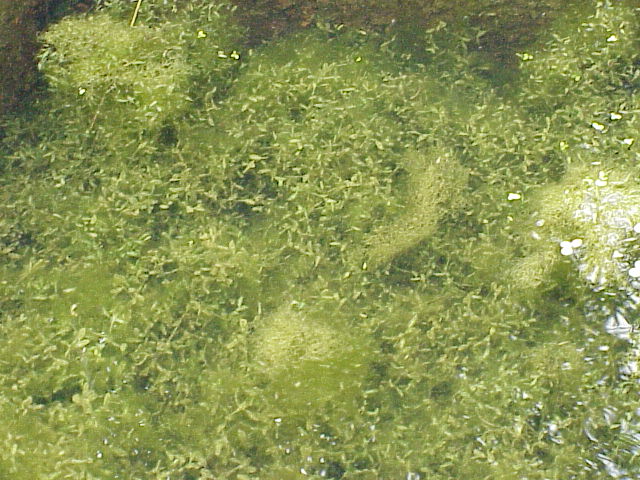
Duckweed is a collective name for a group of very small, free-floating freshwater plants often visible as a green carpet on still or slow-moving water. Common alternative names include water lens and bayroot. The group is taxonomically compact: scientists recognize five genera and roughly 33–38 species. These plants occur worldwide in temperate to tropical regions and are adapted to float on the surface of ponds, ditches, marshes and slow rivers where they can form dense mats.
Image gallery
10 Images



Form and anatomy
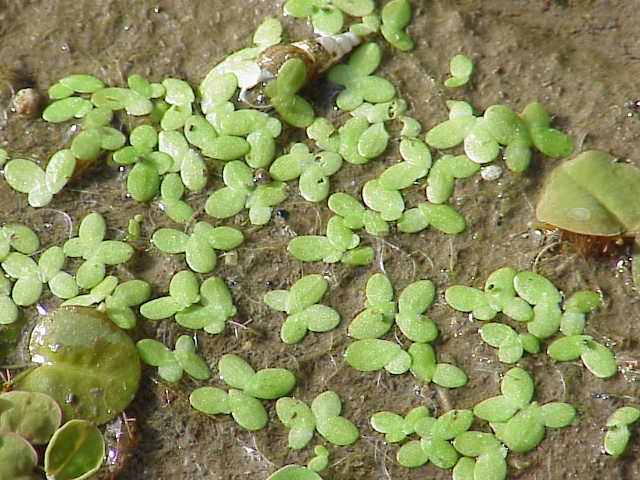
Duckweeds have an unusually simple structure compared with typical vascular plants. A single organism is usually a flattened, oval or round thallus (also called a frond) only a few cell-layers thick. The frond contains chlorophyll and carries out photosynthesis. Many species possess one or more simple rootlets that hang below the frond, but some are essentially rootless. Internal air pockets or aerenchyma commonly help the frond remain buoyant. Because of this reduced body plan they lack an obvious stem, true leaves and complex organs seen in larger plants.
Reproduction and life cycle
Most duckweed species reproduce primarily by rapid asexual budding from the margins or the underside of the frond, producing genetically identical daughter fronds that quickly form colonies. Occasionally they produce tiny flowers and engage in sexual reproduction; such events are infrequent but important for genetic recombination. A typical floral arrangement in flowering duckweed includes a few stamens and a pistil. The genus Wolffia is notable for producing the smallest known flowering structures, with flowers reported at around 0.3 mm in length. Sexual reproduction can yield seeds or dormant structures that survive adverse conditions and sometimes disperse floating in an air-filled sac.
Ecology and environmental roles
Duckweed plays several ecological roles in freshwater systems. Dense mats can shade the water, reducing algal growth and altering temperature profiles. They are efficient at taking up dissolved nutrients such as nitrogen and phosphorus, so they are often used as indicators of nutrient-rich or polluted waters and are employed in constructed wetlands and wastewater treatment to remove excess nutrients. At the same time, thick coverage can reduce oxygen exchange and, if unmanaged, create hypoxic conditions for fish and invertebrates.
Uses and human relevance
Because of their rapid growth and high protein content, some duckweed species have been explored as animal feed and a potential human food supplement. They are studied for applications in bioremediation, nutrient recycling and sustainable biomass production. Researchers also use duckweed as a simple model organism to study plant physiology, pollutant uptake and ecological interactions, since their small size and rapid reproduction make experiments tractable.
Management, cultivation and notable facts
In cultivation, duckweed requires still or slow-moving, nutrient-containing water, adequate light and mild temperatures. Garden ponds and aquaculture systems sometimes intentionally cultivate duckweed to moderate nutrient levels and provide feed, but in natural or managed waterways it may be considered invasive when it forms persistent monocultures. Control methods include mechanical removal, shading, nutrient reduction and biological control by herbivorous waterfowl and fish. Notable facts include the extreme simplicity of their body plan, their use in wastewater treatment, and the remarkably small flowers of Wolffia.
- Taxonomy and distribution: see genera and species information via genera overview and species lists.
- Habitat and ecology: general freshwater plant resources at freshwater plant references.
- Primary reproduction: asexual budding explained at asexual reproduction.
- Sexual structures and rare flowering events: sexual reproduction, including flowers with a few stamens and a pistil.
- Seed formation and dispersal: see seed and dispersal notes.
For readers seeking deeper taxonomic descriptions, ecological studies, or practical guides to cultivation and control, the linked resources above provide entry points to specialized literature and databases. Duckweed's simplicity and ecological versatility make it a subject of interest in both basic research and applied environmental management.
Questions and answers
Q: What are duckweeds?
A: Duckweeds are freshwater aquatic plants that float in still or slow-moving fresh water and wetlands.
Q: How many genera are there for duckweeds?
A: There are five genera for duckweeds.
Q: What is the structure of a duckweed plant?
A: Most of each duckweed plant is a small organized "thallus" or "frond" structure only a few cells thick. It often has air pockets and floats on or under the water surface. Some have no root and some have one or more simple rootlets.
Q: How do duckweeds reproduce?
A: Duckweeds usually reproduce asexually by budding. They occasionally produce three tiny flowers for sexual reproduction, which have two stamens and a pistil. This reproduction produces a seed in an air bag that floats.
Q: How many species of duckweeds are there?
A: There are a total of 33 to 38 species of duckweeds.
Q: Which genus of duckweed has the smallest flower?
A: The duckweed genus Wolffia has the smallest known flower, just 0.3mm long.
Q: What is the most noticeable feature lacking in a duckweed plant?
A: Duckweed plants lack an obvious stem or leaves.
Related articles
Author
AlegsaOnline.com Duckweed: tiny floating freshwater plants and their ecology Leandro Alegsa
URL: https://en.alegsaonline.com/art/29125
Sources
- doi.org : doi:10.1155/2011/570319
- efloras.org : Lemnaceae. – textgleich online wie gedrucktes Werk
- books.google.com : Wetland Ecology: Principles and Conservation
- geocities.com : "Dr. Wastewater's Duckweed Application Page" · web.archive.org
- idrc.ca : "Duckweed Wastewater Treatment and Reuse for Fodder (West Bank)"
- eawag.ch : "Duckweed Aquaculture: potentials, possibilities andl limitations for combined wastewater treatment and animal feed production in developing countries"
- esciencenews.com : "Duckweed genome sequencing has global implications. E! Science News"
- nature.com : The Spirodela polyrhiza genome reveals insights into its neotenous reduction fast growth and aquatic lifestyle.
- lemna.rutgers.edu : "Genome sequencing of the duckweed Spirodela polyrhiza: a biofuels, bioremediation and carbon cycling crop"
- ncsu.edu : "Researchers Find Fuel in Odd Places"
- biomassmagazine.com : "Duckweed Quacks Volumes of Potential"
- pressofatlanticcity.com : "Duckweed a possible solution to energy needs, researchers say"