
Duchy of Saxe‑Gotha
A small early modern German duchy centered on Gotha in Thuringia; created for Ernest I in 1640 and reorganized after his death, it illustrates the fragmentation of the Ernestine territories.
The Duchy of Saxe‑Gotha was a territorial state in the Holy Roman Empire centered on the town of Gotha in what is now Thuringia, Germany. Known in German as Sachsen‑Gotha, it belonged to the Ernestine branch of the Wettin dynasty and formed part of the complex mosaic of small states that characterized central Germany in the early modern period.
Image gallery
4 Images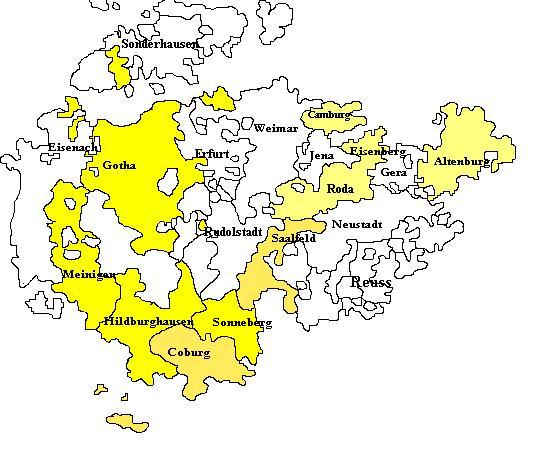


Overview and character
Created in 1640 for Duke Ernest I—often called Ernest the Pious—the duchy combined several territories around Gotha and Altenburg that came under Ernest’s control through inheritance and settlement. As a ducal seat, Gotha became an administrative and cultural center: the ducal court, local institutions and the palace shaped regional government, religion and patronage. The duchy operated within the legal framework of the Holy Roman Empire and followed the patterns of dynastic rule common among the Ernestine duchies.
Territory, administration and institutions
- Territory: a cluster of towns, manors and rural districts around Gotha; borders and composition shifted with inheritances and partitions.
- Administration: ducal officials managed taxation, justice and ecclesiastical matters; the court in Gotha provided a central identity for the state.
- Cultural life: the court supported churches, schools and the arts, and the ducal residence became a local hub for learning and patronage.
History and succession
Ernest I established a relatively compact and well‑organised duchy during a period when the Ernestine Wettins frequently partitioned their lands among sons. Ernest died in 1675, and his territories were later redivided among his male heirs. The initial political entity known specifically as Saxe‑Gotha ceased to exist as a single duchy in 1680, when territorial distribution created successor states. The senior inheritance was held by his eldest surviving son, who became duke of the combined territory often referred to as Saxe‑Gotha‑Altenburg.
Significance and broader context
Saxe‑Gotha exemplifies the fragmentation and dynastic complexity of early modern German lands. Its creation, administration and later partition show how personal inheritance practices shaped political geography. Although small, duchies like Saxe‑Gotha played roles in regional diplomacy, military levies within the Empire and cultural patronage that influenced urban development and confessional life in Thuringia.
Notable facts and distinctions
- The duchy was one of several Ernestine states that repeatedly split and recombined through family inheritance.
- Gotha served as the ducal residence and administrative heart, giving the state its common name.
- The successor arrangement after 1680 linked Gotha with Altenburg under a single ruler, a pattern repeated in later rearrangements of Wettin lands.
For further reading about the region, dynastic policy and cultural institutions tied to the duchy, see general works on the Ernestine duchies and the history of central Germany in the early modern period (Sachsen‑Gotha, Thuringia, Germany). Contemporary online and print resources provide timelines and maps tracing how the original duchy evolved into later configurations such as Saxe‑Gotha‑Altenburg and other Wettin partitions. Primary dates often cited are 1640 (creation), 1675 (death of Ernest I) and 1680 (division); these mark the main legal and dynastic changes in the duchy’s brief existence.
Questions and answers
Q: What was Saxe-Gotha?
A: Saxe-Gotha was a state in Thuringia, Germany.
Q: When was Saxe-Gotha created?
A: Saxe-Gotha was created in 1640.
Q: Who was Saxe-Gotha created for?
A: Saxe-Gotha was created for Duke Ernest I.
Q: When did Saxe-Gotha end?
A: Saxe-Gotha ended in 1680.
Q: Why did Saxe-Gotha end?
A: Saxe-Gotha ended because Duke Ernest I's lands were divided after his death in 1675.
Q: Who inherited the area around Gotha after Saxe-Gotha ended?
A: Frederick of Saxe-Gotha-Altenburg, Duke Ernest I's eldest surviving son, inherited the area around Gotha and became Duke of Saxe-Gotha-Altenburg.
Q: What other lands did Frederick of Saxe-Gotha-Altenburg inherit?
A: Frederick of Saxe-Gotha-Altenburg inherited Altenburg, which Duke Ernest I had inherited through his wife Elisabeth Sophie.
Related articles
Author
AlegsaOnline.com Duchy of Saxe‑Gotha Leandro Alegsa
URL: https://en.alegsaonline.com/art/29116
Sources
- bartleby.com : Saxe-Gotha