
Dualism: concepts, varieties, and significance in thought
Dualism is the view that a thing or domain is fundamentally composed of two distinct kinds or substances. This article explains its forms, history, examples, and how it contrasts with monism and pluralism.
Dualism names a family of views that explain something by dividing it into two fundamentally different kinds, realms, or principles. In general usage it signals a binary split: two separate and irreducible parts that together account for a phenomenon. The idea of a two-part structure appears in many disciplines and everyday thinking. For an introductory overview see the two-part view, and compare it with monism (one underlying kind) and pluralism (many kinds).
Image gallery
3 Images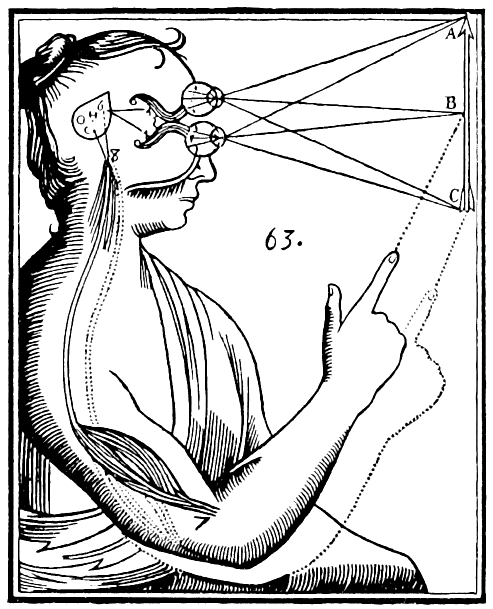


Forms and key characteristics
Different branches of study apply dualism in particular ways. In philosophy the label covers distinct problems and debates rather than a single theory. Common features of dualist claims are:
- an assertion of two ontological categories that are not reducible to one another;
- a claim that interactions between the two categories (if they interact) require special explanation;
- practical or conceptual consequences for how we investigate or treat the subject matter.
Several well-known varieties include:
- Mental–physical dualism: the thesis that the mind and the body (or brain) are distinct kinds of things. This family ranges from substance dualism, which posits two different kinds of substance, to property dualism, which allows one substance with two irreducible properties. See discussions in the philosophy of mind.
- Epistemological dualism: the idea that the knower and the known are separated by a representational gap. It emphasizes that our access to the world is mediated and that perception may not provide direct contact with reality; this notion is often discussed within epistemology.
- Moral or metaphysical dualisms: distinctions such as good/evil or spirit/matter that shape ethical systems, religion, and metaphysical accounts of the cosmos.
History and development
Dualistic motifs appear across cultures and eras. In Western philosophy the clearest modern exemplar is often associated with René Descartes, who formulated a sharp contrast between thinking substance and extended substance when considering mind and body. Other traditions—religious, mythological, and philosophical—have advanced different dualistic frameworks that organize cosmology, morality, or social roles. Over time, many thinkers have challenged dualisms by arguing for reducibility, continuity, or more complex plural structures.
Uses, examples, and importance
Dualism matters both in technical debate and ordinary life. In science and medicine, the mind–body question affects how mental disorders are conceptualized and treated: are they brain states, purely psychological phenomena, or both? In ethics and theology, dualist categories can underpin doctrines that separate spiritual and material goods. Everyday binary thinking—classifying experiences as hot/cold or mine/yours—illustrates how a dualist frame structures perception and language; for a brief note on everyday binaries see common sense.
Epistemological dualism highlights limits of perception: we can observe macroscopic forms but not immediately detect microscopic structure such as atoms without instruments. Debates about whether mental terms reduce to neuroscientific descriptions also invoke contrasts with the brain when defending or criticizing dualist claims.
Distinctions and contemporary perspectives
Critics of dualism often press two lines of response: (1) ontological parsimoniousness—preferring a single explanatory category unless two are necessary—and (2) explanatory integration—showing how phenomena attributed to two kinds can be unified by common mechanisms. Defenders of dualism emphasize explanatory gaps: certain subjective features or moral distinctions, they argue, resist full reduction. The terms monism and pluralism are useful contrasts that mark where thinkers position themselves on the spectrum from one to many fundamental kinds.
Understanding dualism therefore means tracking specific claims (about mind, knowledge, or value), examining arguments for separability, and evaluating whether dual explanations remain the best account of observed phenomena. For accessible introductions and further reading, consult philosophical overviews and specialized literature in cognitive science, metaphysics, and the history of ideas.
Questions and answers
Q: What is dualism?
A: Dualism is the idea or theory that something (an object, an idea or the whole world) is split into two parts. These parts are separate from each other and cannot be divided up in any other way.
Q: What is monism?
A: Monism is the idea or theory that something cannot be split into any parts.
Q: What is pluralism?
A: Pluralism is the idea that something can be split into many parts.
Q: How does dualism relate to philosophy of mind?
A: In philosophy of mind, dualism means that the mind and body are two very different things; nothing part of the body can be part of the mind and vice versa. People like this sort of dualism because they think that the mind is too important or too strange to be part of the body.
Q: How does dualism relate to epistemology?
A: In epistemology, dualism means that there is a barrier between a person and their environment; this barrier splits reality into 'myself' and 'the world'. Each person can see, hear, taste, smell and touch their environment but cannot know it directly.
Q: What does non-dualistic thinking suggest about our relationship with our environment?
A: Non-dualistic thinking suggests that a person is just another part of their environment and there isn't a barrier between them; if somebody cannot see, hear, taste, touch or smell something then it doesn't affect them.
Q: How might we use dualistic thinking in everyday life?
A: We might use dualistic thinking in everyday life by saying things like "this thing is either hot or cold," "this thing is either good or bad," etc., without allowing for possible states in between.
Related articles
Author
AlegsaOnline.com Dualism: concepts, varieties, and significance in thought Leandro Alegsa
URL: https://en.alegsaonline.com/art/29076