
Drug Enforcement Administration (DEA)
The DEA is a United States federal law enforcement agency within the Department of Justice that enforces controlled substance laws, conducts investigations, and coordinates international narcotics control.
The Drug Enforcement Administration (DEA) is a federal law enforcement agency responsible for enforcing the controlled substances laws and regulations of the United States. Created to centralize and strengthen the federal government’s response to illegal drug trafficking and distribution, the DEA operates under the umbrella of the Department of Justice and works closely with other domestic and international partners.
Image gallery
8 Images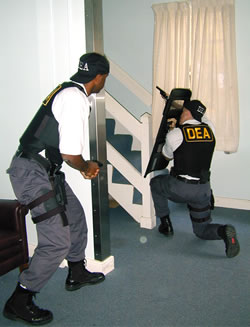



Overview and primary responsibilities
The agency’s mission includes investigating major drug organizations, dismantling trafficking networks, seizing illegal drugs and related assets, and reducing the availability of illicit controlled substances. It enforces statutory provisions found in the United States drug laws, including provisions arising from the Controlled Substances Act, and supports prosecutions brought by federal and state authorities. The DEA also gathers intelligence and maintains databases to track trends in production, trafficking, and abuse.
Organization and capabilities
DEA operational elements typically include investigative divisions, intelligence and analytic sections, forensic laboratories, and administrative units. Its workforce comprises special agents, diversion investigators (who focus on legal supply channels), analysts, and professional staff. Tactical and technical capabilities range from undercover operations and wire intercepts to forensic testing and controlled deliveries. The agency also manages registration and licensing programs for manufacturers, distributors, pharmacies, and practitioners to prevent diversion of lawful drugs into illicit markets.
International work and partnerships
The DEA maintains international offices and attaches in many countries to coordinate with foreign law enforcement and diplomatic partners. It often works in tandem with domestic agencies such as the Federal Bureau of Investigation, state and local police, and public health authorities to combine criminal investigations with prevention and treatment efforts. International cooperation includes joint investigations, training, capacity building, and information sharing to disrupt transnational trafficking organizations.
History and context
Established in the early 1970s during a period of expanding federal drug policy, the DEA consolidated several existing federal drug enforcement units into a single agency to improve coordination. Since then, its role has evolved with changing patterns of drug production, synthetic narcotics, and prescription drug diversion. Public debate about drug policy, enforcement priorities, and civil liberties has accompanied much of the agency’s modern history.
Functions and notable aspects
- Criminal investigations into trafficking, importation, and distribution of controlled substances.
- Diversion control to prevent lawful drugs from being misused.
- Forensic and laboratory analysis of seized substances.
- International liaison and training to support global narcotics control efforts.
- Intelligence collection and trend analysis to inform policy and operations.
As a federal law enforcement body, the DEA’s activities intersect with public health, regulatory policy, and criminal justice. Its actions have significant impacts on drug availability, law enforcement priorities, and international cooperation against narcotics trafficking, while also attracting scrutiny related to effectiveness and civil rights. For further institutional information and official resources, consult publications and guidance issued by the agency and the Department of Justice.
Questions and answers
Q: What is the Drug Enforcement Administration?
A: The Drug Enforcement Administration (DEA) is a law enforcement agency that works for the United States Department of Justice that enforces the United States drug laws.
Q: Who does the DEA work for?
A: The DEA works for the United States Department of Justice.
Q: What is the DEA's primary responsibility?
A: The DEA's primary responsibility is drug enforcement in the United States.
Q: Does the DEA share its responsibilities with any other agency?
A: Yes, the DEA shares its responsibilities with the Federal Bureau of Investigation.
Q: Does the DEA have responsibility for drug enforcement outside of the United States?
A: Yes, the DEA has complete responsibility for U.S. drug enforcement investigations in other countries.
Q: Is the DEA one of the most important agencies when it comes to drug enforcement in the United States?
A: Yes, the DEA is the agency with the most responsibility for drug enforcement in the U.S.
Q: What does "duty to do something" mean in the context of the DEA's responsibilities?
A: In the context of the DEA's responsibilities, "duty to do something" means complete responsibility for U.S. drug enforcement investigations in other countries.
Related articles
Author
AlegsaOnline.com Drug Enforcement Administration (DEA) Leandro Alegsa
URL: https://en.alegsaonline.com/art/29016
Sources
- learning-for-life.org : "Drug Enforcement Administration: Drug Abuse Prevention Service Award"
- dea.gov : "1999-2003"
- a257.g.akamaitech.net : "Title 28, C.F.R., Part 0.102"
- usdoj.gov : "DEA Office Locations"