
Drosophila obscura: common European fruit fly (obscura species group)
Overview of Drosophila obscura, a widespread European fruit fly: appearance, lifecycle, habitats, taxonomy within the obscura species group, and its role in ecological and evolutionary studies.
Drosophila obscura is a common fruit fly across much of temperate Europe. It is typically associated with wooded and semi-natural habitats where fermenting plant fluids occur, and it is less frequent on exposed coastal sites and open heathland. For a general species overview see species overview.
Image gallery
2 Images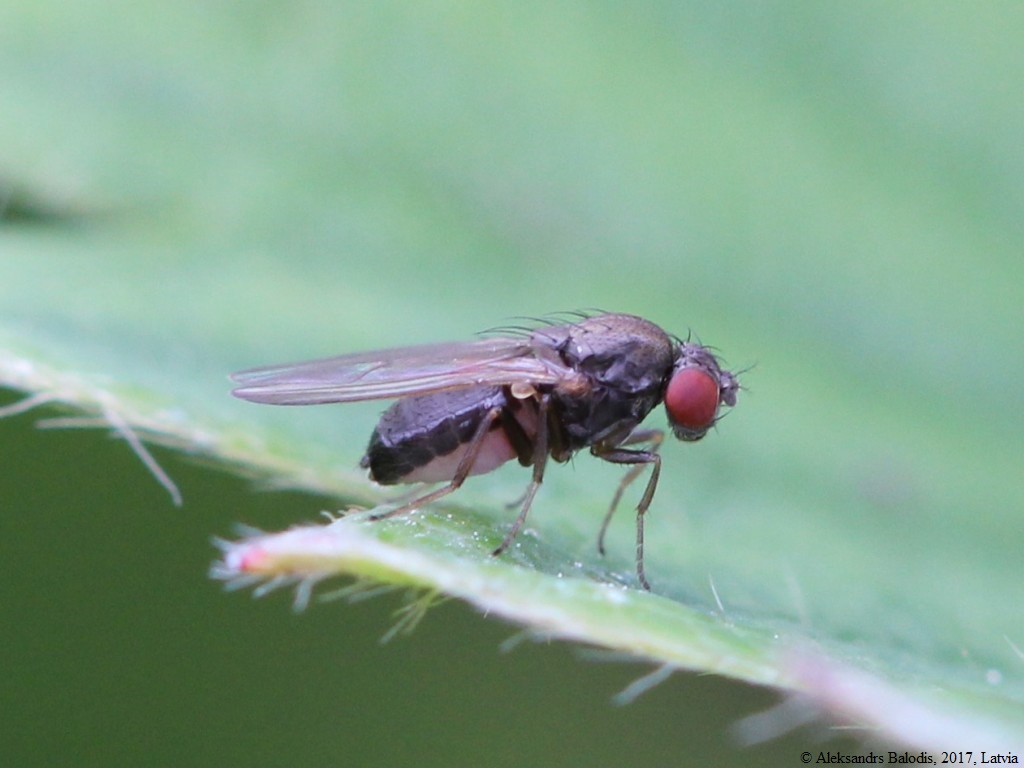

Appearance and life cycle
Adults are small, often dark-coloured flies with modest body patterning and clear wings. Females lay eggs in damp, fermenting substrates; the larvae feed primarily on yeasts and microorganisms that develop in these nutrient-rich sites. Pupation follows larval development and adults emerge to seek new breeding sites. Because many life-history details are shared with related species, observations of behaviour and development are useful but sometimes insufficient for precise identification.
Habitat and larval substrates
Larvae are commonly found in sap runs and fermenting exudates on deciduous trees; they also exploit fallen and decaying fruit, tree wounds and similar resource patches. Field collectors often seek sap flows and wounds on broad-leaved trees to sample immature stages. Practical information on larval biology and sampling methods is summarised at larval biology and regional host records at deciduous tree hosts.
Taxonomy and related species
Drosophila obscura belongs to the subgenus Sophophora and is the nominal member of the obscura species group. This group comprises several closely related and morphologically similar species, including the Mediterranean Drosophila subobscura and the North American D. pseudoobscura. Because external characters can overlap, taxonomists use genital morphology, chromosomal data and molecular markers to separate species reliably.
Ecological and scientific importance
Though not a classical laboratory model like Drosophila melanogaster, members of the obscura group are valuable in studies of ecology, population genetics and speciation. Variation in habitat preferences, range limits and reproductive isolation among sibling species has made the group useful for studying how populations adapt to local environments and how new species form.
Field identification and sampling tips
- Search adults near sap runs, fallen fruit and fermenting vegetation at woodland edges, hedgerows and parks.
- Collect larvae from tree wounds or decaying fruit and rear to adults for reliable identification.
- Use careful morphological examination or genetic methods to confirm species within the obscura group.
For regional faunal treatments, identification keys and further reading consult specialist monographs and faunal guides linked above. Field workers should also consult local biodiversity records to understand seasonal occurrence and habitat associations.
Questions and answers
Q: What is Drosophila obscura?
A: Drosophila obscura is a European species of fruit fly.
Q: In which habitats does Drosophila obscura live?
A: Drosophila obscura lives in most habitats except coastal areas and open heathland.
Q: Where can larvae of Drosophila obscura be found?
A: Larvae of Drosophila obscura can be found in the sap runs of deciduous trees.
Q: Are there any other species included in the subgenus Sophophera?
A: Yes, the subgenus Sophophera includes the common Mediterranean fly Drosophila subobscura and the North American D. pseudoobscura.
Q: What is the group called that includes all the similar species to Drosophila obscura?
A: The group is called the Drosophila obscura species group.
Q: Is Drosophila obscura the only species in its group?
A: No, Drosophila obscura is not the only species in its group.
Q: How many species are included in the Drosophila obscura species group?
A: It is not specified how many species are included in the Drosophila obscura species group.
Related articles
Author
AlegsaOnline.com Drosophila obscura: common European fruit fly (obscura species group) Leandro Alegsa
URL: https://en.alegsaonline.com/art/28995