
Dromornis — extinct giant flightless birds of Australia
Dromornis is a genus of large, extinct flightless birds from Australia known for massive skulls and powerful beaks. Lived in the late Miocene–early Pliocene; diet and lifestyle remain debated.
Dromornis is a fossil genus first recognized from remains found in Australia. Early descriptions emphasized its enormous skull and bill and its broadly ostrich-like silhouette, but detailed study places these birds in the distinctive Australian family Dromornithidae, a lineage of large, flightless birds that evolved in long-isolated Australasian ecosystems. The name and classification emphasize that Dromornis and its relatives represent a unique branch of avian evolution adapted to local environments.
Image gallery
10 Images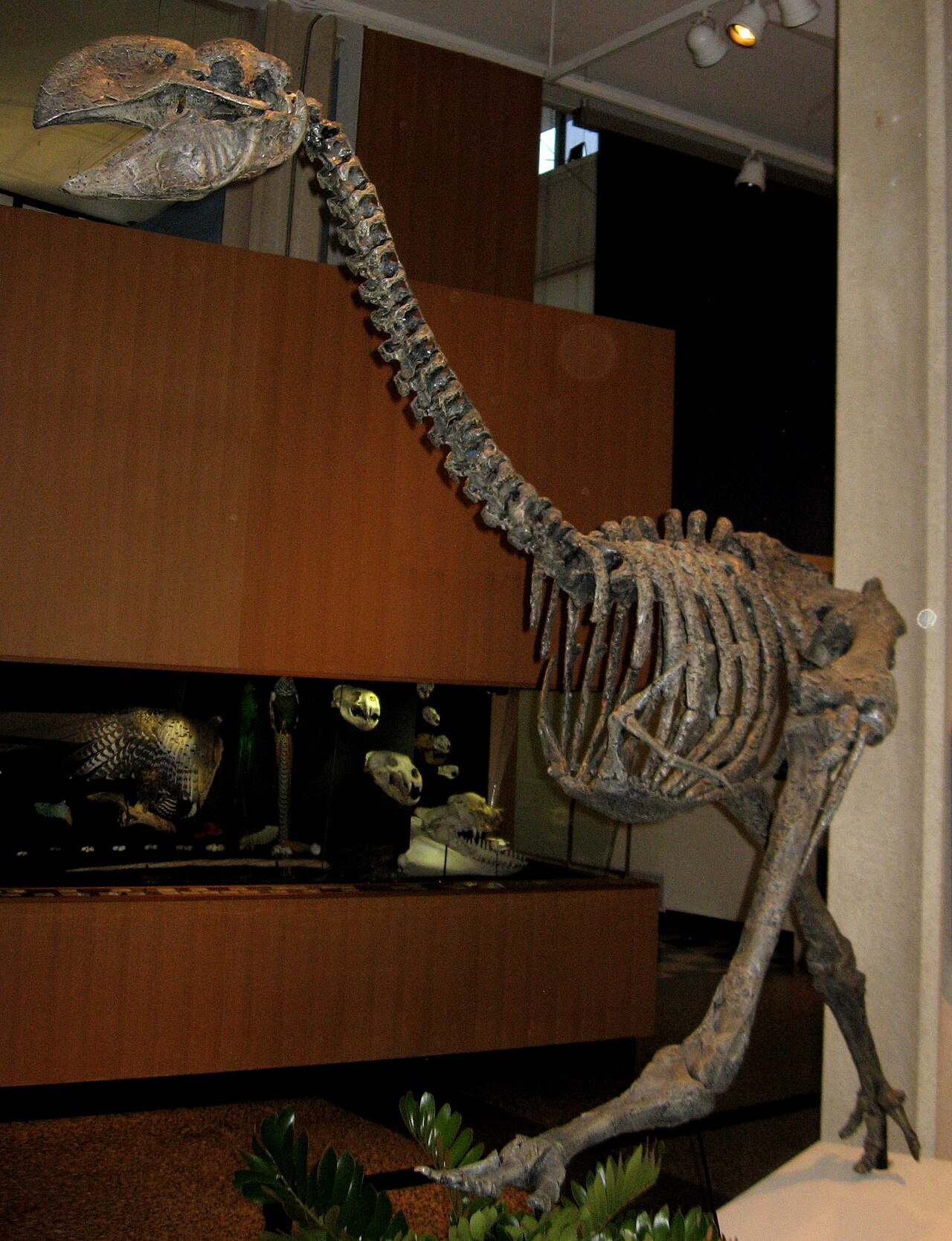



Appearance and anatomy
Members of the genus possessed extremely robust skulls with a deep, broad beak and heavy jaws. A long neck and reduced wings show clear adaptations to a flightless life. The legs were stout and capable of supporting great mass, but their proportions suggest these birds were not built for sustained high-speed running. One of the best-known species, Dromornis stirtoni, reached heights around three metres and has been estimated to weigh several hundred kilograms, making it among the largest known terrestrial birds. Because the beak lacks the sharp hooked tip and talons seen in many meat-eating birds, functional interpretations of feeding rely on comparisons of bone shape and jaw-muscle reconstructions.
Diet and behavior: a debated topic
The enormous bill and jaw musculature have led to two main, competing interpretations. Some researchers argue the beak was adapted for shearing and crushing tough plant material such as fibrous stems and branches, implying primarily herbivorous or omnivorous habits. Others note the raw power suggested by the skull and consider that occasional scavenging or active predation on relatively large prey cannot be ruled out. The absence of obvious carnivorous specializations—curved beak tips, grasping talons or raptorial feet—leans current consensus toward at least substantial herbivory, although a generalist diet remains plausible.
Fossil record and age
Fossils attributable to Dromornis occur in deposits that date to the late Miocene through the early Pliocene in Australia. These dates place the genus well before the arrival of modern humans on the continent, so Dromornis species were not encountered by people. The broader family, Dromornithidae, persisted in Australia for many millions of years and included other large forms with a range of sizes and beak shapes; some related genera survived later into the Quaternary.
Environment and extinction
During the Miocene and Pliocene, much of Australia supported woodland, riverine forests and mixed open habitats that could sustain large herbivores. Climatic shifts toward increasing aridity through the late Neogene changed vegetation patterns and likely altered food availability for large specialists. While the precise causes and timing of extinction differ among genera, habitat change and ecological competition are considered important factors. Isolation of the Australian continent after the breakup of Gondwana produced a distinctive fauna in which large flightless birds played significant ecological roles.
Relations and significance
- Taxonomic placement: Dromornis belongs to the family Dromornithidae and shows closer affinities to waterfowl-like groups than to ratites; this highlights convergent body plans among large flightless birds across continents. Genus, fossil, flightless birds.
- Geographic context: All known specimens come from Australia, in layers dated to the Miocene and early Pliocene.
- Diet debate: interpretations range from predominantly herbivorous to opportunistic carnivory—some studies invoke comparisons with modern carnivore biomechanics to test hypotheses.
- Comparisons: superficially similar to large ratites such as emus, but differing in skull and jaw design; larger than many extinct giant birds like the Moa and taller than some giant island forms such as Aepyornis in certain dimensions.
Understanding Dromornis contributes to broader questions about how isolated continental faunas evolve large, flightless forms and how functional morphology informs reconstructions of extinct animal behavior. The family Dromornithidae remains a focus for paleontologists studying convergent evolution, island and continental gigantism, and the changing palaeoenvironments of ancient Australia and Australasia.
Historical and geological context
The modern pattern of Australasian endemism traces back to the breakup of Gondwana and events in the Mesozoic and Cenozoic eras. Australia's long separation—completed when connections to Antarctica and other landmasses were lost—meant lineages evolved in relative isolation on the Australian landmass and nearby islands such as New Guinea. Occasional dispersal events from immigrant species originating in Asia did occur, but the endemic megafauna retained distinct evolutionary paths.
Research into Dromornis continues as new fossils and analytical techniques refine size estimates, functional interpretations and their place in Australia’s deep past. Each new find helps clarify how these remarkable birds fit into ancient ecosystems and why they ultimately disappeared.
Questions and answers
Q: What is Dromornis?
A: Dromornis is a genus of fossil flightless birds that lived in Australia from the late Miocene to the early Pliocene.
Q: How large was Dromornis stirtoni?
A: Dromornis stirtoni was three metres (10 feet) tall and weighed up to half a ton (500 kilos).
Q: What did it look like?
A: It looked like a giant emu, but it was more closely related to geese. It had a long neck and stub-like wings, so it was flightless. Its legs were powerful, but it was not a fast runner. The bird's beak was large and immensely powerful.
Q: What kind of environment did they live in?
A: They inhabited subtropical open woodland in Australia during the late Miocene with forests and permanent water supply, although the climate was unpredictable.
Q: When did they exist?
A: They existed from 15 million years ago until less than 30,000 years ago.
Q: How did Australasia become isolated from other continents?
A: Australasia became isolated when its last connection with Antarctica broke about 40 million years ago as Gondwana started to break up in the Mesozoic era.
Q: What type of lifestyle did Dromornis have?
A: Its life style is not certain, though some believe it may have been partly carnivorous due to its size of beak suggesting carnivorous behavior.
Related articles
Author
AlegsaOnline.com Dromornis — extinct giant flightless birds of Australia Leandro Alegsa
URL: https://en.alegsaonline.com/art/28980