
Allier (department in central France)
Allier is a department in central France, in Auvergne-Rhône-Alpes, named for the Allier river. Its prefecture is Moulins. The area combines Bourbonnais heritage, oak forests, spa towns and rural economy.
Overview
Department of Allier lies in central France within the Auvergne-Rhône-Alpes region. It takes its name from the river Allier, which crosses much of the territory. The department combines agricultural plains, rolling uplands and river valleys; its cultural identity is strongly linked to the historic province of Bourbonnais and to rural traditions that survive in market towns and villages.
Image gallery
10 Images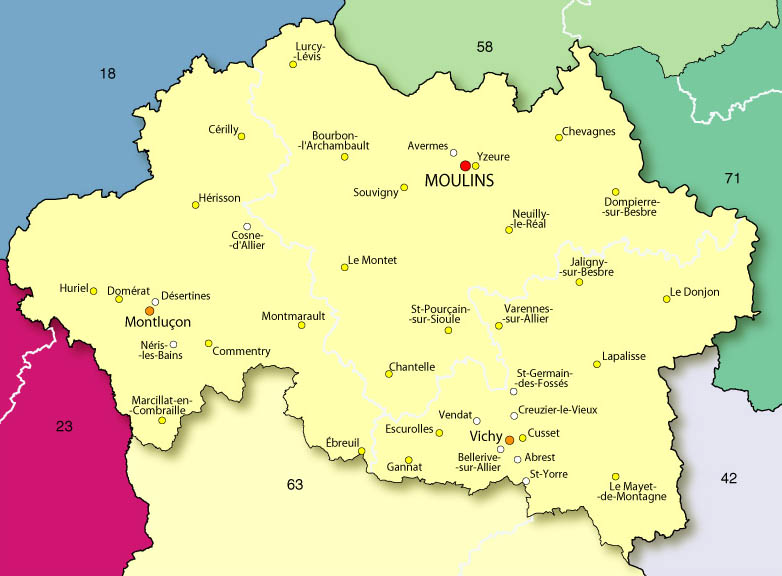


Geography and environment
The landscape is structured by the valley of the Allier river, an important natural corridor and a tributary of the Loire. Riverine habitats, meadows and hedged farmland are interspersed with significant woodlands, most notably the Forest of Tronçais, valued for its mature oaks. Elevations are moderate, ranging from low river plains to gentle hills, making the department suitable for mixed farming, forestry and outdoor recreation.
History and identity
Allier was created during the upheavals of the French Revolution and largely overlaps the old Bourbonnais province. The legacy of the House of Bourbon, medieval churches, châteaux and rural architecture contribute to a visible historical fabric. Local festivals, culinary specialities and artisan crafts continue to reflect a distinct regional culture rooted in centuries of rural life.
Economy and tourism
The economy remains largely rural: agriculture, livestock and forestry are important employers, while small industries and crafts persist in towns. Tourism is based on spa towns, notably the well-known resorts that developed in the 19th and early 20th centuries, heritage sites, river activities and nature tourism. Local products and small-scale food production support a network of markets and short supply chains.
Administration, towns and transport
The prefecture of the department is Moulins. Other principal towns include Vichy and Montluçon, which serve as regional centres for services and culture. The department is divided into arrondissements and many communes, reflecting a dispersed settlement pattern. Road and rail links connect localities to larger regional cities, while inland waterways and trails support leisure activities.
Notable facts
- Historically tied to Bourbonnais, the department preserves a strong sense of local identity through architecture and traditions.
- Forests such as Tronçais supply quality oak used in cooperage and furniture, and they support biodiversity.
- Thermal towns, riverside recreation and numerous heritage sites make Allier a destination for cultural and nature tourism.
Questions and answers
Q: What is Allier?
A: Allier is a department located in the center of France.
Q: Where is the Auvergne-Rhône-Alpes region located?
A: The Auvergne-Rhône-Alpes region is also located in the center of France.
Q: What is the name of the river that Allier is named after?
A: Allier is named after the river Allier.
Q: What is a tributary of the Loire River?
A: The river Allier is a tributary of the Loire River.
Q: What is the capital city of Allier?
A: Moulins is the capital city of Allier.
Q: What kind of administrative unit is Allier?
A: Allier is a departmental administrative unit.
Q: In what region of France is Allier located?
A: Allier is located in the Auvergne-Rhône-Alpes region of France.
Tags
Related articles
Author
AlegsaOnline.com Allier (department in central France) Leandro Alegsa
URL: https://en.alegsaonline.com/art/2829
Sources
- allier.fr : "Le Président"
- insee.fr : "Département de l'Allier (03) - Résumé statistique"
- insee.fr : "Populations légales 2014 des départements et des collectivités d'outre-mer"
- splaf.free.fr : "Historique de l'Allier"
- allier.fr : "Géographie du département de l'Allier"
- peakbagger.com : "Puy de Montoncel, France"
- annuaire-mairie.fr : "Le département de l'Allier"
- insee.fr : "Département de l'Allier (03)"
- insee.fr : "Régions, départements, arrondissements, cantons et communes"
- insee.fr : "Département de l'Allier (03) et Arrondissements"
- legifrance.gouv.fr : "Décret n° 2014-265 du 27 février 2014 portant délimitation des cantons dans le département de l'Allier"