
Domesday Book: England's 1086 survey and its purpose
An encyclopedic overview of the Domesday Book: its compilation in 1086, contents, organisation, exclusions, legal and historical importance, and modern use for medieval English landholding studies.
The Domesday Book is the standard name for the record of a large, systematic survey of landholding and resources in much of England and parts of Wales completed in 1086. Commissioned by William I (William the Conqueror) after the Norman Conquest, the survey was intended primarily as a fiscal and administrative instrument: to establish who held land, what resources each holding contained and how much could be raised in rent or other dues. It remains one of the best-preserved administrative documents from medieval Europe and a cornerstone source for the study of late 11th‑century England.
Image gallery
8 Images

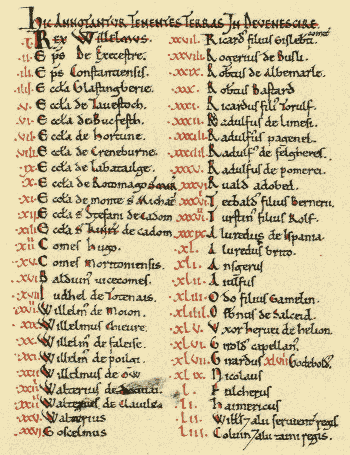


Purpose and context
The immediate purpose of the inquiry was practical. After 1066 William redistributed large amounts of land to his followers and needed a reliable record of taxable values and obligations. The material was used to determine crown revenues, to settle disputes about tenure and to identify those liable to provide military service. Because its focus was on obligations and assets rather than on recording every inhabitant, the Domesday returns reflect fiscal priorities more than a modern demographic census.
How it was compiled
The survey was organised by royal commissioners who travelled with armed escorts and teams of clerks. At the local level the commissioners convened juries made up of local landholders, free men and officials who answered a set of standard questions about holdings and resources. Answers were recorded in Latin by scribes and later copied into the formal volumes and summaries that survive. Field enquiries and compilation were concentrated in 1086, and the king died in 1087 before every aspect of the work had been completed or revised.
Contents and format
The Domesday Book is not a single book in the modern sense but a set of related records arranged largely by county and by manor. Material that survives is conventionally grouped into two main volumes: a fuller, county-by-county register often called Great Domesday, and a shorter, more detailed surviving section sometimes referred to as Little Domesday, covering some eastern counties. Typical entries record the holder in 1066 and in 1086, the taxable value, numbers of plough teams, areas of arable, meadow and woodland, mills, fisheries and some counts of livestock. In some entries particular animals, such as pigs, are explicitly counted, reflecting their economic importance on certain estates.
Exclusions and limitations
The survey omits or treats differently several significant categories of person and place. Large towns and many urban populations are not represented in the same manner as rural manors; major urban centres were often returned in a different fashion or omitted from the manorial lists. Religious houses and ecclesiastical estates were recorded under particular headings and the inhabitants of monasteries or convents therefore appear in different records. Individuals resident within fortified places such as castles are frequently absent from local returns. In short, the Domesday Book lists those from whom the crown expected payments or military service rather than the entire population.
Legal status and later use
Because the returns were compiled under royal authority and often recorded perceived historical ownership as well as current holding, the book became a legal reference used in disputes over rights and tenure in subsequent centuries. Its authority derived from the royal endorsement and the sworn testimony taken during the surveys. Over time the document served both as a fiscal register and a source for resolving contested claims about land.
Survival, editions and modern scholarship
The original rolls and early copies of the Domesday material survive in national collections and have been edited, translated and published in multiple scholarly editions since the early modern period. Modern techniques — including diplomatic editions, county summaries and online databases — have made the text widely accessible to historians, archaeologists and genealogists. Digital projects now permit searches by place-name, lord or resource, aiding studies of settlement patterns, agricultural capacity and the social consequences of the Conquest.
Interpretation and caution
Scholars emphasise that the Domesday evidence must be read with care. It provides a valuable snapshot of economic resources and the structure of landholding at a particular moment, but it is not a comprehensive portrait of population or everyday life. Regional variation in how questions were answered, the interests of local informants, and the crown’s fiscal priorities all shaped the returns. Comparative use with archaeology and other documentary sources gives a fuller picture of 11th‑century England.
Further reading and key terms
Readers seeking introductory materials, transcriptions or county-by-county surveys can consult facsimiles, annotated editions and digital repositories maintained by libraries and research projects. Key terms and topics associated with the Domesday inquiry include the geography of England, the frontier areas of Wales, the role of William I, the work of royal scribes and local jury testimony, the use of Latin in official entries, the assessment of rent, the omission of some small villages, the treatment of major urban centres such as London and Winchester, questions about who could be taxed, the counting of stock such as pigs, debates over whether it resembles a census, and the recording of religious communities including monks and nuns, as well as those resident in castles. These subjects are entry points for both popular and specialist study of the Domesday Book and its enduring significance.
Questions and answers
Q: What is the Domesday Book?
A: The Domesday Book is a record of all taxable land in England, together with information about its worth, that was completed in 1086 for William I of England (also known as William the Conqueror).
Q: Who led the groups collecting information for the Domesday Book?
A: Each group was led by a Royal Commissioner.
Q: What language were the answers to questions written down in?
A: All answers were written down in Latin.
Q: Why did William I want to create the Domesday Book?
A: William I wanted to know details of the land he had conquered and get rent money from his knights and barons.
Q: Are major cities like London and Winchester listed in the Domesday Book?
A: No, major cities like London and Winchester are not listed in the Domesday Book, perhaps because of their size or because they could not be taxed.
Q: Does the Domesday book give names of people living at that time?
A: No, it does not give names of all people living at that time - it only lists heads of households who might supply men to fight in his army and who he could get rent from. It left out Londoners, monks, nuns and anyone living in castles.
Q: Are small villages included in The Domesday Book?
A: Yes, small villages are included in The Domesday Book but some may have been missed due to their size or other factors.
Related articles
Author
AlegsaOnline.com Domesday Book: England's 1086 survey and its purpose Leandro Alegsa
URL: https://en.alegsaonline.com/art/28277
Sources
- domesdaybook.co.uk : "The Domesday Book Online - Frequently Asked Questions"
- domesdaybook.co.uk : Domesday Book
- historic-uk.com : "The Domesday (Doomsday) Book"