
Allied invasion of Sicily (Operation Husky), July–August 1943
Operation Husky was the large Allied amphibious and airborne invasion of Sicily in July–August 1943 that knocked Axis forces from the island and helped open the way into Italy.
Overview
The Allied invasion of Sicily, code-named Operation Husky, was a major combined-arms offensive in the Mediterranean theatre of World War II. Launched on the night of 9–10 July 1943, the operation involved large-scale amphibious landings, airborne drops, naval gunfire and sustained air support. Within six weeks of combat, Allied forces secured the island and forced Axis troops to evacuate to the Italian mainland, clearing sea lanes and setting the stage for the invasion of Italy. For general background on the Mediterranean campaign see Mediterranean operations.
Image gallery
10 Images



Forces and planning
Husky was a complex multinational effort that brought together British, American, Canadian and other Allied units, supported by naval and air forces. The invasion required detailed coordination of sea transports, landing craft, and airborne elements, as well as deception and intelligence measures to mislead Axis commanders about the invasion’s timing and location. Planners combined lessons learned from earlier amphibious actions and used diversionary tactics; readers can explore planning and deception in greater depth at Allied deception plans.
Course of the campaign
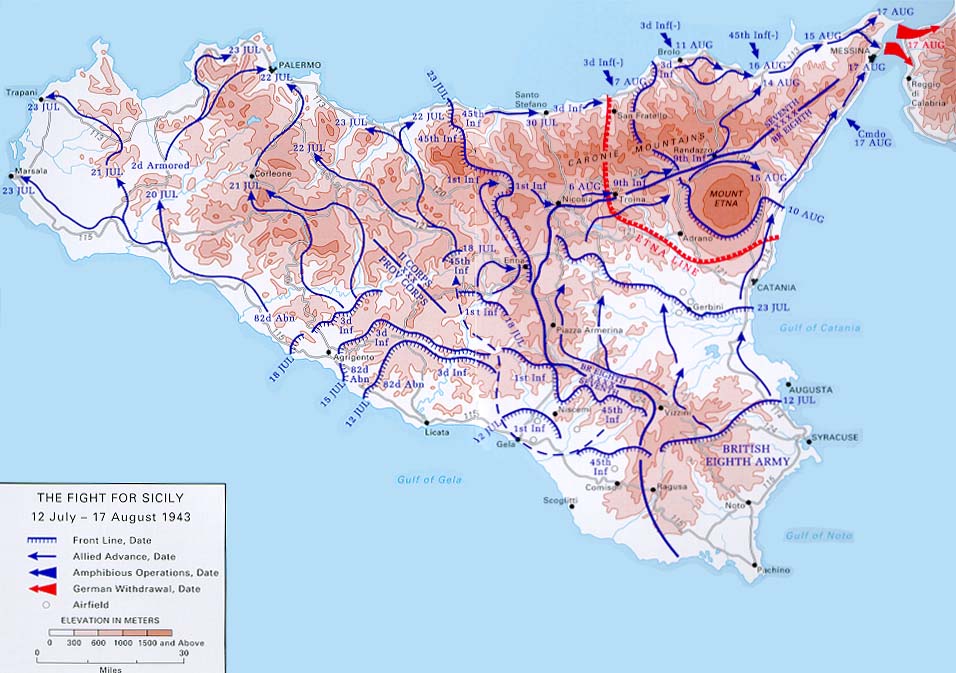
The operation began with nocturnal sea landings on multiple beaches along Sicily’s southern and southeastern coasts accompanied by parachute and glider operations inland. Allied troops seized key ports and airfields, pushed north and west across the island, and engaged German and Italian formations in a campaign of maneuver, local counterattacks, and attrition. The fighting continued through July and into August, culminating in the withdrawal of most Axis forces across the Strait of Messina. Contemporary military accounts and summaries discuss troop movements and engagements in more detail: campaign chronology.
Results and immediate effects
Operation Husky achieved its primary objectives: the capture of Sicily, the removal of Axis air, land and naval control from the island, and the opening of Mediterranean sea lanes for Allied shipping. The success also contributed to political upheaval in Italy, where Benito Mussolini was deposed within weeks of the invasion; for political consequences see Italian political aftermath. The Allies used Sicily as a staging area for subsequent operations and as a bargaining point in broader strategic planning: a summary of follow-on actions is available at invasion of mainland Italy.
Significance and notable aspects
Husky was significant for several reasons. It demonstrated the growing Allied mastery of large amphibious and airborne operations and highlighted the importance of joint command, logistics and air-sea integration. The campaign compelled Axis commanders to divert resources to the Italian theatre and undermined Axis control of the central Mediterranean. It also exposed weaknesses in Axis coordination and provided experience that influenced later amphibious assaults. For analysis of these strategic consequences, see Mediterranean strategic impact.
Key facts at a glance
- Code name: Operation Husky (Allied operations index).
- Dates: Night of 9–10 July 1943 to mid-August 1943.
- Nature: Combined amphibious and airborne invasion with sustained land combat.
- Outcome: Capture of Sicily, Axis evacuation to mainland Italy, and political fallout in Italy.
Operation Husky remains widely studied as a turning point in the Mediterranean war. It combined operational innovation with logistical scale and had immediate tactical results as well as longer-term strategic and political consequences that helped shape the later stages of the European conflict.
Questions and answers
Q: What was the Allied invasion of Sicily?
A: The Allied invasion of Sicily was a major battle of World War II that involved the capture of Sicily from the Axis Powers (Italy and Nazi Germany).
Q: What was the code name for the Allied invasion of Sicily?
A: The code name for the Allied invasion of Sicily was Operation Husky.
Q: How long did the land fighting in the Allied invasion of Sicily last?
A: The land fighting in the Allied invasion of Sicily lasted for six weeks.
Q: What did the Allied invasion of Sicily start?
A: The Allied invasion of Sicily started the Italian Campaign.
Q: What came after the Allied invasion of Sicily?
A: The Allied invasion of Italy came after the Allied invasion of Sicily.
Q: When did the Allied invasion of Sicily begin and end?
A: The Allied invasion of Sicily began on the night of 9–10 July 1943 and ended on 17 August.
Q: What were the goals of the Allies in the Allied invasion of Sicily, and were they achieved?
A: The goals of the Allies in the Allied invasion of Sicily were to remove Axis air, land, and naval forces from the island and to open the Mediterranean's sea lanes to the Allies. These goals were achieved, and Italian dictator Benito Mussolini was briefly removed from power as well.
Related articles
Author
AlegsaOnline.com Allied invasion of Sicily (Operation Husky), July–August 1943 Leandro Alegsa
URL: https://en.alegsaonline.com/art/2825
Sources
- amazon.com : B0016LQN3K