
Allied invasion of Italy (1943): operations, commanders, and consequences
The Allied invasion of Italy in September 1943 began the Italian Campaign in WWII. Major landings at Calabria, Salerno and Taranto opened a hard, prolonged fight against German defenses and reshaped the Mediterranean war.
Overview
The Allied invasion of mainland Italy in 1943 marked a major phase of the Mediterranean theatre of World War II. Following the successful conquest of Sicily, Allied planners sought to force Italy out of the war, secure sea lanes in the Mediterranean and draw German strength southward. Allied forces began landing on the Italian mainland in early September 1943. The operation combined amphibious assaults, limited airborne and seaborne insertions, and close naval and air support to establish beachheads and advance inland against determined opposition.
Image gallery
10 Images


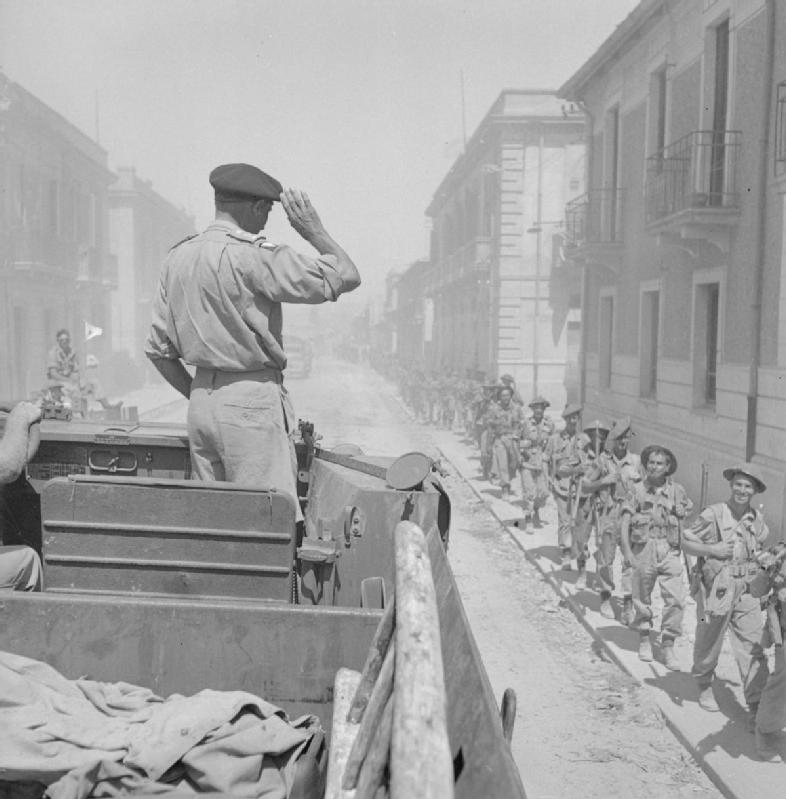

Principal operations and landings
The campaign began with several coordinated operations, each directed at a different sector of southern Italy. Key landings included:
- Operation Baytown — a crossing into Calabria intended to tie down Axis forces and open the toe of the peninsula. Calabria was the southernmost axis of the initial invasion.
- Operation Avalanche — the main assault aimed at the Gulf of Salerno, intended to secure a lodgement for drives toward Naples and the Italian interior. The Salerno landing is often treated as the focal point of the mainland invasion; see Salerno.
- Operation Slapstick — an amphibious landing at the heel of Italy at Taranto, conducted by British forces to outflank German defenses and link up with advancing units.
Forces and command
Allied operations were coordinated by General Sir Harold Alexander's 15th Army Group. Field formations included Lieutenant General Mark Clark's U.S. Fifth Army and General Bernard Montgomery's British Eighth Army. Naval and air forces provided critical convoy protection, shore bombardment and air cover during the landings. The opposing Axis response featured German units rapidly moved into Italy to hold key defensive lines and to occupy strategic areas after the collapse of Italian resistance.
Political context and German reaction
Italy's government had been weakened by military reverses and internal dissent. An armistice with the Allies was negotiated in early September and publicly affected the situation that month, but German forces anticipated Italian defection and implemented plans to disarm Italian troops and occupy the country. The German countermeasures transformed what some planners had hoped would be a swift collapse into a drawn-out campaign marked by well-prepared defensive lines.
Consequences and significance
The invasion removed the southern Italian peninsula as a secure Axis base and forced Germany to commit substantial forces to hold the area, tying them down for months. Fighting in Italy progressed slowly through mountainous terrain and fortified positions—most famously the Gustav Line and the bitter battles that followed—delaying the Allied advance to Rome and beyond. The campaign produced important lessons in combined operations, shaped post-armistice Italian politics and contributed to the wider attrition of Axis resources in 1943–1944.
Notable distinctions and further reading
The Allied invasion of Italy differs from the earlier Sicilian campaign in scale, terrain and strategic outcome: Sicily cleared Axis air and naval threats from the central Mediterranean, while the mainland campaign became a grinding contest against a prepared defender. For chronological and geographic details, see related entries on the Mediterranean operations and the subsequent Italian Campaign; for operational summaries consult resources listed at Allied sources, WWII overviews and contemporary accounts of the landings at Sicily. Additional archival and interpretive materials can be found via reference guides at Salerno references, regional studies for Calabria and port operations at Taranto.
For commanders, strategy and unit-level narrative consult primary unit histories and modern syntheses available through military history collections and specialist works on the Italian Campaign.
Previous story
At the Casablanca Conference in early 1943, British Prime Minister Winston Churchill had tried to convince US President Franklin D. Roosevelt of the idea of beginning the attack on "Fortress Europe" with an assault from the south on Sicily. Churchill argued that in order to proceed, it was necessary to secure the shipping lanes in the Mediterranean. Moreover, Italy could be persuaded to break away from the Axis front in this way. At the Trident Conference in May 1943, agreement was reached in principle to continue operations in the Mediterranean in 1943 with the aim of bringing about Italy's withdrawal from the war. This was intended to improve the prospects of Operation Roundup, planned for 1944, since the German Army would be forced to commit additional divisions to occupy the Balkans and defend northern Italy and southern France. The Allied commander in chief in the Mediterranean Theater of Operations General Dwight D. Eisenhower was then tasked with developing options for follow-on operations for Operation Husky. The Americans originally favored a landing on Sardinia and Corsica and an intensification of the air war, while the British advocated a landing on the Italian mainland with the option of later establishing a bridgehead in Albania.
Operation Husky against Sicily began on 10 July 1943 and was successfully completed by mid-August. At the suggestion of American Chief of Staff George C. Marshall, planning began in mid-July for an operation to capture the port of Naples under the name Operation Avalanche.
After a meeting of the Great Fascist Council on July 25 deposed Italian dictator Benito Mussolini, his successor Pietro Badoglio began negotiations for a separate peace with the Allies. At the Quadrant Conference in August 1943, Churchill and Roosevelt decided to continue operations on the Italian mainland.
Previously, the German High Command had decided to station additional German divisions in northern Italy and near Rome in order to be able to disarm the Italian army in the event of a separate peace by the new Italian government. The plans for this and for the takeover of the Italian occupied territories in the Balkans and in southeastern France were worked out under the heading "Fall Achse" (Axis Case).
Plan
While the U.S. 7th Army remained in Sicily, the British 8th Army, also involved at Husky, commanded by General Bernard Montgomery, and the U.S. 5th Army, deployed in North Africa and commanded by General Mark W. Clark, were designated for the landings and combined into the 15th Army Group. The British Field Marshal Harold Alexander, who was also Eisenhower's deputy, had the supreme command.
Opposing them was the German 10th Army of General Heinrich von Vietinghoff under the commander-in-chief for southern Italy GFM Albert Kesselring. It was reinforced in August by the units of the XIV Panzer Corps evacuated from Sicily.
Due to Italy's impending exit from the war, Allied commanders decided to conduct the main landing on the west coast of Italy. The landings in Calabria via the Strait of Messina and in the Gulf of Taranto were planned as secondary operations to make the German defences more difficult.
The British 8th Army was to land from Messina on the opposite coast of Calabria at Reggio Calabria on 3 September (Baytown). This operation could be carried out with light landing craft due to the short distance.
The Gulf of Salerno south of Naples was selected as the landing point for the main landing (avalanche) planned one week later, since better conditions were to be expected there than in the estuary of the Volturno northwest of Naples, which was also being considered. For this the 5th U.S. Army, consisting of the American VI Corps and the British X Corps with the 82nd U.S. Airborne Division in reserve, were selected, transported by sea from North Africa. A plan to use the 82nd Division to occupy airfields near Rome (Operation Giant II) was dropped at short notice when it became clear that the Italian Army would not side with the Allies.
The British 1st Airborne Division was to conduct simultaneous landings at Taranto (Slapstick) as a diversionary maneuver for Avalanche.

Questions and answers
Q: What was the Allied invasion of Italy?
A: The Allied invasion of Italy was the invasion of mainland Italy by the Allies during World War II.
Q: When did the Allies land on the mainland of Italy?
A: The Allies landed on the mainland of Italy on 3 September 1943.
Q: What was the objective of the Allied invasion of Italy?
A: The Allied invasion of Italy aimed to advance further into Europe and defeat the Axis powers.
Q: Who led the invasion of Italy?
A: General Harold Alexander's 15th Army Group led the invasion of Italy.
Q: What were the two other attacks carried out during the invasion of Italy?
A: The two other attacks were done in Calabria (Operation Baytown) and Taranto (Operation Slapstick).
Q: Which armies were involved in the invasion of Italy?
A: Lieutenant General Mark Clark's U.S. Fifth Army and General Bernard Montgomery's British Eighth Army were involved in the invasion of Italy.
Q: Where did the main invasion force land during the invasion of Italy?
A: The main invasion force landed near Salerno on the western coast in Operation Avalanche.
Related articles
Author
AlegsaOnline.com Allied invasion of Italy (1943): operations, commanders, and consequences Leandro Alegsa
URL: https://en.alegsaonline.com/art/2824
Sources
- amazon.com : B0016LQN3K