
Division of Calare (Australian federal electoral division)
An Australian federal electorate in central‑western New South Wales, named from the Indigenous name for the Lachlan River; a rural and regional seat centred on towns such as Bathurst, Orange and Parkes.
The Division of Calare is a federal electoral division in central‑western New South Wales. It returns one member to the Australian House of Representatives and covers a broad swathe of rural and regional country, combining agricultural districts, mining and service towns. The division takes its name from an Indigenous Australian word for the Lachlan River, which flows through the western parts of the electorate; the traditional pronunciation is often rendered as Kal‑ah‑ree, though many residents pronounce it Kul‑air.
Image gallery
10 Images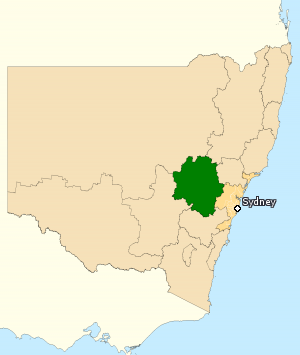


Geography and communities
Calare occupies inland country characterised by plains, river valleys and low ranges. It includes a mix of population centres and smaller townships that provide local services, education and regional commerce. Transport corridors and agricultural lands dominate much of the landscape, with the Lachlan and tributary waterways influencing settlement patterns and irrigation.
- Bathurst — a regional service and education centre;
- Blayney, Molong and Orange — regional centres with commercial and agricultural roles;
- Parkes and Forbes — towns linked to cropping, rail and local industry;
- Smaller communities such as Canowindra, Eugowra, Oberon, Peak Hill, Portland, Wallerawang and Yeoval.
History and development
The electorate was created for the 1906 federal election during early redistributions that followed federation. Over time its boundaries have been redrawn several times to reflect population change and the redistribution process used for federal electorates. These adjustments have shifted which towns and local government areas are included, so the division today may differ substantially from its original extent.
Character and importance
Calare is primarily rural and regional in character. Its economy draws on cropping, livestock production, mining and regional services. Towns within the division serve as hubs for health, education and transport for surrounding agricultural districts. As an electorate it highlights typical issues for non‑metropolitan Australia, including regional infrastructure, water management along the Lachlan system, and the economic sustainability of smaller towns.
Notable points and distinctions
The name links the seat to the Indigenous heritage of the Lachlan River valley and reflects the common Australian practice of using local geographical names for electorates. Pronunciation varies locally, and boundary changes mean community composition can change from one redistribution to the next. For current boundaries, representation and electoral details consult the Australian Electoral Commission or official sources linked from this overview.
Questions and answers
Q: What is the Division of Calare?
A: The Division of Calare is an Australian Electoral Division in New South Wales.
Q: When was the Division of Calare set up?
A: The Division of Calare was set up for the 1906 election.
Q: What does the name Calare mean?
A: Calare is the local Indigenous Australian name for the Lachlan River, which runs through the western part of the division.
Q: How should the name Calare be pronounced?
A: The name Calare should be pronounced Kal-ah-ree, but the pronunciation Kul-air is used.
Q: What towns are included in the Division of Calare?
A: The division includes the towns of Bathurst, Blayney, Canowindra, Eugowra, Forbes, Lithgow, Molong, Oberon, Orange, Parkes, Peak Hill, Portland, Wallerawang, and Yeoval.
Q: Which river runs through the western part of the Division of Calare?
A: The Lachlan River runs through the western part of the Division of Calare.
Q: What is the significance of the name Calare?
A: The name Calare is of local Indigenous Australian origin and refers to the Lachlan River.
Related articles
Author
AlegsaOnline.com Division of Calare (Australian federal electoral division) Leandro Alegsa
URL: https://en.alegsaonline.com/art/27845
Sources
- aec.gov.au : "Profile of the electoral division of Calare (NSW)"
- abc.net.au : "Andren dies after four-month illness"