
Districts of Sri Lanka: structure, roles, history and notable examples
An overview of Sri Lanka's 25 districts—second‑level administrative units grouped into nine provinces—covering organization, governance, functions, history and notable districts.
The island nation of Sri Lanka is divided into 25 districts, which serve as the primary subprovincial administrative units. Districts sit below the nine provinces in the country’s territorial hierarchy and are the basis for many government services, statistical reporting and local administration. The English term "district" corresponds to native names in Sinhala and Tamil, reflecting the country’s bilingual official terminology.
Image gallery
8 Images

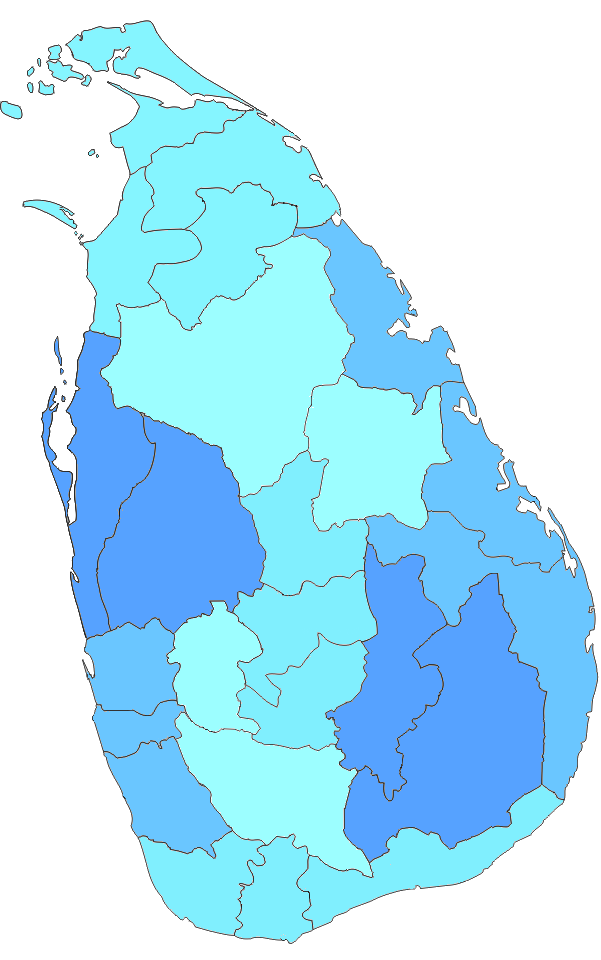


Administrative structure and terminology
Each district is headed by a District Secretary (historically known as a Government Agent), who is a central government appointee responsible for coordinating state functions at the district level. Districts are subdivided into Divisional Secretariats and then into smaller units such as Grama Niladhari divisions.
- The word for district in Sinhala is displayed as: දිස්ත්රික්ක.
- The Tamil equivalent is shown as: மாவட்டம்.
Historical background
The modern district system developed during colonial rule and was refined after independence to improve administrative reach and service delivery. Boundaries and responsibilities have changed over time to accommodate population shifts, development planning and political reforms. The current set of 25 districts has been used to organize national elections, census enumeration and the delivery of welfare and infrastructure programs.
Districts operate within the two-tiered context of provincial devolution and central oversight: provinces provide a level of regional government while many day‑to‑day administrative powers and key appointments remain with the national government through the District Secretariat.
Typical responsibilities at the district level include coordination of disaster response, land administration, implementation of national development projects, maintenance of vital statistics and acting as the liaison between central ministries and local government bodies such as municipal councils, urban councils and pradeshiya sabhas.
Notable districts by population and prominence include Colombo (the commercial capital), Kandy (a major cultural and historical center), Jaffna (a northern urban hub), Galle (a southern port city) and Batticaloa. District identities often reflect geographic features, ethnic composition and historical trade routes, contributing to the island’s regional diversity.
Understanding districts is essential to grasp how Sri Lanka organizes public administration, plans development, and delivers services across urban and rural communities. For further detail on legal frameworks or district‑level data, consult official government publications and national statistics sources.
Questions and answers
Q: What are districts in Sri Lanka?
A: In Sri Lanka, districts are the second-level administrative divisions.
Q: What is the first level of administrative divisions in Sri Lanka?
A: The first level of administrative divisions in Sri Lanka are the provinces.
Q: How many districts are there in Sri Lanka?
A: There are 25 districts in Sri Lanka.
Q: How many provinces are there in Sri Lanka?
A: There are 9 provinces in Sri Lanka.
Q: Who administers each district in Sri Lanka?
A: Each district in Sri Lanka is administered under a District Secretary.
Q: Who appoints the District Secretaries in Sri Lanka?
A: The central government appoints the District Secretaries in Sri Lanka.
Q: What are the names of the administrative divisions used in Sinhala and Tamil in Sri Lanka?
A: The administrative divisions in Sri Lanka are known as "දිස්ත්රික්ක" in Sinhala and "மாவட்டம்" in Tamil.
Related articles
Author
AlegsaOnline.com Districts of Sri Lanka: structure, roles, history and notable examples Leandro Alegsa
URL: https://en.alegsaonline.com/art/27771
Sources
- commons.wikimedia.org : Districts of Sri Lanka
- priu.gov.lk : "At a Glance"
- ds.gov.lk : "Vision & Mission" · web.archive.org
- archives.dailynews.lk : "Kilinochchi a brief look"