
Discus throw
The discus throw is a track and field event in which an athlete throws a heavy circular disc for distance. It has ancient origins, distinct technique, regulated equipment, and a long competitive history.
Overview
The discus throw is a field athletics event in which competitors hurl a heavy, flat circular implement called a discus with the aim of achieving the greatest horizontal distance. It is contested at major track and field meets, multi-sport events and the Olympic Games. For a concise event description see discus throw.
Image gallery
8 Images




Equipment and field
The implement is a circular disc with a weighted rim and a flat or slightly concave profile. Standard senior implements differ by sex: the men's discus is heavier than the women's. Throws are made from a defined throwing circle set into the ground and athletes must release the discus so it lands inside a marked sector that opens out from the circle by roughly 35 degrees. Officials measure distance from the nearest mark made by the discus to the circumference of the circle.
Technique and phases
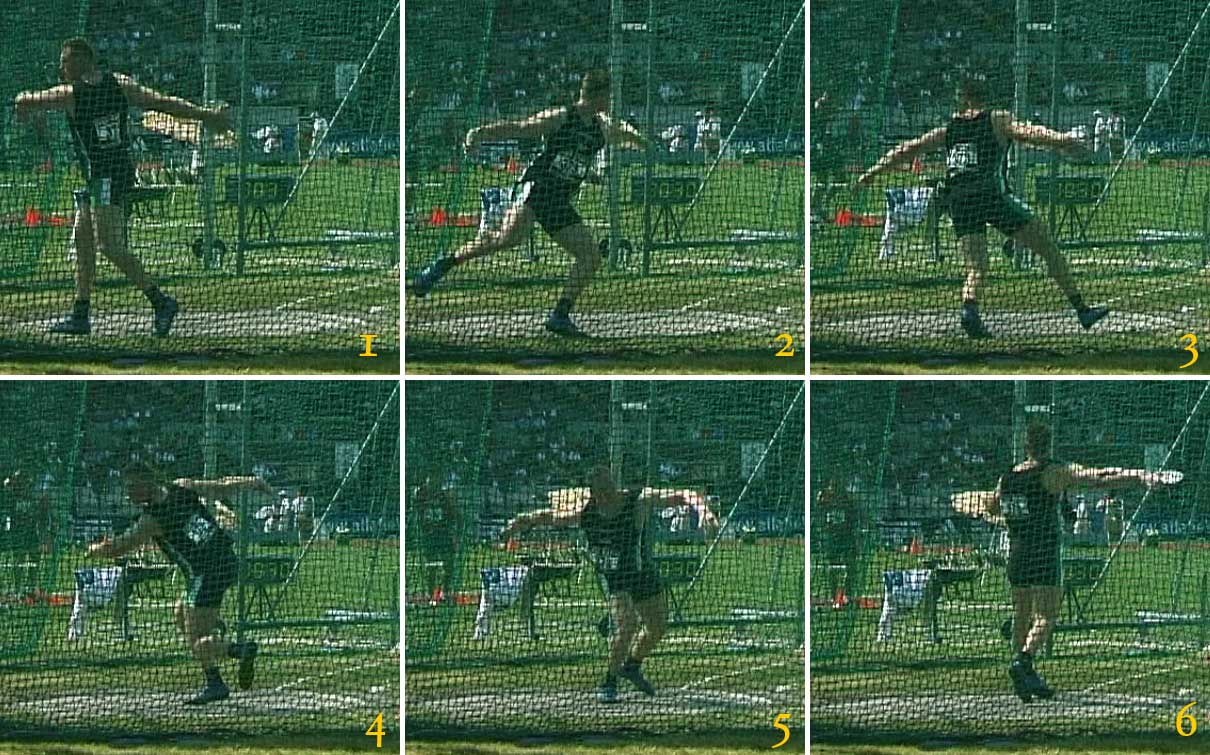
Successful throwing combines strength, balance and technique. Athletes typically begin with a preparatory stance and one or more rotations across the circle to build angular momentum before releasing the discus. Coaches break the action into phases such as the wind-up, entry, turning rotation, power position and release, followed by a controlled recovery to avoid fouling. Grip, rim speed and the angle of release are critical to maximizing distance while keeping the implement within the sector.
Competition format and rules
Competitions usually have a qualification phase and a final. Each competitor receives a set number of attempts; the longest legal throw counts. Throws that land outside the sector, that touch the top of the throwing circle's rim on exit, or where the athlete steps out of the circle before the implement lands are ruled fouls and are not measured. Measurement is taken from the inner edge of the circle to the nearest point where the discus first contacts the ground.
History and cultural significance
The event dates back to antiquity and was a component of the ancient pentathlon in Ancient Greece. It became a subject of classical sculpture, most famously in works such as the Discobolus, and later Roman reproductions preserved many Greek originals; these cultural links continue to connect the modern sport with its artistic past. The modern men's discus was part of the first modern Olympic Games, and a women's contest was added in the early 20th century.
Notable facts and legacy
- Technique has evolved from strength-based throwing to highly technical rotational methods that emphasize speed and balance.
- High-profile champions and historic artworks have kept the discus prominent in sporting and cultural histories; museums and collections often display classical bronzes and Roman copies inspired by the subject.
- The event remains a staple of track and field, taught at youth through elite levels and featured in international championships.
Questions and answers
Q: What is the discus throw?
A: The discus throw is an event in athletics where a heavy disc is thrown for distance.
Q: When was the discus throw invented?
A: The discus throw was invented in 708 BC in Ancient Greece.
Q: What is the goal of the discus throw?
A: The goal of the discus throw is to throw the discus farther than your opponents.
Q: Who is one of the most famous discus throwers?
A: US thrower Al Oerter is one of the most famous discus throwers.
Q: Why is the discus throw significant in art history?
A: The discus throw is the subject of a number of well-known ancient Greek statues and Roman copies of them.
Q: How many consecutive Olympic Games did Al Oerter win the discus throw in?
A: Al Oerter is one of only two athletes to win the same individual event at four consecutive Olympic Games.
Q: What kind of object is the discus that is used in the discus throw?
A: The discus used in the discus throw is a heavy disc.
Related articles
Author
AlegsaOnline.com Discus throw Leandro Alegsa
URL: https://en.alegsaonline.com/art/27667