
Diorite: Composition, Formation, Characteristics, and Uses
Diorite is a coarse-grained igneous rock intermediate between basalt and granite. This article covers its composition, textures, geologic settings, classification, uses, and how to distinguish it from related rocks.
Overview
Diorite is a coarse-grained intrusive igneous rock formed when magma cools slowly beneath the Earth's surface. Its overall composition places it between mafic rocks such as basalt/gabbro and felsic rocks such as granite, giving it distinct intermediate mineralogy and a typically speckled, salt-and-pepper appearance.
Image gallery
10 Images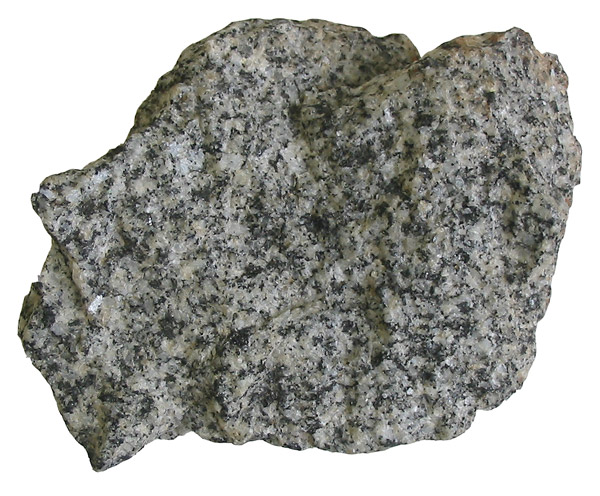


Composition and appearance
Diorite is dominated by intermediate silicate minerals and commonly contains a mixture of dark and light crystals. The dark component typically includes hornblende and other mafic minerals, while plagioclase feldspar makes up much of the lighter fraction. For discussions of common silicate minerals see silicate mineral groups. Compared with gabbro or basalt, diorite’s plagioclase feldspar is richer in sodium than in calcium; see notes on sodium and calcium content. Minor constituents can include quartz (quartz), microcline, olivine (olivine) and small amounts of mica.
Texture and hand-sample characteristics
Diorite generally exhibits a phaneritic texture—coarse enough that individual mineral crystals are visible to the eye—often producing a distinctive speckled or salt-and-pepper look. For more on textural descriptions see rock textures. Colors range from light to dark grey, sometimes with bluish or greenish tones depending on the precise mineral mix.
Formation and geologic settings
Diorite forms by the partial melting and subsequent crystallization of rocks in subduction-related settings, particularly in volcanic arcs above zones where one tectonic plate sinks beneath another. These processes concentrate intermediate magmas that crystallize at depth as plutons and batholiths. Dioritic bodies are often spatially associated with both more mafic intrusions and more felsic ones; see information on igneous intrusions. Large dioritic complexes are typical in cordilleran mountain belts such as those described under cordilleran orogenic systems.
Classification and related rock types
When quartz makes up more than about 5% of the rock it is commonly called quartz-diorite; if quartz exceeds roughly 20% the rock may be classified as tonalite. The volcanic (extrusive) equivalent of diorite is andesite, which shares similar chemistry but has much finer texture due to rapid surface cooling. Diorite lies compositionally between gabbro (more mafic) and granite (more felsic).
Uses, importance, and identification
Diorite is a hard, durable rock that has been used historically for construction and stone carving where a fine, long-lasting material was required. It is valued in engineering as aggregate and occasionally as a facing stone. Identification in the field relies on texture, color, and mineral proportions: look for visible plagioclase crystals combined with darker hornblende or biotite and an overall intermediate chemistry. A simple checklist:
- Coarse-grained, phaneritic texture
- Salt-and-pepper or speckled appearance
- Plagioclase feldspar dominant; dark mafic minerals present
- Intermediate silica content—between basalt/gabbro and granite
Because diorite commonly occurs with other intrusive rocks and may grade into them, careful petrographic or chemical analysis is often required for precise classification. For further study, consult sources on mineralogy and igneous petrology represented by the linked topics above.
Questions and answers
Q: What is diorite?
A: Diorite is a melted rock that has cooled made mostly of the silicate minerals (materials made of silicon and oxygen). It is usually grey to dark-grey in color, but it can also be black or bluish-grey, and often has a greenish cast.
Q: How does diorite differ from gabbro (basalt)?
A: Diorite differs from gabbro (basalt) because the materials in diorite have more sodium and less calcium.
Q: Does diorite contain quartz?
A: Yes, diorite may have small amounts of quartz, microcline, and olivine. Tiny amounts of muscovite may also be found. If there is a lot of quartz it makes the rock type quartz-diorite (>5% quartz) or tonalite (>20% quartz).
Q: What does diorites texture look like?
A: Diorites texture is speckled with coarse grain size.
Q: Where are diorites commonly produced?
A: Diorites are commonly produced in volcanic arcs, and in cordilleran mountain building such as in the Andes Mountains as large batholiths.
Q: What is the extrusive volcanic equivalent rock type for doriate?
A: The extrusive volcanic equivalent rock type for doriate is andesite.
Q: How does doriate form?
A: Doriate forms when partial melting occurs above an area where two tectonic plates merge under each other.
Tags
Related articles
Author
AlegsaOnline.com Diorite: Composition, Formation, Characteristics, and Uses Leandro Alegsa
URL: https://en.alegsaonline.com/art/27551