
Diomedes: Greek Hero of the Trojan War
Diomedes, son of Tydeus, is a principal Achaean warrior in Homeric epic and later Greek myth, noted for his courage, leadership of the Argive contingent, and prominent exploits in the Iliad and post-Homeric cycles.
Overview
Diomedes (Greek: Διομήδης) is one of the principal heroes of Greek epic tradition. Presented most famously in Homer's Iliad, he is the son of Tydeus and Queen Deipyle and ranks among the chief leaders of the Achaeans as commander of the Argive contingent. In the poem he—along with Greater Ajax—is portrayed as one of the greatest fighters after Achilles.
Image gallery
10 Images



Lineage and role
Traditional genealogies make Diomedes a prince of Argos who inherits leadership from a heroic father associated with older cycles (the Seven Against Thebes). His parentage, martial reputation and kingship emphasize the blend of local dynastic claims and the pan-Hellenic world of epic warfare. In many accounts he is a model warrior-king whose authority rests on personal valor and the loyalty of his followers.
In the Iliad: aristeia and divine interactions
In the Iliad Diomedes experiences a notable aristeia, a sequence in which a warrior achieves extraordinary success in battle. He fights with unusual effectiveness, and several episodes highlight his interaction with the gods: with Athena's favor he wounds the god Ares and later drives back the goddess Aphrodite, demonstrating how divine support and mortal bravery are intertwined in epic narrative. His partnership with Odysseus in scouting missions and raiding episodes also displays a combination of cunning and strength.
Later myths and post-Homeric tradition
Outside Homeric poetry, Diomedes appears in various legendary cycles. He is sometimes credited with the theft of the Palladium from Troy together with Odysseus, a deed that features in the wider story of the city's fall. Accounts of his return home vary: some traditions describe a peaceful restoration, others describe exile or founding of new settlements abroad — motifs common to many heroic returns. These later stories helped make Diomedes a figure in regional foundation myths.
Notable episodes and cultural legacy
- His aristeia in the Iliad, where he leads successful sorties and duels.
- The wounding of deities while acting with Athena's aid, a rare and striking motif.
- Participation in post-Iliadic cycles such as the theft of the Palladium.
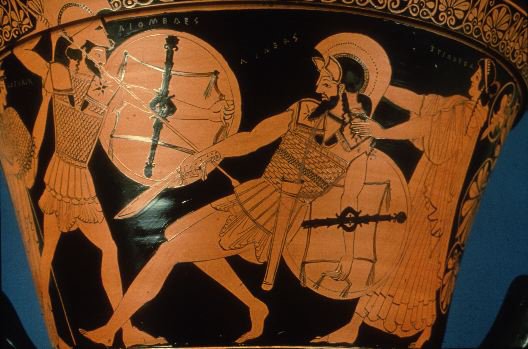
Diomedes appears frequently in ancient art and later literature as the archetypal capable warrior-king: helmeted, armed with spear and shield, and often paired with Odysseus or Ajax in scenes of cunning and combat. His story illustrates central themes of Greek heroic culture—valor, divine favor, and the uncertain fate of returning heroes—making him a persistent subject for poets, playwrights and vase-painters through antiquity and later reception.
For further reading on his figure in epic and myth scholarship see introductions to Homeric heroes and collections of the Epic Cycle.
Trojan War context provides the larger historical-mythical framework in which Diomedes operates, and the complexity of his portrayal helps explain why he remains a distinctive and well-studied character of ancient Greek storytelling.
Questions and answers
Q: Who was Diomedes?
A: Diomedes was an ancient Greek hero and one of the central figures of the Iliad.
Q: What is the meaning of Diomedes' name?
A: Diomedes' name means "God-like cunning, advised by Zeus"
Q: Who were Diomedes' parents?
A: Diomedes' parents were King Tydeus and Queen Deipyle.
Q: What was Diomedes' role in the Trojan War?
A: Diomedes was the leader of the Argive contingent during the Trojan War.
Q: How was Diomedes regarded among the Achaean warriors?
A: Diomedes was regarded as one of the greatest of all the Achaean warriors, second only to Achilles in terms of prowess.
Q: Who was another warrior that was equivalent to Diomedes?
A: Greater Ajax was another warrior who was regarded as an equal to Diomedes.
Q: What was the significance of Zeus advising Diomedes?
A: The significance of Zeus advising Diomedes was that it helped to elevate his status among the other heroes and demonstrated his favor with the gods.
Related articles
Author
AlegsaOnline.com Diomedes: Greek Hero of the Trojan War Leandro Alegsa
URL: https://en.alegsaonline.com/art/27537