
Dinosaur Ridge — Morrison Formation fossils and Dakota tracksite near Denver
Dinosaur Ridge, on the Dakota hogback west of Denver, exposes Late Jurassic bone beds and Cretaceous track-bearing sandstones. It is noted for landmark fossil discoveries, public interpretation and long-term conservation.
Overview
Dinosaur Ridge is a nationally recognized paleontological and geological site on the Dakota hogback immediately west of Denver. The outcrop is unusual because it presents a clear vertical sequence in which sedimentary rocks that preserve large-bodied dinosaur skeletons are overlain by younger sandstones that preserve abundant footprints. The combination of historic excavations, visible in-situ fossils and a developed program of interpretation and conservation makes the site important to scientists, educators and visitors.
Image gallery
6 Images


Geology and stratigraphy
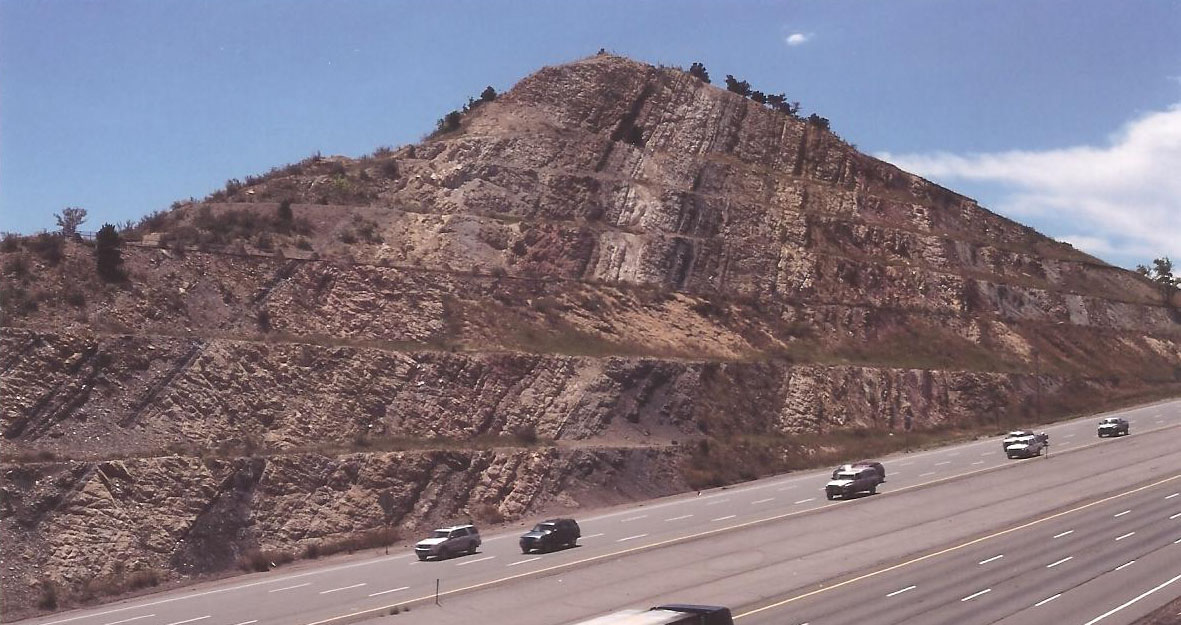
The ridge exposes two principal units in close succession. The lower beds belong to the regional Morrison Formation, a widespread Late Jurassic unit famous for yielding nearly complete sauropod and theropod skeletons. These sediments accumulated in floodplains, rivers and lakes and preserve both bones and plant remains. Above the Morrison are sandstones of the Dakota Formation, deposited during the Cretaceous as coastal plain and nearshore deposits. These higher beds preserve bedding surfaces and horizons that captured animal activity as trace fossils, including extensive dinosaur tracksites. A distinctive volcanic ash bed and other marker layers aid regional correlation and help geologists interpret the succession of environments recorded at the site.
Historic discoveries and paleontological significance
In 1877 Arthur Lakes and his field parties discovered large bones in the Morrison beds; these remains were among those that defined the classic dinosaur fauna of North America. Fossils collected from the area were attributed to well-known genera such as Apatosaurus, Diplodocus, Stegosaurus and Allosaurus. The quality and quantity of material helped shape early scientific descriptions and public interest in dinosaurs during the late 19th and early 20th centuries. Because of its scientific and historic importance, the location was designated a National Natural Landmark in 1973 through the National Park Service, recognizing both its research value and need for protection.
Tracks, trace fossils and paleoecology
The Dakota sandstones higher on the ridge preserve hundreds of footprints and other traces. Many prints resemble broad, three-toed or hand-marked herbivore tracks attributed to iguanodontian-like animals (commonly described as Iguanodon-type), while smaller three-toed impressions were left by carnivorous theropods. These trace fossils record behavior such as gait, stride and group movement and provide a direct window into the environments—tidal flats, shorelines and river margins—where animals were active. Researchers use the tracks in combination with the skeletal record to reconstruct the paleoenvironments and ecosystems that existed at different times at the site.
Conservation, interpretation and public access
Local stewardship has been a key part of Dinosaur Ridge’s history. In 1989 community members formed the Friends of Dinosaur Ridge to focus on site preservation, public education and research facilitation. The site now includes a visitor-oriented exhibit hall with displays on regional geology, fossil discoveries and the economic resources of the area, and outdoor interpretive panels placed along trails and roadside stops. Guided walks and school programs help non-specialists understand stratigraphy, fossil preservation and the broader context of the finds.
Why Dinosaur Ridge matters
Dinosaur Ridge is valuable both as a historical type locality for classic Jurassic dinosaur discoveries and as an unusually accessible example of how a single outcrop can record multiple episodes of Earth history. It illustrates how floodplain and coastal processes can preserve different kinds of fossil evidence—bones preserved in the Morrison floodplain facies and, slightly higher, footprints preserved on ancient shorelines in the Dakota sandstones. The site continues to serve as a field classroom for students and as a managed public resource where visitors can see and learn from fossils in situ.
- Key formations: Morrison Formation and Dakota Formation
- Representative taxa: Apatosaurus, Diplodocus, Stegosaurus, Allosaurus
- Trace fossils: Iguanodon-like prints and theropod tracks
- Historic designation: National Natural Landmark by the National Park Service
For focused study, professional researchers consult geological maps and peer-reviewed papers; visitors can learn from the on-site exhibits and the nonprofit that coordinates stewardship and interpretation. The ridge remains a vivid, teachable exposure of deep-time change in western North America and an accessible place to observe the fossil record preserved in both bone-bearing and track-bearing rocks. Additional educational resources are provided by regional museums and university collections involved in ongoing study of the area and its fossils. Geologic context and outreach materials offer further background for those wishing to explore stratigraphy, sedimentology and paleobiology at greater depth.
Questions and answers
Q: What is Dinosaur Ridge?
A: Dinosaur Ridge is part of the Morrison Formation, just west of Denver. It is one of the world's most famous dinosaur fossil localities and was designated as a National Natural Landmark by the National Park Service in 1973.
Q: What type of fossils have been found at Dinosaur Ridge?
A: At Dinosaur Ridge, some of the best-known dinosaurs have been found including Apatosaurus, Diplodocus, Stegosaurus, and Allosaurus. Additionally, hundreds of dinosaur footprints have also been discovered at the site.
Q: What rocks are on either side of Dinosaur Ridge?
A: The rocks on the west side of Dinosaur Ridge are part of the widespread Morrison Formation from Jurassic age while those on the east side are part of the Cretaceous Dakota Formation.
Q: When was Alameda Parkway constructed?
A: Alameda Parkway was constructed in 1937 to provide access to Red Rocks Park.
Q: What did workers discover when constructing Alameda Parkway?
A: When constructing Alameda Parkway in 1937, workers discovered hundreds of dinosaur footprints which were mostly Iguanodon-like footprints with carnivorous theropod tracks also present.
Q: Who formed Friends Of Dinosaur Ridge?
A: The Friends Of Dinosaur Ridge formed in 1989 to address increasing concerns regarding preservation at this site and offer educational programs about its resources.
Related articles
Author
AlegsaOnline.com Dinosaur Ridge — Morrison Formation fossils and Dakota tracksite near Denver Leandro Alegsa
URL: https://en.alegsaonline.com/art/27504
Sources
- dinoridge.org : dinoridge.org/