
Dinitrogen pentoxide (N2O5): properties, preparation, uses and safety
Dinitrogen pentoxide (N2O5) is the anhydride of nitric acid, an oxidizing and nitrating reagent used in synthesis and atmospheric chemistry; it is reactive, corrosive and releases toxic NO2 on decomposition.
Overview
Dinitrogen pentoxide is a chemical compound with the formula N2O5. It can be described as the anhydride of nitric acid: when water is removed from HNO3, N2O5 is formed. In many contexts it behaves as a source of the nitronium ion (NO2+), and it is valued in laboratory chemistry for nitration and as a strong oxidizing agent. It is typically encountered as a white or off-white solid and is unstable in moist air.
Image gallery
1 Image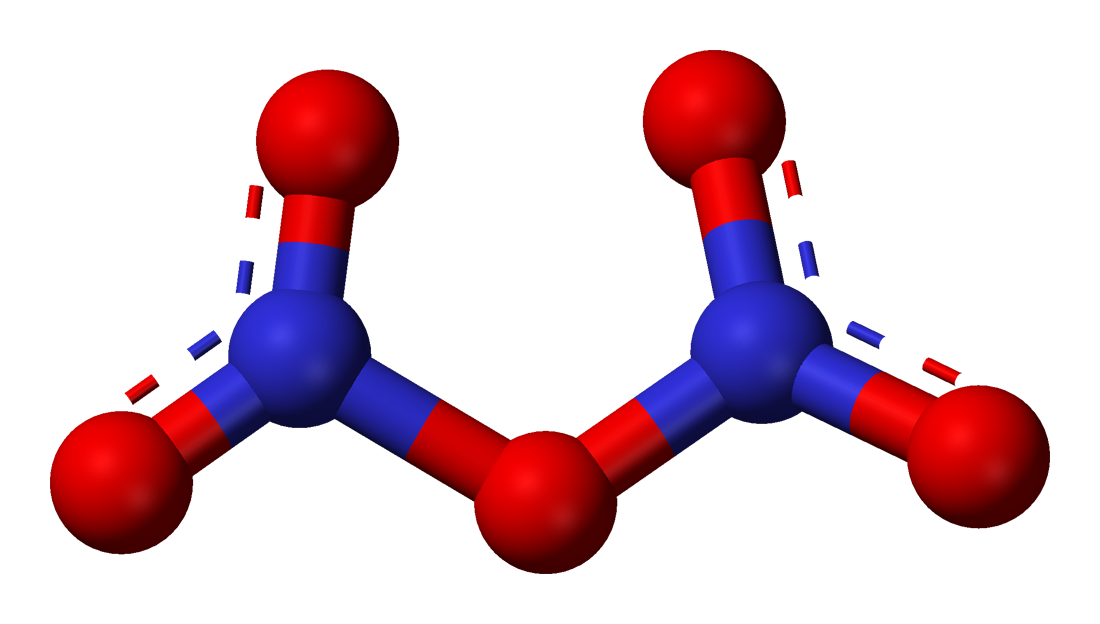
Structure and chemical characteristics
In the condensed solid state N2O5 commonly exists as an ionic assembly of nitronium cations (NO2+) and nitrate anions (NO3−), whereas isolated molecules or gas-phase species are better described in covalent terms. The nitrogen atoms are in a high oxidation state (formal +5). The compound hydrolyzes readily to regenerate nitric acid and can decompose to nitrogen oxides, including nitrogen dioxide (NO2).
Preparation and typical reactions
N2O5 is commonly prepared by dehydrating nitric acid using powerful drying agents such as phosphorus(V) oxide; see a description of that method here. More generally, dehydration of concentrated nitric acid under controlled, dry conditions yields the pentoxide. Because it provides NO2+ when dissolved in nonpolar solvents like chloroform, it is used to effect electrophilic nitration of sensitive substrates; an example of such a solvent system is referenced here. Chemically, N2O5 acts as a strong oxidant and can transfer oxygen or nitronium fragments to other molecules (oxidizing behavior).
Uses and significance
Practical applications include serving as a reagent for laboratory nitrations and as a precursor to nitronium salts. In atmospheric chemistry, N2O5 functions as a nocturnal reservoir for reactive nitrogen oxides (NOx): it forms at night from the reaction of NO2 and O3-derived radicals and is removed by hydrolysis on aerosol surfaces, contributing to nitrate aerosol formation and affecting ozone chemistry (relation to nitric acid).
Safety, handling and notable facts
- Toxicity: Decomposition or hydrolysis can produce nitrogen dioxide (NO2), a toxic, reddish-brown gas; safety data are summarized here.
- Reactivity: It is a strong oxidizer and reacts violently with reducing agents or combustible materials.
- Storage: Keep dry, cool and away from organic matter; handle under inert atmosphere when preparing or using isolated material.
Although useful in specialized chemical syntheses and important in atmospheric processes, N2O5 demands careful control and respect due to its reactivity and potential to generate toxic nitrogen oxides.
Questions and answers
Q: What is Dinitrogen pentoxide?
A: Dinitrogen pentoxide is a chemical compound made by removing water from nitric acid.
Q: What is its chemical formula?
A: Its chemical formula is N2O5.
Q: What is it used for?
A: It is a powerful oxidizing agent and can be used to add the NO2+ group to some chemical compounds.
Q: How is Dinitrogen pentoxide made?
A: It is made by reacting phosphorus(V) oxide with nitric acid which removes the water from the nitric acid.
Q: What is the color and texture of Dinitrogen pentoxide?
A: It is a white solid.
Q: Is Dinitrogen pentoxide toxic?
A: Yes, it is toxic as it can make nitrogen dioxide gas.
Q: Can Dinitrogen pentoxide dissolve in chloroform?
A: Yes, it can be dissolved in chloroform to add the NO2+ group to some chemical compounds.
Related articles
Author
AlegsaOnline.com Dinitrogen pentoxide (N2O5): properties, preparation, uses and safety Leandro Alegsa
URL: https://en.alegsaonline.com/art/27489