
Dingo: wild canid of Australia and Southeast Asia
Overview of the dingo (Canis lupus dingo): appearance, distribution, origins, behaviour, relationships with people, taxonomy, conservation and management issues.
Overview
The dingo is a wild canid native to mainland Australia and found historically in parts of Southeast Asia. It resembles a medium-sized, tawny domestic dog but is generally leaner and more uniform in form. Dingoes occupy a wide range of habitats, from arid interior and grasslands to woodlands and coastal areas. They are absent from Tasmania because rising sea levels separated the island from the mainland about 10,000 years ago, before dingoes arrived (Tasmania and sea-level change).
Image gallery
10 Images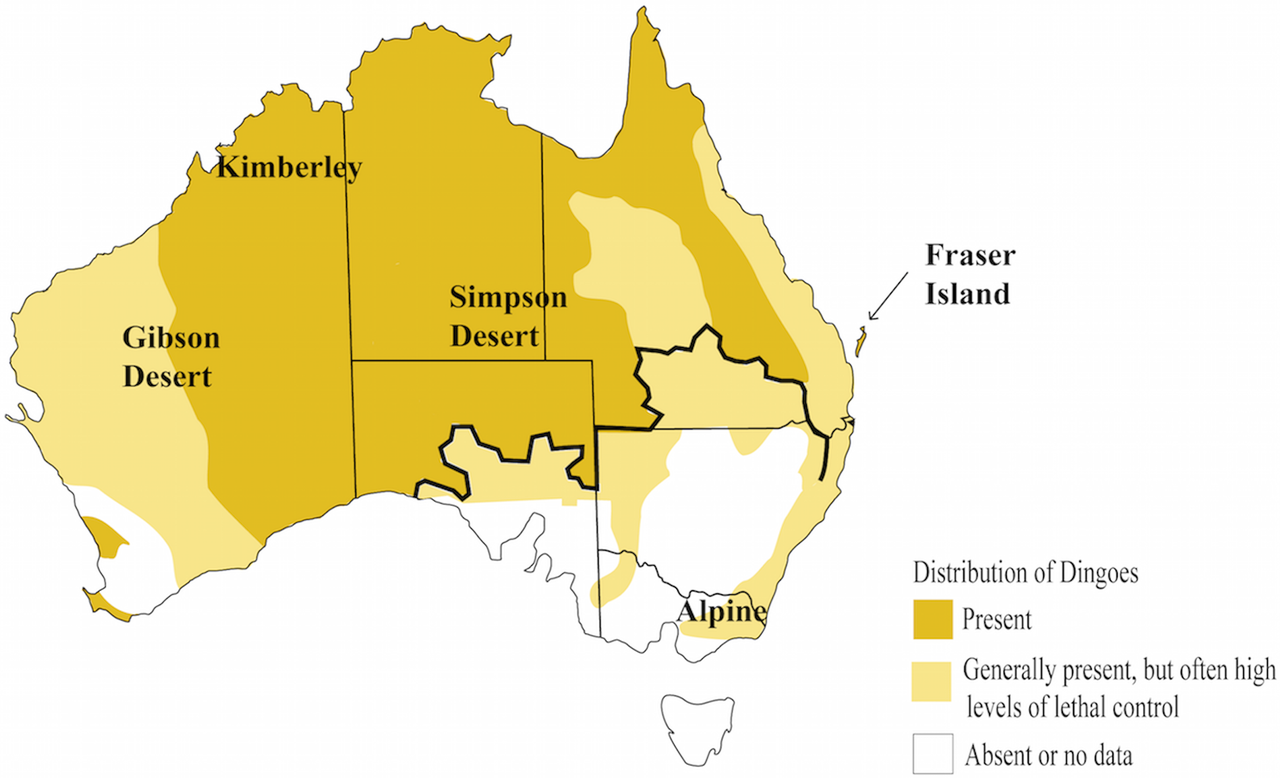


Physical characteristics
Dingoes typically weigh between about 13 and 20 kilograms and stand roughly 50 to 60 cm at the shoulder, though size varies regionally. They have erect ears, a pointed muzzle and a bushy tail. Coat colours include sandy, ginger, tan, black-and-tan and cream; many individuals show white markings on the chest, feet or tail tip. Skeletal and fossil evidence indicates the species has shown relatively little morphological change over several thousand years, suggesting limited deliberate selective breeding by humans in most of its history (domestication and selection).
Distribution and habitat
Dingoes are widespread across mainland Australia, absent only where intensive control has removed them. They occupy deserts, open woodlands, coastal heath and agricultural landscapes. In some parts of Southeast Asia and the Indonesian archipelago there are populations or historical records of similar canids that may be related or ancestral to the Australian dingo; the precise relationships vary by region and remain an active area of study (regional fauna surveys).
Origins and fossil record
Evidence about when and how dingoes reached Australia comes from both archaeology and genetics. The earliest securely dated dingo fossil currently reported from Western Australia is about 3,450 years old (archaeological record). Genetic studies, using modern and ancient DNA, have suggested an earlier arrival for dingo ancestors—estimates of several thousand years earlier—indicating a probable arrival following human movements through Southeast Asia (genetic research). Who first transported dingoes to Australia and the routes they took are not definitively known.
Behaviour, diet and ecology
Dingoes are opportunistic predators and scavengers. Their diet includes small to medium-sized mammals, birds, reptiles and in some areas larger macropods or introduced livestock when hunting in groups. Social organisation ranges from solitary individuals to family packs that defend territories and cooperate in hunting. Breeding typically occurs once a year, with litters commonly numbering several pups; pups are raised by parents and other pack members. As apex or mesopredators in many ecosystems, dingoes can influence prey populations and can suppress some introduced predators, with cascading ecological effects.
Relationship with people
Indigenous Australian peoples have long associations with dingoes, using them in various cultural contexts and as camp companions in some regions. Since European settlement, dingoes have sometimes conflicted with pastoral interests because of predation on livestock. Control measures such as exclusion fencing and lethal control have been used to protect stock, and these measures in turn affect dingo distribution and ecology. Hybridization with free-roaming domestic dogs is widespread and poses a major challenge for conservation and for defining the "wild" dingo in legal and management contexts.
Taxonomy and notable distinctions
The dingo's taxonomic placement has changed over time. It has been treated as a variety of the domestic dog (Canis familiaris) and more recently as a subspecies of the gray wolf (Canis lupus dingo) to reflect its close relationship to other wolf-like canids of Asia. Different authorities use different classifications, and scientific debate continues about how best to represent the dingo's evolutionary history and relationship to domestic dogs and wolves.
Conservation and management
Dingoes are the focus of competing objectives: conserving a native predator valued for its ecological role and cultural importance, while also protecting agricultural interests and public safety. Concerns that attract management attention include lethal control, exclusion fencing, habitat change, and especially genetic mixing with domestic dogs. Conservation approaches vary across jurisdictions and often seek to reduce hybridisation, maintain ecological function and limit livestock losses through non-lethal and targeted strategies.
Further reading and resources
- General information on canids and comparative biology
- Regional surveys and faunal records for Southeast Asia and Australia
- Studies on Tasmania and post-glacial sea changes
- Archaeological and fossil studies relevant to dingoes
- Genetic research and analyses of dingo origins
- Research on domestication, selection and hybridisation
Questions and answers
Q: What is a dingo?
A: A dingo is a type of dog found in Australia and South-East Asia.
Q: Where are dingoes not found?
A: Dingoes are not found in Tasmania, as the sea levels cut the island off from mainland Australia about 10,000 years ago.
Q: When was the earliest known dingo fossil found, and where?
A: The earliest known dingo fossil was found in Western Australia, dating to 3,450 years ago.
Q: When did the dingo reach Australia, and who brought them?
A: The genes show that dingoes reached Australia 8,300 years ago, but the humans who brought them are unknown.
Q: Has artificial selection been done on dingoes over the past 3,500 years?
A: No, the morphology of dingoes has not changed over the past 3,500 years, suggesting that artificial selection has not been done over this period.
Q: What is the scientific name for dingoes and what is the recent change to it?
A: The scientific name for dingoes is Canis lupus dingo, and it recently changed from Canis familiaris dingo, to show that it is related to the white-footed wolf living in Asia.
Q: What part of Asia are dingoes related to?
A: Dingoes are related to the white-footed wolf which lives in Asia.
Related articles
Author
AlegsaOnline.com Dingo: wild canid of Australia and Southeast Asia Leandro Alegsa
URL: https://en.alegsaonline.com/art/27484
Sources
- environment.nsw.gov.au : "The Dingo"
- australianfauna.com : "Australian Dingo"
- abc.net.au : "Dingoes"
- fido.org.au : "Dingos of Fraser Island"
- independent.co.uk : "Fear of the dingo returns to Australia in wake of boy's death"