
Differential (mechanical device)
A differential is a gear assembly that distributes torque to vehicle wheels while permitting different wheel speeds; used in cars, trucks and many machines to enable smooth cornering and traction control.
A differential is a gearbox assembly that transmits engine torque from a driveshaft to two output shafts while allowing those outputs to rotate at different speeds. It is a fundamental component in most wheeled vehicles because, during a turn, the outer wheel must travel farther than the inner wheel and therefore must rotate faster. Without a differential, tires would have to slip or bind when cornering, causing handling problems and accelerated wear.
Image gallery
10 Images




Basic components and how it works
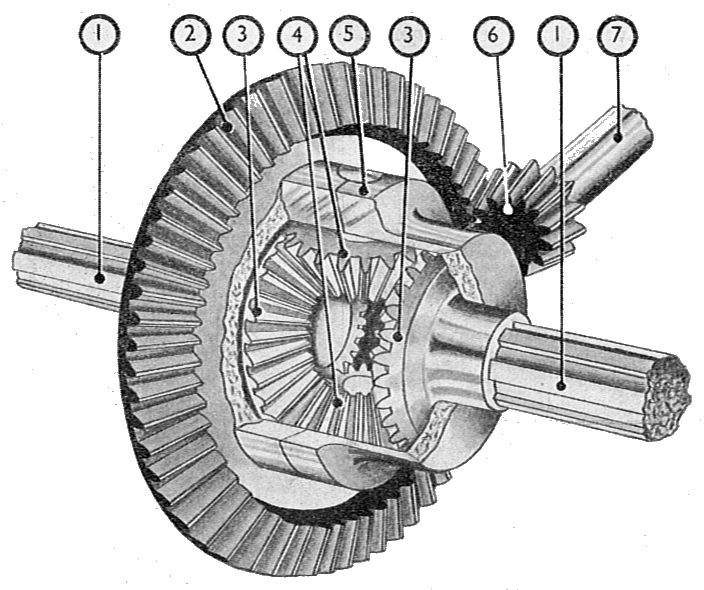
At its core the differential uses a set of meshing gears arranged inside a carrier. Typical elements include:
- Input pinion and ring gear that receive torque from the transmission or transaxle, often via the driveshaft.
- Side (sun) gears connected to the axle shafts that turn the wheels.
- Spider or planet gears that rotate on pins and transfer relative motion between the two side gears.
- The differential carrier (housing) that holds the assembly and is turned by the ring gear.
When both wheels encounter equal resistance, the carrier drives the side gears equally and both wheels turn at the same speed. In a turn, the spider gears allow one side gear to overrun the other so wheel speeds differ while torque continues to be delivered.
Types and variations
There are several differential designs for different goals:
- Open differential — the simplest and most common; allows free speed difference but can send power to the wheel with least traction.
- Limited-slip differential — uses clutches or gearing to reduce the tendency for one wheel to receive all the torque when traction is low.
- Locking differential — can mechanically lock the two outputs together for maximum traction at low speed.
- Electronic and torque-vectoring differentials — use sensors and actuators to distribute torque dynamically for performance and stability.
History and development
Concepts of differential gearing date back centuries in various forms, but the device became widely associated with road vehicles as the automobile developed in the late 19th and early 20th centuries. Since then, refinements such as hypoid gears, limited-slip mechanisms and electronic controls have improved strength, noise characteristics and traction management.
Uses, importance and maintenance
Besides road cars, differentials are used in trucks, off-road vehicles, tractors and many pieces of industrial equipment where two driven outputs must rotate at different speeds. Proper function affects safety, fuel economy and tire life. Differentials operate with gear oil and require periodic inspection for leaks, wear and correct lubrication. Specialty units for high-performance or off-road use often demand more frequent service and specific fluids.
Understanding the differential clarifies why vehicles behave as they do in turns and why different designs exist to balance traction, efficiency and handling in varied driving conditions.
Questions and answers
Q: What is a differential?
A: A differential is a mechanical device that is made up of multiple gears and is commonly found in four-wheel vehicles.
Q: What is the purpose of a differential?
A: The main function of a differential is to allow the drive wheels to turn at different rpms so that they can turn around corners while still receiving power from the engine.
Q: Where is a differential located?
A: A differential is located between the driveshaft and the drive wheels of a vehicle.
Q: What kind of power does a differential transmit?
A: A differential is used to transmit power from the driveshaft to the drive wheels.
Q: What type of vehicles use differentials?
A: Almost all mechanized four-wheel vehicles use differentials.
Q: What happens if a vehicle doesn't have a differential?
A: If a vehicle doesn't have a differential, the drive wheels would have to turn at the same speed, which would make it difficult to turn corners and could damage the vehicle.
Q: Can a differential be used in a two-wheel vehicle?
A: A differential is not commonly used in two-wheel vehicles, as they do not require the ability to allow drive wheels to turn at different speeds.
Related articles
Author
AlegsaOnline.com Differential (mechanical device) Leandro Alegsa
URL: https://en.alegsaonline.com/art/27347
Sources
- learnengineering.org : "How does a Differential work ?"
- fourwheeler.com : "Open Differential vs Spool - Differential Differences"
- drivingfast.net : "Differentials & Limited Slip Differentials (LSDs)"
- offroad-ed.com : "Traversing a Slope"