
Dice snake (Natrix tessellata)
A non-venomous, mostly aquatic colubrid found across parts of Europe and western Asia, the dice snake hunts fish and amphibians, is an adept swimmer, and shows seasonal hibernation.
Overview
The dice snake (Natrix tessellata) is a non-venomous snake in the family Colubridae, subfamily Natricinae. It is best known for its close association with freshwater and for a dorsal pattern of dark markings on a lighter background — a tessellated or “dice-like” appearance that gives the species its common name. It is widely regarded as a shy, primarily aquatic predator that plays a role in riparian and lacustrine food webs.
Image gallery
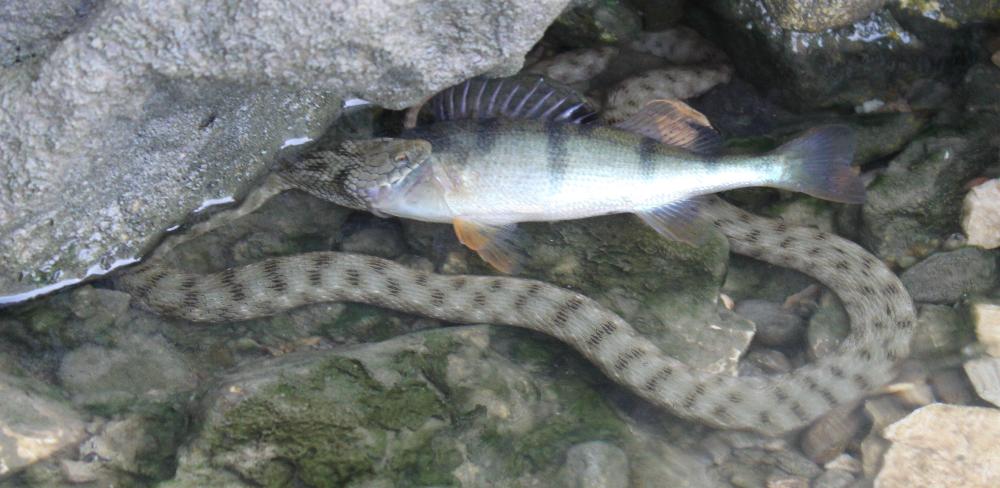
5 Images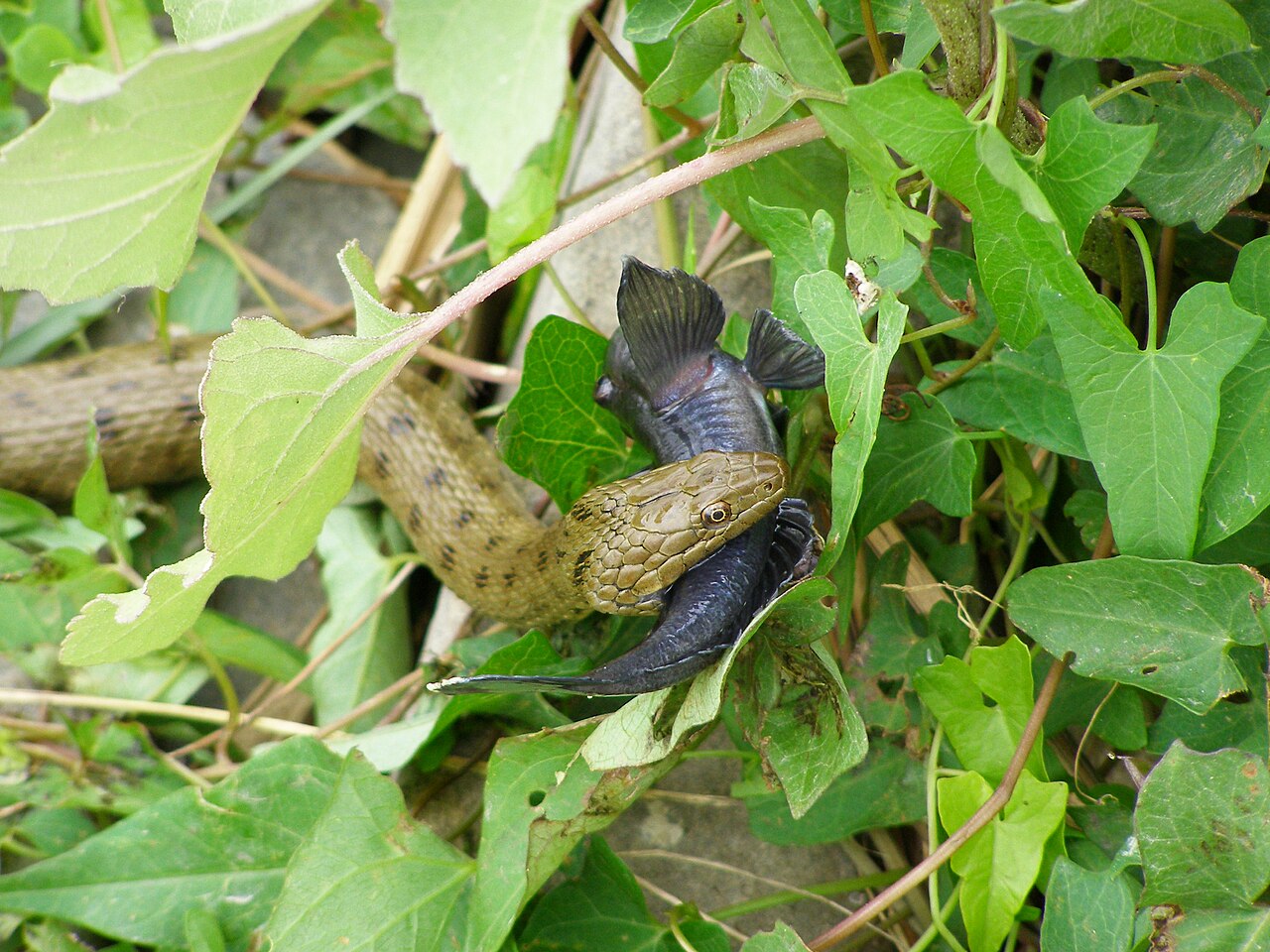


Description and identification
Dice snakes are generally slender and streamlined, adapted for swimming. Adult lengths commonly reach around 90 cm, though individuals vary. The dorsal scales are usually keeled, producing a matt texture; coloration ranges from grey to brown with dark, irregular markings. The belly often shows lighter tones with spots or blotches. When threatened they may emit a foul-smelling musk and sometimes feign death; they are non-venomous and rarely attempt serious biting.
Distribution and habitat
The species occurs across much of central and eastern Europe and into parts of western Asia. It is most frequently found adjacent to rivers, lakes, marshes and slow-flowing streams where its preferred prey are abundant. Dice snakes are strong swimmers and are often seen bathing on rocks or diving underwater to pursue fish. They may also be found near human-modified water bodies and occasionally in coastal lagoons or island localities; some authors note distinct island populations and taxonomic variants. See regional habitat summaries at freshwater habitat sources and broader range notes at distribution references. Mountain stream occurrences are recorded in upland areas as well (mountain streams).
Diet and behavior
Fish are the primary food item for dice snakes; they also take amphibians such as frogs and newts and will occasionally eat invertebrates or carrion. They hunt by active pursuit and by ambush in or near water, using keen underwater swimming ability to catch fish. Defensive behaviors include fleeing to water, cloacal musk release, and death-feigning. Their activity is seasonal: most populations brumate or hibernate during the cold months, retreating to dry burrows, rock crevices or other suitable refuges.
Reproduction and life cycle
Dice snakes are oviparous, laying clutches of eggs in summer in concealed, warm locations. Eggs hatch after several weeks, and young snakes are independent at birth. Survival through the first winter depends on finding secure hibernation sites and sufficient prey to accumulate energy reserves.
Conservation and human interactions
While not globally threatened, local populations can decline because of habitat loss, water pollution, river regulation, and persecution. Conservation actions focus on protecting freshwater habitats, maintaining connectivity along waterways, and reducing pollution. The species is uncommon or absent in some Mediterranean islands; for example, records from places such as Crete are sparse compared with continental populations. For information on diet and amphibian prey, see sources on amphibians and fish ecology.
- Key traits: non-venomous, fish-eating, aquatic, tessellated pattern.
- Typical habitat: rivers, lakes, marshes, coastal lagoons.
- Defence: musk, escape to water, death-feigning.
Further reading and regional accounts can be consulted through general herpetological resources and conservation databases (taxonomy, habitat, distribution, mountain records, prey references, island notes).
Questions and answers
Q: What is the Dice snake?
A: The Dice snake is a non-venomous snake that belongs to the Colubridae family and Natricinae subfamily.
Q: Where does the Dice snake live?
A: The Dice snake lives a lot in eastern Europe and western Asia, though not as much as the grass snake.
Q: How many species of Dice snakes are recognized?
A: Only one species, N.t.heinrothi, is recognized, from the island of Serpilor (Osrov Zminyi) in the Black Sea.
Q: What is the diet of the Dice snake?
A: The Dice snake mostly eats fish, and sometimes they may also eat amphibians.
Q: How does the Dice snake defend itself?
A: The Dice snake can let out a very bad smell and play dead for defense.
Q: Where do Dice snakes hibernate?
A: Dice snakes go into dry holes next to the water and sleep from October to April.
Q: Are Dice snakes venomous?
A: No, Dice snakes do not have any venom.
Tags
Related articles
Author
AlegsaOnline.com Dice snake (Natrix tessellata) Leandro Alegsa
URL: https://en.alegsaonline.com/art/27163
Sources
- iucnredlist.org : "Natrix tessellata "
- reptilechannel.com : "The Dice Snake"
- crete-guide.info : "Snakes on Crete - European Ratsnake, Dice Snake, Green Whip Snake, European Cat Snake"
- seh-herpetology.org : First records of the Dice Snake (Natrix tessellata) from the North-Eastern part of the Czech Republic and Poland.