
Dhole (Cuon alpinus) — the Asiatic wild dog
The dhole is a social, diurnal canid native to parts of Asia. This article covers its identity, behaviour, historic range, ecological role, and the threats that have made it an endangered species.
Overview
The dhole (Cuon alpinus) is a wild canid native to parts of Asia. Classified with other members of the dog family, it is often called the Asiatic wild dog, Indian wild dog, red dog or whistling dog because of its high-pitched calls. Taxonomically the dhole belongs to the canid group (Canidae) and is closely related to species in the genus Canis (Canis includes wolves and some domestic dog lineages), though it is placed in its own genus, Cuon.
Image gallery
10 Images




Description and social behaviour
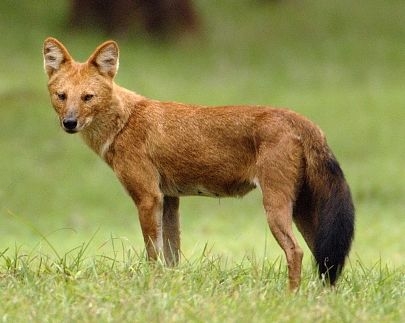
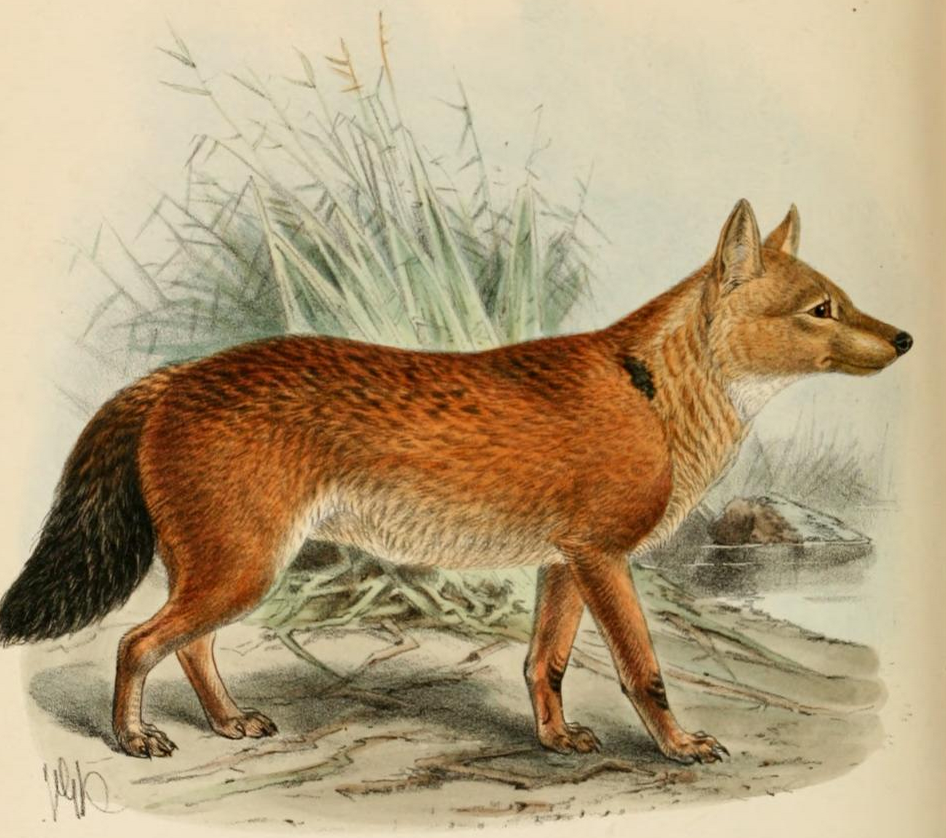
Dholes have a reddish coat, rounded ears and a bushy tail; their build is generally lean and adapted to endurance running. They are highly social and live in loose packs that differ from the tightly organised family packs of wolves: several females may breed within a single group. Typical group sizes are around a dozen individuals, but packs of several dozen have been recorded. Dholes are largely active by day and cooperate when hunting, using coordinated chases and vocal signals—hence the local name "whistling dog." Their cooperative behaviour extends to communal care of pups and shared feeding.
Distribution, habitat and fossil history
Today the dhole occurs in parts of Central Asia, South Asia and Southeast Asia, occupying a range of forested and mountainous habitats where sufficient prey and cover remain. Fossil evidence shows that during the Pleistocene epoch the species and its close relatives ranged more widely, with remains reported from Asia, Europe and North America. By the end of the last ice ages, roughly 12,000–18,000 years ago, their range contracted to the Asian continent where the modern populations persist.
Diet, ecology and interactions with other predators
Dholes are primarily carnivorous hunters that specialise in medium-sized ungulates, although they will take smaller mammals or scavenge when opportunities arise. In parts of their range they share landscapes with larger felids; dholes compete with and are sometimes displaced by apex predators such as tigers and leopards, leading to partitioning of prey species and hunting times. Their group hunting strategy allows them to bring down prey that individual predators might not manage.
Threats and conservation
The dhole is classified as Endangered and populations have declined over recent decades; current estimates suggest there are probably fewer than 2,500 mature individuals remaining in the wild. Multiple, interacting threats have driven the decline:
- Loss and fragmentation of suitable habitat, reducing both cover and access to prey.
- Reduction in prey populations through hunting and habitat change, making it harder for packs to sustain themselves.
- Direct persecution and accidental killing by people viewing them as threats to livestock.
- Transmission of disease from domestic dogs and other animals, which can cause local crashes.
Conservation efforts include protection of forest and grassland habitats, measures to maintain or restore wild prey, vaccination and disease control for domestic animals near dhole populations, and protected-area management that recognises the dhole's need for large territories and connected landscapes. Captive breeding and reintroduction programs have been limited but are part of some regional strategies. Continued monitoring, research into pack dynamics and human-wildlife conflict mitigation are widely recommended.
Notable facts and distinctions
The dhole stands out among canids for its social flexibility—multiple breeding females within a single group—and its distinctive vocalisations. Although it shares ancestry and some behaviours with members of the genus Canis, its unique ecological role as a pack hunter in Asian forests makes it an important species for ecosystem function. Conservation of the dhole also benefits broader biodiversity by focusing attention on large, connected natural landscapes and the prey species they support.
For further reading on taxonomy, regional status and conservation actions see resources on canids (family Canidae), regional mammal guides for Central Asia, South Asia and Southeast Asia, and literature covering the Pleistocene distribution of large carnivores in Asia, Europe and North America. Species interactions with tigers and leopards and habitat concerns (habitat) are central themes in conservation planning.
Questions and answers
Q: What is a dhole?
A: A dhole is a canid species from Asia, related to dogs and foxes.
Q: What are some common names for the dhole?
A: Some common names for the dhole include Asiatic wild dog, Indian wild dog, whistling dog, red dog, and mountain wolf.
Q: Where is the dhole native to?
A: The dhole is native to Central, South, and Southeast Asia.
Q: What is the dhole's hunting behavior?
A: The dhole hunts in groups during the day and usually eats medium-sized to big hoofed animals.
Q: What is the dhole's relationship with tigers and leopards in tropical forests?
A: The dhole competes with tigers and leopards in tropical forests, targeting somewhat different prey species, but still with substantial dietary overlap.
Q: Why is the dhole listed as Endangered by the IUCN?
A: The dhole is listed as Endangered by the IUCN due to lack of habitat, lack of food, competition with other animals, being hunted, and getting diseases from pet dogs.
Q: How many dhole adults are estimated to be left in the population?
A: There are probably fewer than 2,500 dhole adults left in the population.
Related articles
Author
AlegsaOnline.com Dhole (Cuon alpinus) — the Asiatic wild dog Leandro Alegsa
URL: https://en.alegsaonline.com/art/27057
Sources
- iucnredlist.org : "Cuon alpinus"
- science.smith.edu : Cuon alpinus
- ui.adsabs.harvard.edu : 2005Natur.438..803L
- pubmed.ncbi.nlm.nih.gov : 16341006
- biostor.org : "A review of the family Canidae, with a classification by numerical methods"
- doi.org : 10.1007/s11033-010-0276-y
- pubmed.ncbi.nlm.nih.gov : 20859694
- carnivoreconservation.org : Dhole Cuon alpinus (Pallas 1811)
- wild-russia.org : "Then and Now: Updates from Russia's Imperiled Zapovedniks". Tunkinsky National Park.
- doi.org : 10.1007/s10344-015-0947-z
- canids.org : "First camera trap record of pack hunting dholes in Chitwan National Park, Nepal"
- bhutanstudies.org.bt : "Predator-prey dynamics: the role of predators in the control of problem species"
- doi.org : 10.1017/S0030605316001113
- fauna-flora.org : "Sumatran secrets start to be revealed by high altitude camera trapping"
- science-education.ru : science-education.ru/123-19037