
All Night (1918) — silent comedy-drama starring Carmel Myers and Rudolph Valentino
Overview, plot, production, preservation and historical context of the 1918 American silent comedy-drama All Night, an early film appearance for Carmel Myers and Rudolph Valentino released by Universal's Bluebird Photoplays.
Overview
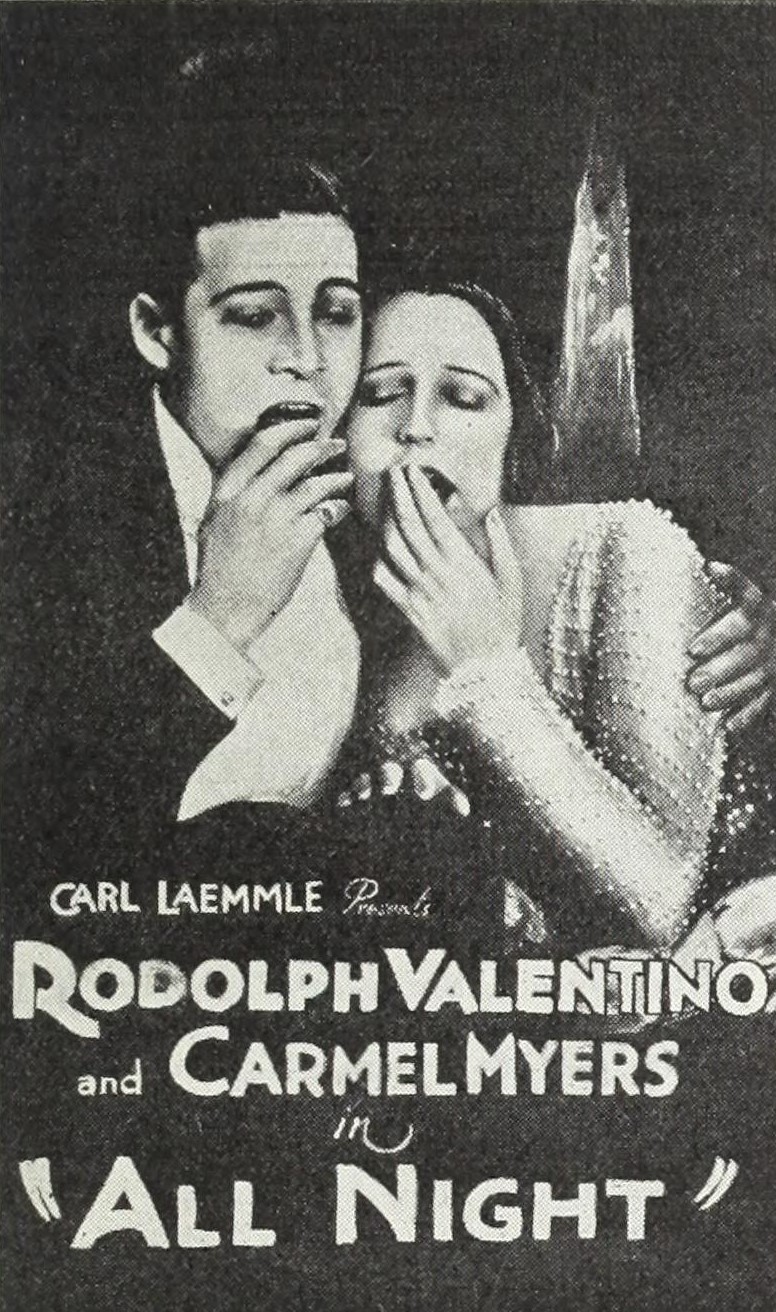
All Night is a 1918 American silent comedy-drama directed by Paul Powell and released by Universal Pictures under its Bluebird Photoplays brand. The film is chiefly remembered today as an early screen appearance by Carmel Myers and Rudolph Valentino before either reached the peak of their fame. As a product of the late 1910s, the picture reflects popular silent-era fashions for romantic misunderstanding and social comedy while also illustrating studio marketing through named production lines such as Bluebird.
Image gallery
6 Images



Plot
The story centers on Richard Thayer, a young man in love with Beth Lane. Though he wishes to propose marriage, Richard finds Beth constantly attended by other suitors and closely watched by her father, which prevents a private moment. To secure an opportunity for the couple, Richard’s friends William and Maude Harcourt arrange a dinner party and invite both Richard and Beth so the pair can be alone. The plan is complicated when William’s business partner arrives unexpectedly, generating a series of awkward encounters, comic misunderstandings and social entanglements that drive the film’s dramatic and humorous beats. The plot follows conventions common in romantic comedies of the era, using a constrained setting and a single night’s events to test relationships and social pretenses.
Production and cast
Paul Powell, the director, was active in the silent era and worked on a variety of features during the 1910s and 1920s. Cast members include Carmel Myers and Rudolph Valentino in supporting roles prior to their stardom; Myers later became a leading actress in both silent and early sound films, while Valentino rose to major fame in the early 1920s as an internationally recognized screen star. The film was produced and distributed by Universal Pictures but released under the Bluebird Photoplays imprint, a trade name used by Universal for a line of mid-priced, commercially oriented features intended to signal quality to audiences and exhibitors.
Preservation and legacy
Unlike many silent films that have been lost, All Night is among the survivals. Prints or elements still exist, and the film was made available on home video in the 21st century when Grapevine Video issued a DVD release in 2005. The survival and reissue of All Night allow scholars and enthusiasts to study the early screen work of performers who later achieved greater renown and to observe the filmmaking style and social conventions of its time.
Significance and context
All Night is not widely cited as a landmark of cinematic technique, but it has historical value as an example of studio-era production practices and casting pathways. It illustrates how performers could move from modest roles to stardom and how studios used sub-brands such as Bluebird to organize and promote their output. The film also exemplifies silent-era approaches to light comedy-drama, where confined situations, social oversight, and the contrast between private desire and public decorum produce both tension and humor.
Further reading and resources
- General information on the film and studio context: All Night (1918) entry.
- Background on Bluebird Photoplays and Universal marketing: Bluebird Photoplays overview.
- Biographical summaries of Carmel Myers and Rudolph Valentino: Cast biographies.
- Home-video and archival notes, including the 2005 DVD release: Preservation and DVD release.
Questions and answers
Q: What is All Night?
A: All Night is a 1918 American silent comedy-drama movie.
Q: Who stars in All Night?
A: Carmel Myers and Rudolph Valentino star in All Night.
Q: Who directed All Night?
A: Paul Powell directed All Night.
Q: Who released All Night?
A: Universal Pictures released All Night, but they used the name Bluebird Photoplays.
Q: Does All Night still exist today?
A: Yes, the film still exists even after 97 years.
Q: Who put All Night on DVD in 2005?
A: Grapevine Videos put All Night on DVD in 2005.
Q: What is the storyline of All Night?
A: All Night is about a young man named Richard Thayer who is in love with a young woman named Beth Lane. He wants to ask her to marry him, but he can't because she is always surrounded by other men who like her and by her father. Richard's friends, William and Maude Harcourt, decide to have a dinner party and invite Richard and Beth so that they can be together. However, the night they plan it, William's business partner shows up for a surprise visit, causing problems for Richard, Beth, and the Harcourts.
Related articles
Author
AlegsaOnline.com All Night (1918) — silent comedy-drama starring Carmel Myers and Rudolph Valentino Leandro Alegsa
URL: https://en.alegsaonline.com/art/2704
Sources
- silentera.com : "2005 Grapevine Video DVD edition"
- silentera.com : Progressive Silent Film: All Night