
Desert locust (Schistocerca gregaria): biology, outbreaks and impacts
Overview of the desert locust, its biology, outbreak behaviour, historical impact on agriculture across Africa, the Middle East and Asia, and approaches to monitoring and control.
Overview
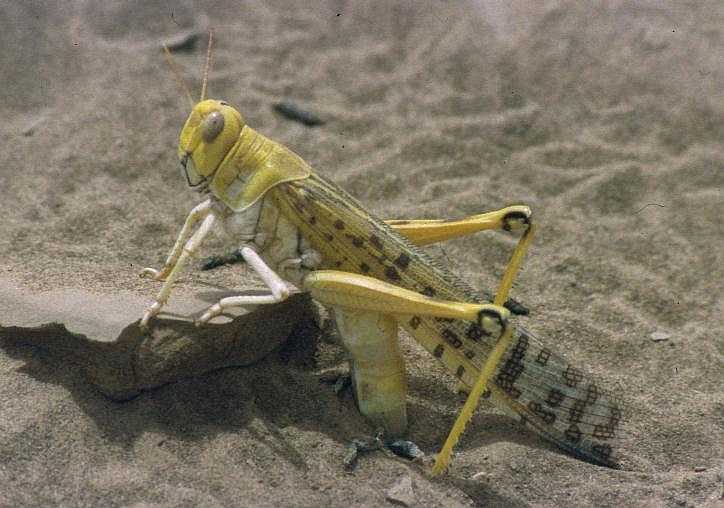
The desert locust, Schistocerca gregaria, is a migratory grasshopper species that can switch into a gregarious, swarm-forming phase and become one of the most destructive agricultural pests in arid and semi‑arid regions. Populations occur across parts of Africa, the Middle East and Asia, and when conditions favour breeding and aggregation they may form dense swarms capable of rapid long‑distance movement. Many millions of people live in areas that could be affected directly or indirectly by such outbreaks.
Image gallery
10 Images


Characteristics and behaviour
Desert locusts exhibit phase polyphenism: individuals adopt either a solitary or a gregarious form depending on population density and environmental cues. In the gregarious phase they change in colour, physiology and behaviour, becoming more mobile and tolerant of crowding. Winged adults are strong fliers and can be carried long distances by winds, enabling a swarm to cross national borders and even seas. A single swarm can consume very large amounts of vegetation in a short time, stripping crops, pastures and native plants.
Life cycle and reproduction
Breeding is tied to rainfall and the availability of moist sandy or loamy soil for egg‑laying. Females deposit egg pods in the ground; nymphs (also called hoppers) emerge and, when crowded, move in cohesive bands until wings develop and adults take flight. Under favourable conditions there are typically two to five generations per year, and rapid population growth can follow sequences of rain and vegetation growth. These biological traits make early detection and rapid response important for outbreak prevention.
History, notable outbreaks and impacts
Plagues of desert locusts have been recorded for centuries and periodically cause severe agricultural damage. Large upsurges in recent decades have led to significant crop losses and local food shortages; for example, a major upsurge in 2004–05 affected parts of West Africa. More recently, extensive breeding and invasions have challenged governments and humanitarian agencies in the Horn of Africa and neighbouring regions. While locusts alone do not usually cause widespread famines, they are an important contributing factor to food insecurity when combined with drought, conflict and market disruptions.
Management and control
Responses to locust outbreaks combine surveillance, early warning and rapid control operations. Typical measures include:
- Monitoring by ground teams, remote sensing and community reporting to detect breeding sites early.
- Targeted control using ground or aerial application of approved insecticides to destroy hoppers and adults before they form large swarms.
- Increasing use of biological agents and reduced‑impact pesticides in sensitive environments.
- Regional coordination and information sharing to track movements and plan joint operations.
Notable facts and distinctions
The desert locust differs from many other grasshoppers because of its pronounced ability to change behaviour and form vast, highly mobile swarms. This capacity makes it potentially the most dangerous of the locust pests for agriculture in its range. International bodies and national agencies maintain monitoring systems and contingency plans to reduce the risk of large outbreaks and to limit the socio‑economic harm when they do occur. For general background on locust biology and management see resources on locust species and regional reports available through agricultural authorities and international agencies.
Questions and answers
Q: What is the desert locust?
A: The desert locust is a species of locust.
Q: What is the threat of desert locusts?
A: Plagues of desert locusts threaten agricultural production in Africa, the Middle East, and Asia, and the livelihood of one-tenth of the world’s human population may be affected by this voracious insect.
Q: When do destructive swarms of locusts form?
A: The destructive swarms of locusts do not form every year, but only when conditions are right for them.
Q: Why is the desert locust potentially the most dangerous of the locust pests?
A: The desert locust is potentially the most dangerous of the locust pests because of the ability of swarms to fly rapidly across great distances.
Q: How many generations does the desert locust have per year?
A: The desert locust has two to five generations per year.
Q: What was the impact of the last major desert locust upsurge in 2004-05?
A: The last major desert locust upsurge in 2004-05 caused crop loss in West Africa and reduced food supply in the area.
Q: Is the desert locust solely responsible for famines?
A: No, the desert locust alone is not responsible for famines, but it is a contributing factor.
Related articles
Author
AlegsaOnline.com Desert locust (Schistocerca gregaria): biology, outbreaks and impacts Leandro Alegsa
URL: https://en.alegsaonline.com/art/26830
Sources
- nzdl.org : nzdl.org/gsdlmod?e=d-00000-00---off-0hdl--00-0----0-10-0---0---0direct-10---4-------0-1l-…
- ipmworld.umn.edu : "The Desert Locust in Africa and Western Asia: complexities of war, politics, perilous terrain, and development"