
Derivative (mathematics): definition, notation, rules, and applications
A derivative measures a function's instantaneous rate of change. Covers definitions, notation (dy/dx, f′), basic rules, history, examples, and why differentiability matters in science and optimization.
Overview
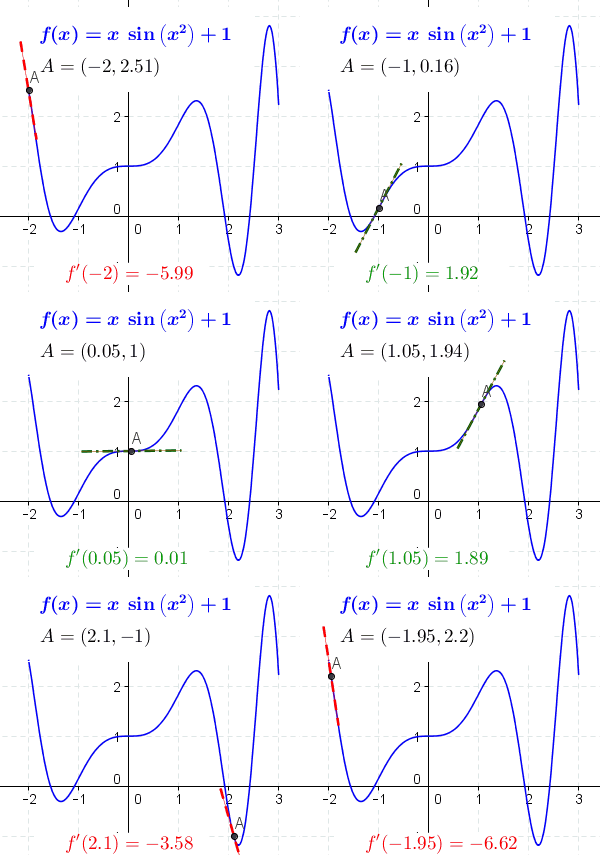
The derivative is a fundamental concept in mathematics, especially in differential calculus. Informally, it describes how a quantity represented by a function changes with respect to its input. For real-valued functions of a real variable, the derivative at a point can be visualized as the slope of the instantaneous tangent to the graph: a linear approximation to the function near that point. Common notations include dy/dx, f'(x), and Df(x).
Image gallery
2 Images
Definition and notation
Formally, the derivative of a function f at x is the limit of the difference quotient when it exists: (f(x+h)-f(x))/h as h approaches zero. This limit, if it exists, is denoted f'(x) or df/dx. The Leibniz notation dy/dx emphasizes the dependent and independent variables and is convenient for expressing the chain rule and differential equations. The prime notation f'(x) is compact and often used for higher derivatives like f''(x) or f^{(n)}(x).
Basic properties and rules
Derivatives obey a set of algebraic rules that simplify computation. Important rules include:
- Linearity: (af + bg)' = a f' + b g' for constants a, b.
- Product rule: (fg)' = f'g + fg'.
- Quotient rule: (f/g)' = (f'g - fg')/g^2, where g ≠ 0.
- Chain rule: (f ∘ g)'(x) = f'(g(x)) · g'(x), which links nested functions.
These rules extend to polynomials, rational functions, exponentials, logarithms and many standard elementary functions.
Continuity, differentiability, and higher derivatives
If a function is differentiable at a point, it must be continuous there; however continuity alone does not guarantee differentiability. Points where the derivative fails to exist include corners, vertical tangents, and oscillatory behavior. Repeated differentiation yields higher derivatives, with second derivatives measuring curvature and acceleration in physical contexts. The existence and behavior of higher derivatives are central in Taylor series and approximation theory.
History and development
The modern idea of the derivative emerged in the 17th century through independent work on infinitesimal change by several mathematicians. Two historically prominent approaches are credited to Isaac Newton and Gottfried Wilhelm Leibniz: Newton developed fluxions and fluents emphasizing rates in motion, while Leibniz introduced the differential notation still used today. Subsequent work formalized limits and rigorous definitions in the 19th century.
Examples, applications, and notable facts
In physics, the derivative of position with respect to time gives velocity; the derivative of velocity gives acceleration. In optimization, setting f'(x)=0 locates critical points that may be minima, maxima, or saddle points. Derivatives are also central in differential equations, modeling rates of growth, decay, heat flow, and wave propagation. Computationally, symbolic rules allow exact derivatives for many expressions, while numerical differentiation approximates derivatives when closed forms are unavailable. For further reading on foundational concepts, see links on slope, tangent lines, and related topics in calculus.
Questions and answers
Q: What is the derivative?
A: The derivative is a way to show instantaneous rate of change, or the amount by which a function is changing at one given point.
Q: How is it typically written?
A: It is typically written as "dy over dx" or "dy upon dx", meaning the difference in y divided by the difference in x. Another common notation is f'(x), which means the derivative of function f at point x.
Q: Is d a variable?
A: No, d is not a variable and cannot be cancelled out.
Q: What does 'f' represent in this context?
A: In this context, 'f' represents a function.
Q: What does 'x' represent in this context?
A: In this context, 'x' represents a point on a graph.
Q: What does 'y' represent in this context?
A: In this context, 'y' represents the slope of the tangent line at that point on the graph.
Q: How can you read "f’(x)"? A: You can read "f’(x)" as "f prime of x".
Related articles
Author
AlegsaOnline.com Derivative (mathematics): definition, notation, rules, and applications Leandro Alegsa
URL: https://en.alegsaonline.com/art/26780