
Der Fuehrer's Face (1943) — Disney wartime short
A 1943 Walt Disney animated short featuring Donald Duck in a satirical nightmare of life under Nazism; a piece of World War II propaganda notable for its popular song and Academy Award recognition.
Overview
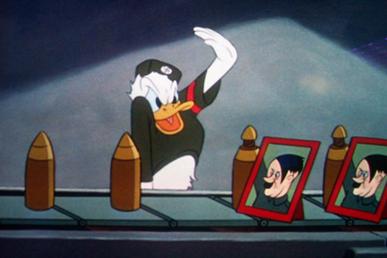
Der Fuehrer's Face is a 1943 Walt Disney wartime short that uses satire and slapstick to lampoon the Axis powers. Released during World War II, the film presents a darkly comic fantasy in which Donald Duck dreams he is living and working under an oppressive Nazi regime. It was produced as part of the American studio system's broader contribution to the war effort and is commonly discussed as an example of cinematic propaganda from that period. For context on the wartime genre, see World War II propaganda and the form of the animated short as a medium, animated cartoon.
Image gallery
4 Images

Production and style
The short was produced by Walt Disney Productions and released to theaters as part of the studio's contemporary output. It combines exaggerated animation, musical parody and surreal imagery to convey its message. The protagonist, Donald Duck, is voiced by the character's long-time performer and is placed in situations designed to ridicule authoritarian ritual, mass conformity and militaristic pageantry. The piece mixes visual gags with a rousing march that functions as a recurring motif throughout the film.
Plot and caricatures
The narrative is framed as a nightmare: Donald awakens in a totalitarian state where factory labor and endless salutes replace ordinary life. The cartoon populates its world with unmistakable caricatures of Axis leaders of the era. Notable on-screen depictions include musical-cum-caricature figures such as Benito Mussolini and others shown as part of a satirical parade. The film explicitly references several historical personalities in its gags, for example:
- Benito Mussolini portrayed in a marching-bass-drum caricature
- Hermann Göring caricatured on a high, squeaking instrument
- Hideki Tojo represented in a brass role
- Heinrich Himmler depicted in a military-drum gag
- Joseph Goebbels shown as part of the propagandistic musical ensemble
Reception and legacy
At the time of its release the short was both popular and controversial. Audiences in the United States generally received it as patriotic satire aimed at enemy regimes, while it was predictably banned in Axis territories. Historically the film is cited in discussions of how American entertainment industries supported wartime messaging. It also helped popularize the march motif and its title song among wartime listeners, and it remains a frequently referenced cultural artifact when examining animation's political uses.
Notable facts and modern view
The short is often shown today with historical framing: scholars and curators emphasize its period context and propagandistic intent. Modern presentations tend to explain that such work reflects the urgent public sentiments and government-supported messaging of the 1940s. While the cartoon retains importance as an example of animation craft and social history, contemporary viewers are encouraged to approach it with an understanding of the wartime environment that produced it.
Der Fuehrer's Face remains a studied piece of film history for its combination of humor, political caricature and the role it played in shaping home-front morale during World War II.
Questions and answers
Q: What is "Der Fuehrer's Face"?
A: "Der Fuehrer's Face" is a World War II animated cartoon featuring Donald Duck.
Q: When was "Der Fuehrer's Face" released?
A: "Der Fuehrer's Face" was released in 1943.
Q: What is the plot of "Der Fuehrer's Face"?
A: In the cartoon, Donald Duck has a nightmare that he is living in Germany and being forced to slave under the Nazi regime.
Q: Who are the "Nutzis" in "Der Fuehrer's Face"?
A: The "Nutzis" are caricatures of Benito Mussolini, Herman Göring, Hideki Tojo, Heinrich Himmler, and Joseph Goebbels.
Q: What musical instruments do the "Nutzis" play in "Der Fuehrer's Face"?
A: The "Nutzis" play a bass drum, a piccolo, a tuba, a snare drum, and a trombone in "Der Fuehrer's Face".
Q: What is the significance of "Der Fuehrer's Face"?
A: "Der Fuehrer's Face" is significant because it was a popular cartoon during World War II and helped to boost morale among the Allied forces.
Q: Why is "Der Fuehrer's Face" also known as "Donald Duck in Nutzi Land"?
A: "Der Fuehrer's Face" is also known as "Donald Duck in Nutzi Land" because the cartoon portrays Donald Duck in a nightmare world where he is forced to slave under the Nazi regime, represented by the "Nutzis".
Related articles
Author
AlegsaOnline.com Der Fuehrer's Face (1943) — Disney wartime short Leandro Alegsa
URL: https://en.alegsaonline.com/art/26731