
Department of Alto Adige — Napoleonic administrative division in northern Italy
A short encyclopedic overview of the Department of Alto Adige: its origins in the Napoleonic Kingdom of Italy, territory and administration, later evolution and relationship to modern Trentino-Alto Adige/Südtirol.
Overview
The Department of Alto Adige was an administrative division established during Napoleon's reorganization of northern Italy in the early 19th century. Its name referred to the Adige river (Etsch), which runs through the area and gave the department a geographic identity. The city of Trento served as its administrative centre.
Image gallery
3 Images

Territory and administration
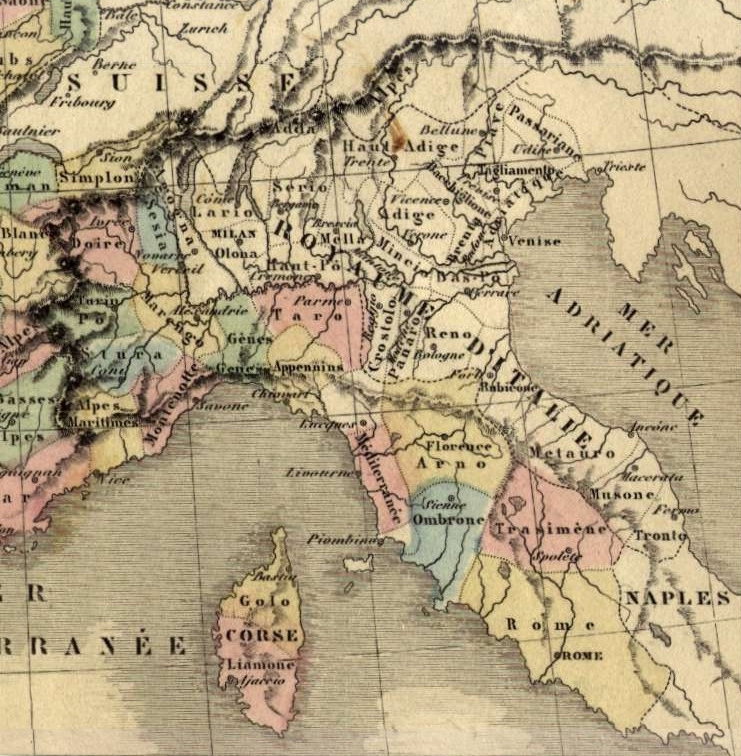
Boundaries of the department were defined by French imperial administrative practice rather than by older local jurisdictions. They did not correspond exactly to contemporary provincial borders: although the department included important towns such as Bolzano and Trento, substantial parts of its territory today belong to what is now the province of Trento. Administration followed the Napoleonic model of departments governed from a capital with prefectural and subprefectural offices, and civil law and institutions were introduced or reinforced during this period.
History and development
The department emerged as part of the wider creation of the Napoleonic Kingdom of Italy, when French revolutionary and imperial reforms reconfigured traditional states into departments organized along rational lines. The reform process emphasized centralized administration, standard legal codes and the integration of transport and fiscal systems. The Napoleonic period was relatively short, and subsequent political settlements after Napoleon's fall altered territorial arrangements across the region.
Legacy and modern context
Today the area once covered by the department lies mainly within the autonomous region commonly referred to as Trentino-Alto Adige/Südtirol. The historical department is not identical to the modern province of Alto Adige (often called South Tyrol); parts of the former department are now in the province of Trento. The city of Bolzano was among the urban centres associated with the department, and the river Adige remained the region's defining natural feature. The department's Italian designation appears in some historical records as Dipartimento dell'Alto Adige, and administrative references commonly point back to its role in Napoleonic state-building.
Key points
- Created during Napoleonic restructuring in northern Italy, with Trento as capital (Trento).
- Named for the Adige river (Adige / Etsch) which traverses the territory.
- Territorial footprint differs from the modern provinces of Bolzano and Trento, now parts of the autonomous region Trentino-Alto Adige/Südtirol.
As a historical entity the Department of Alto Adige illustrates how Napoleonic reforms reshaped local governance and left administrative legacies that influenced later territorial arrangements in northern Italy.
Questions and answers
Q: What was the Department of Alto Adige?
A: The Department of Alto Adige was a department of Napoleon's Kingdom of Italy.
Q: Why was it named Alto Adige?
A: It was named after the river Adige (Etsch), which flowed through it.
Q: What was the capital of the department?
A: The capital of the department was Trento.
Q: Was the department's territory the same as the modern Italian province of Alto Adige?
A: No, the department's territory was not the same as that of the modern Italian province of Alto Adige.
Q: What are some areas in the province of Alto Adige that were part of the department's territory?
A: Some of the territory is the same, such as the city of Bolzano.
Q: What happened to the rest of the department's territory?
A: Most of the rest is now part of the province of Trento.
Q: What is the modern-day region that includes Trento and Alto Adige called?
A: These two provinces form the region Trentino-Alto Adige/Südtirol.
Related articles
Author
AlegsaOnline.com Department of Alto Adige — Napoleonic administrative division in northern Italy Leandro Alegsa
URL: https://en.alegsaonline.com/art/26675