
Death Star (Star Wars superweapon and space station)
Fictional moon-sized battle station in the Star Wars franchise, known for its spherical design and planet-destroying superlaser; a recurring symbol in films, books and popular culture.
Overview
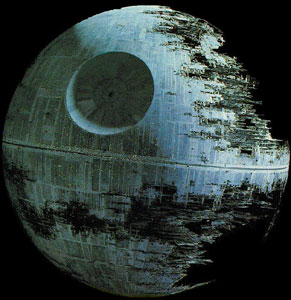
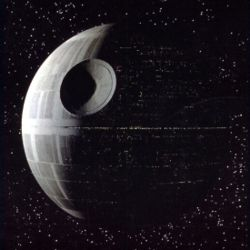
The Death Star is a fictional, moon-sized orbital battle station introduced in the Star Wars saga. First seen in the original 1970s film release, it functions in-story as both a military superweapon and a symbol of authoritarian power. Narratively, its existence drives the plot of the early films by posing an existential threat to planets and motivating resistance efforts within the galactic setting.
Image gallery
8 Images



Design and characteristics
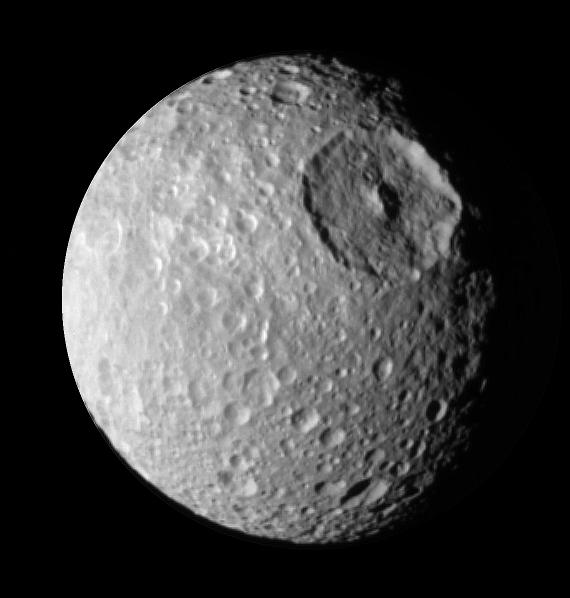
Depicted as a large, roughly spherical artificial satellite, the Death Star combines crew habitats, industrial facilities and military installations. Visual designs emphasize a prominent concave dish that channels the main weapon, extensive docking bays, layered armor and surface weapon emplacements. Interpretations of internal layout, mobility and materials vary among film visuals, licensed publications and production art; see general discussions of visual design and space station concepts.
Weapon and vulnerability
The station's most famous feature is a concentrated energy array commonly called the superlaser, portrayed as capable of destroying planetary targets in fiction. The dramatic vulnerability of the design, illustrated in the original film, is often cited in commentary about narrative tension and engineering plausibility. For technical and thematic commentary consult material on the superlaser and broader weapon ethics.
Appearances and origins
Created for the cinematic production by its original filmmakers, the Death Star has appeared across films, novels, comics and games. Behind-the-scenes histories and production notes document its development and effects work; further context is available in sources covering the original films and later franchise releases. Expanded universe works explore variants and related installations; see expanded media and archival material for extended treatments.
Role and cultural impact
Within the story world the station represents overwhelming military capacity and the political reach of the ruling power. In real-world culture the Death Star is widely referenced as a symbol of technological hubris and state coercion, and it has inspired discussion in design, ethics and popular commentary. Readers interested in comparative analysis may consult studies of franchise iconography and pieces on scale and representation.
Further reading
- Official production histories and art books document creative and technical choices.
- Fictional encyclopedias and licensed technical guides expand on variants and construction lore.
- Academic and fan analyses examine symbolism, influence and cultural reception.
Questions and answers
Q: What is the Death Star?
A: The Death Star is a fictional moon-sized space station and superweapon.
Q: Was the Death Star invented for Star Wars movies?
A: Yes, the Death Star was invented for the Star Wars movies.
Q: How was the Death Star designed?
A: The Death Star was designed as a huge spherical space station.
Q: What could the Death Star ray of energy destroy?
A: The Death Star ray of energy could destroy a planet.
Q: How big was the Death Star?
A: The Death Star was moon-sized.
Q: What did the Death Star do in Star Wars movies?
A: The Death Star was a superweapon that fired a ray of energy to destroy planets in the Star Wars movies.
Q: Is the Death Star a real space station?
A: No, the Death Star is a fictional space station and superweapon.
Related articles
Author
AlegsaOnline.com Death Star (Star Wars superweapon and space station) Leandro Alegsa
URL: https://en.alegsaonline.com/art/26046
Sources
- starwars.com : "Death Star (behind the scenes)"
- starwars.com : "Death Star II (behind the scenes)"