
de Havilland Comet: pioneering jet airliner and its legacy
The de Havilland Comet was the world’s first production commercial jet airliner. Introduced in 1952, its streamlined design transformed air travel but early structural failures led to redesigns and long-term industry changes.
The de Havilland DH.106 Comet introduced the era of jet-powered scheduled passenger flights. Developed in Britain by de Havilland at Hatfield, Hertfordshire, it was the first jet airliner to enter ordinary commercial service and demonstrated how turbine propulsion could shorten long-distance journeys and improve cabin comfort. The prototype made its maiden flight in July 1949 and the type entered airline service in the early 1950s, immediately drawing attention for its clean lines, quiet cabin and higher cruise speeds compared with contemporary piston airliners.
Image gallery
10 Images

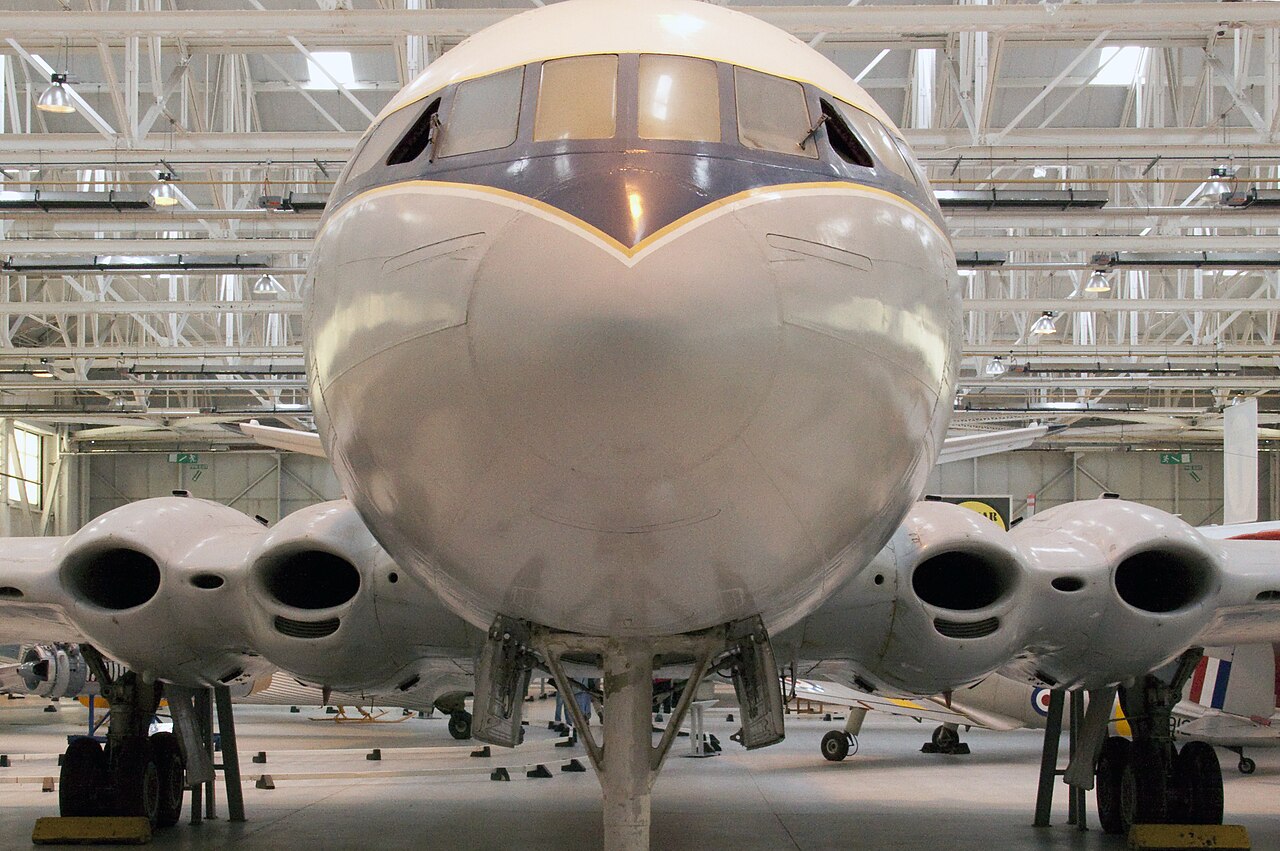


Design and technical characteristics
The Comet was a relatively compact four-engined jet featuring engines buried within the wing roots, a pressurised fuselage and a low-drag, aerodynamically refined layout. Its layout emphasised passenger comfort: a relatively roomy cabin for the period, reduced vibration and higher cruising altitudes than piston types. Early production Comets had large, square windows and a fully pressurised cabin, which were seen as modern conveniences that attracted high-profile passengers and prestigious routes.
- Manufacturer: de Havilland at Hatfield — the company’s design and production centre.
- Engines: de Havilland Ghost turbojets installed within the wing roots for a clean wing planform.
- Pressurisation: enabled sustained high-altitude cruise for speed and comfort.
- Passenger layout: fewer seats than later jets but more personal space and a quieter cabin than piston types.
Operational history and significance
When introduced on scheduled services the Comet established new expectations for commercial air travel. Airlines used it on premier routes and it carried notable passengers, helping to promote jet travel as a faster, more comfortable alternative. Operators scheduled faster long-range itineraries than had previously been practical; one early service notably reduced a London–Tokyo itinerary from several days to roughly a day and a half with multiple stops, illustrating the step change in speed.
Accidents, investigation and redesign
Within a few years of entering service the Comet suffered several catastrophic in-flight breakups. These accidents prompted an intensive programme of testing and investigation by British authorities and independent engineers. Investigators identified metal fatigue and stress concentrations around the cabin windows and other structural details as contributing factors. The hull shape, square-cornered windows and repeated pressurisation cycles had created crack initiation points that propagated until failure.
The inquiries led to major structural modifications: fuselage reinforcements, relocation and redesign of windows into rounded shapes to reduce stress concentration, and improvements in manufacturing and inspection practice. De Havilland developed subsequent versions—often described as Mark 2, Mark 3 and the later Mark 4 series—incorporating these changes and more powerful engines, but the loss of confidence and the emergence of larger, longer-range American jets limited the Comet’s commercial recovery.
Legacy and distinctions
Although the Comet lost market share to later types such as the Boeing 707 and the Douglas DC-8, its role was formative. It proved that turbine-powered airliners could reliably and efficiently carry paying passengers on scheduled services, and the lessons learned from its failures led directly to safer structural design and fatigue testing practices that became standard industry procedure. The Comet programme also influenced future airframe features, including the now-universal use of rounded windows and rigorous fatigue-life analysis.
Survivors and remembrance
Only a small number of Comets remain today, preserved in museums where they testify both to the promise of early jet transport and to the engineering improvements that followed the accidents. The type is remembered as a technological pioneer whose early problems accelerated the development of safer, more reliable commercial jets.
Further reading and references
- Early jet airliners and context
- de Havilland company and development history
- Hatfield Aerodrome and production site
- de Havilland Ghost engine technical notes
- Cabin pressurisation principles
- Fuselage structure and materials
- Contemporary comparisons: early 737-100 dimensions
- Passenger comfort and interior design factors
- Notable passengers and promotional use
- Special executive Comet for royal clients
- Notable incidents and crash locations
- Design investigations and structural findings
Questions and answers
Q: What was the first production commercial jetliner?
A: The de Havilland DH 106 Comet was the first production commercial jetliner.
Q: Where was the jet made?
A: The jet was made by de Havilland at its Hatfield Aerodrome, Hertfordshire, United Kingdom headquarters.
Q: When did the prototype first fly?
A: The prototype first flew on 27 July 1949.
Q: What type of engines were fitted to the Avro Tudor and Vickers VC.1 Viking?
A: The Avro Tudor and Vickers VC.1 Viking were fitted with Rolls-Royce Nene turbojets.
Q: How long did it take for BOAC scheduled nine-stop London to Tokyo flights by Comet in August 1953?
A: It took 36 hours for BOAC scheduled nine-stop London to Tokyo flights by Comet in August 1953. Other aircrafts took more than 86 hours.
Q: What caused design flaws in the original Comet model that led to its redesign into models 2, 3, and 4?
A: Design flaws including dangerous stresses at the corners of the square windows were noted as causing design flaws in the original Comet model that led to its redesign into models 2, 3, and 4.
Q: Who bought de Havilland in 1960 as part of a consolidation of British aerospace industry? A: Hawker Siddeley bought de Havilland in 1960 as part of a consolidation of British aerospace industry.
Related articles
Author
AlegsaOnline.com de Havilland Comet: pioneering jet airliner and its legacy Leandro Alegsa
URL: https://en.alegsaonline.com/art/25925
Sources
- flightglobal.com : "Great Airliners 11: de Havilland Comet"