
Darwinopterus: a transitional Jurassic pterosaur
Darwinopterus is a Middle Jurassic pterosaur from China that combines primitive and advanced features. Known from dozens of specimens, it illuminates pterosaur evolution, sexual differences, and Middle Jurassic ecosystems.
Overview
Darwinopterus (literally "Darwin's wing") is a genus of pterosaur first described in 2010 from fossils recovered in northeastern China. It is notable because individual skeletons display a mixture of classic, long-tailed pterosaur traits and features more typical of later, short-tailed pterodactyloid pterosaurs. Because of that combination, Darwinopterus is widely discussed as a transitional form that helps explain how major anatomical changes accumulated during pterosaur evolution. Most specimens come from the Tiaojishan Formation and date to the Middle Jurassic (around 160 million years ago).
Image gallery
10 Images


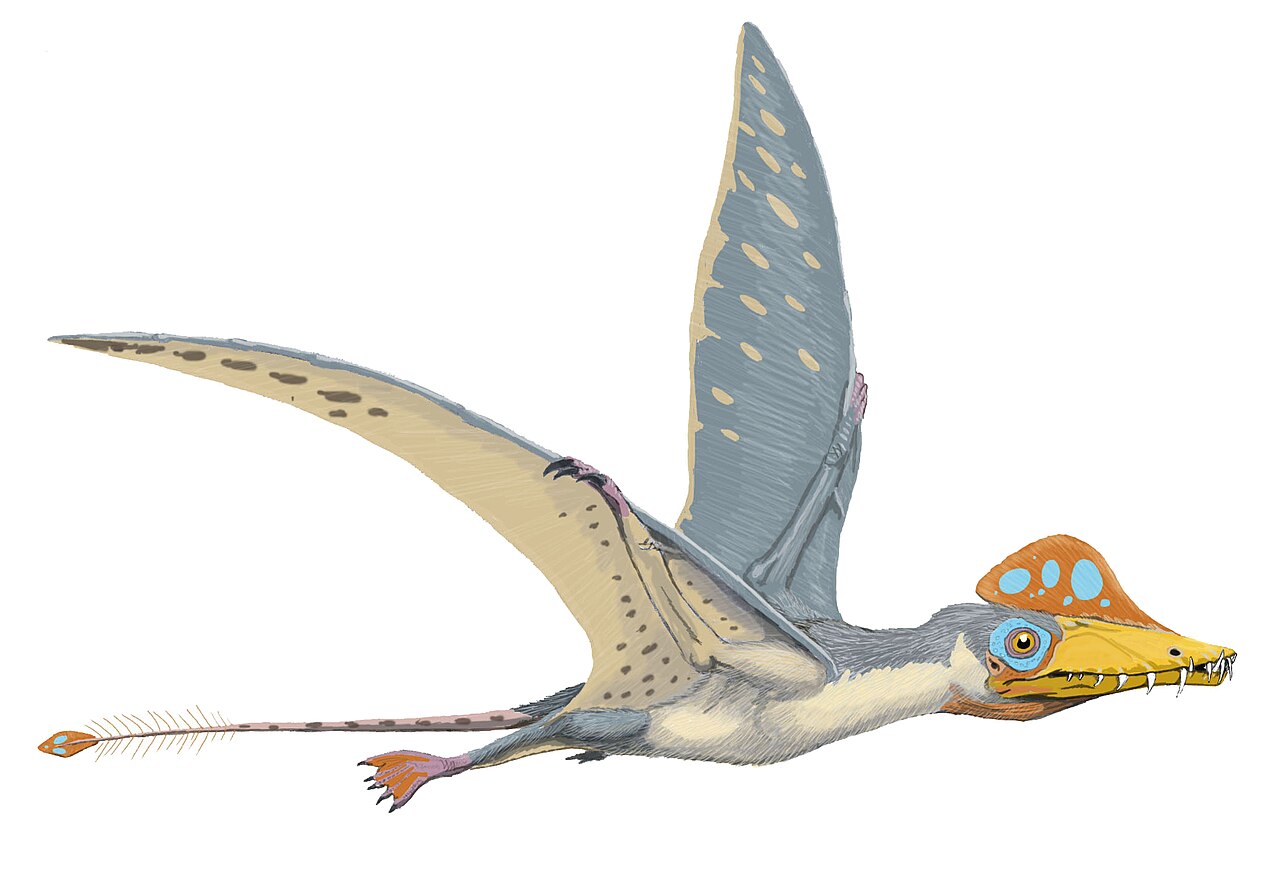

Anatomy and distinguishing features
Fossils of Darwinopterus show a mosaic of characters. The tail and some aspects of the limb proportions are similar to earlier rhamphorhynchoid pterosaurs, while the skull, neck and parts of the pelvis resemble those of later pterodactyloids. This combination led researchers to propose that pterosaurs evolved by modifying distinct anatomical "modules" rather than changing every part at once.
- Cranial traits: elongated skull with a pointed rostrum and openings that foreshadow pterodactyloid proportions.
- Axial skeleton: a relatively long tail retained from more primitive relatives.
- Pelvis and limbs: features that anticipate the shortened tails and different flight mechanics of derived pterosaurs.
Discovery, species and fossils
Between about thirty and forty specimens attributed to Darwinopterus have been recovered from the same Jurassic beds. The type species, D. modularis, was published in early 2010. Additional species described subsequently include D. linglongtaensis and D. robustodens, named from closely associated strata. The preservation of multiple individuals, some nearly complete, has allowed paleontologists to examine variation between individuals, growth stages and apparent sex differences.
For more on classification and formal descriptions see taxonomic references and comparative reviews at pterosaur databases. Information about the geological context is available through resources on the Tiaojishan Formation (formation overview).
Sexual dimorphism and life history
One of the notable findings from the Darwinopterus material is evidence interpreted as sexual dimorphism. Some specimens bear cranial crests while others do not; the crested individuals also tend to show narrower pelvic openings, whereas crestless specimens have broader hips. These differences have been read as male and female distinctions respectively, with the broader pelvis possibly related to egg-laying. Because the sample size is comparatively large for pterosaurs of this age, Darwinopterus has been influential in studies of growth, behavior and reproductive biology.
Researchers have discussed these discoveries in the context of behavior and ecology; general discussions and summaries may be consulted at popular science resources and technical overviews at academic summaries.
Importance and scientific implications
Darwinopterus has been central to debates about how major anatomical transformations occurred in pterosaur evolution. The pattern of combined primitive and derived traits supports the idea of modular evolution, where some body regions change independently of others. This has broader implications for understanding macroevolutionary processes in other groups as well.
Because the fossils preserve a range of individuals, they also provide rare data on variation and ontogeny in Jurassic pterosaurs. The specimen assemblage continues to be studied, and additional analyses can be found in museum reports and peer-reviewed articles; see links for further reading: research papers, stratigraphic studies, and morphological datasets.
Notable facts and distinctions
Key points to remember about Darwinopterus:
- It dates to the Middle Jurassic and bridges an anatomical gap between early and later pterosaurs.
- Its fossils come from a single geological unit that preserves a diverse set of organisms, offering ecological context.
- Sexual dimorphism inferred from crests and pelvic anatomy has been debated but remains a widely discussed interpretation.
Questions and answers
Q: What is Darwinopterus?
A: Darwinopterus is a genus of pterosaur discovered in China and named after Charles Darwin.
Q: What is unique about Darwinopterus?
A: Darwinopterus is the first known pterosaur to display features of both long-tailed (rhamphorhynchoid) and short-tailed (pterodactyloid) pterosaurs, making it a transitional fossil between the two groups.
Q: How many fossil specimens of Darwinopterus have been found?
A: Between 30 and 40 fossil specimens of Darwinopterus have been found.
Q: From which formation were the Darwinopterus fossils collected?
A: All the fossil specimens of Darwinopterus were collected from the Tiaojishan Formation, which dates to the Middle Jurassic, 160 million years ago (mya).
Q: When was the type species of Darwinopterus described?
A: The type species of Darwinopterus, D. modularis, was described in February 2010.
Q: Were there any additional species of Darwinopterus described?
A: Yes, two additional species of Darwinopterus were described from the same fossil beds in December 2010 and June 2011, respectively. These species are D. linglongtaensis and D. robustodens.
Q: What did the sexual dimorphism of Darwinopterus specimens show?
A: The sexual dimorphism of Darwinopterus specimens showed that the males had crests on their heads and narrower hips than the females.
Related articles
Author
AlegsaOnline.com Darwinopterus: a transitional Jurassic pterosaur Leandro Alegsa
URL: https://en.alegsaonline.com/art/25594
Sources
- news.nationalgeographic.com : "Odd new pterosaur: 'Darwin's wing' fills evolution gap."
- newscientist.com : Did pterosaurs fly out of their eggs?
- dx.doi.org : 10.1098/rspb.2009.1603
- ncbi.nlm.nih.gov : PMID 19828548
- scielo.br : "New long-tailed pterosaurs (Wukongopteridae) from western Liaoning, China"
- dx.doi.org : 10.1111/j.1755-6724.2011.00444.x
- dx.doi.org : 10.1126/science.1197323
- ncbi.nlm.nih.gov : PMID 21252343
- doi.org : 10.1038/432572a
- pubmed.ncbi.nlm.nih.gov : 15577900