
Algonquian languages: overview, structure, history, and present status
A comprehensive overview of the Algonquian language family: classification, structural features, geographic spread, history, examples, and contemporary vitality and revitalization efforts.
Overview
The Algonquian languages form a major subfamily of the wider Algic language family spoken by numerous Indigenous peoples of North America. Spoken historically from the Atlantic coast across the subarctic and northeastern woodlands to the foothills of the Rocky Mountains, the group includes roughly thirty distinct languages and many dialects. The name derives from an eastern Algonquian term often translated as "they are our relatives" or "allies." Algonquian languages have played a central role in the cultural life of many Indigenous nations, and they have contributed a number of loanwords to English and French.
Image gallery
2 Images
Classification and distribution
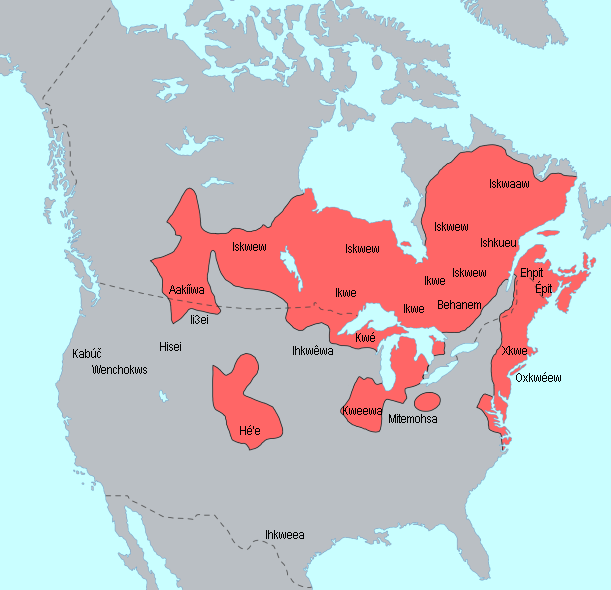
Scholars commonly divide the family into three broad geographic clusters: Eastern Algonquian, Central (or Core) Algonquian, and Plains Algonquian. Eastern Algonquian is widely accepted as a genuine genetic subgroup—its members share innovations not found elsewhere—while the Central and Plains labels are primarily geographic convenience categories that group languages with shared features due to contact as well as inheritance.
- Eastern Algonquian: maritime and coastal languages of the northeastern seaboard.
- Central Algonquian: a wide band across the Great Lakes region and adjacent areas.
- Plains Algonquian: languages spoken on the North American Great Plains and nearby regions.
Speakers historically ranged from the Atlantic provinces and New England in the east to areas near the Rocky Mountains in the west. For maps and comparative summaries see resources collected under Algic/Algonquian studies and regional language surveys at Indigenous language archives and academic repositories.
Linguistic characteristics
Algonquian languages share several typological features that distinguish them from many other language families:
- Polysynthesis: words—especially verbs—can incorporate many morphemes, producing long complex words that convey what would be a full sentence in English.
- Complex verbal morphology: verbs encode person, number, negation, aspect, tense, and sometimes incorporated nouns or oblique arguments.
- Noun classification: a grammatical distinction often translated as "animate" vs. "inanimate," which affects agreement and verb forms rather than biological animacy alone.
- Proximate–obviative system: a marking system that distinguishes the most topical (proximate) third person from less topical (obviative) third persons in clauses and narratives.
History and reconstruction
Linguists reconstruct an ancestral tongue, Proto-Algonquian, from which the known Algonquian languages descend. While precise dating is debated, many estimates place Proto-Algonquian several thousand years in the past. Over millennia, populations speaking this ancestral language diversified, migrating and adapting to different ecological zones, and developing the regional clusters recognized today. Contact among neighboring peoples produced areal similarities as well as the diffusion of vocabulary and morphosyntactic patterns.
Examples, vitality, and revitalization
Well-known members of the family include languages such as Cree and Ojibwe (Anishinaabemowin), as well as Blackfoot, Arapaho, Cheyenne, Mi'kmaq, and a number of others; many smaller languages and dialects have become extinct. Today the situation varies widely: some Algonquian languages retain substantial numbers of fluent speakers and active intergenerational transmission, while many are severely endangered or dormant. Community-driven efforts—immersion programs, school curricula, dictionaries, recordings, and digital resources—support language maintenance and revitalization across many nations.
Significance and notable facts
Algonquian languages have had a lasting impact on place names and everyday vocabulary in North America; a number of commonly used English words originate from Algonquian languages. Their distinctive grammatical systems, especially the proximate–obviative distinction and rich verb morphology, make them a central focus for comparative and typological linguistics. Current scholarship balances historical reconstruction, documentation of endangered varieties, and collaborative revitalization with Indigenous communities.
Questions and answers
Q: What is the Algonquian language?
A: The Algonquian language is a subfamily of Native American languages that includes most of the languages in the Algic language family.
Q: Where does the term "Algonquin" come from?
A: The term "Algonquin" comes from the Maliseet word elakómkwik, which means "they are our relatives/allies".
Q: How many Algonquian languages are there?
A: There are about 30 different Algonquian languages.
Q: What are the three categories of Algonquian languages?
A: The three categories of Algonquian languages are Plains Algonquian Languages, Central Algonquian Languages and Eastern Algonquian Languages.
Q: Where do speakers of these languages live?
A: Speakers of these languages stretch from the east coast of North America all the way to the Rocky Mountains.
Q: How long has this language been around for?
A: This language has been around for at least 3,000 years.
Q: What type of language is it?
A: It is a poly-synthetic language, which means that entire sentences can be made in one word.
Related articles
Author
AlegsaOnline.com Algonquian languages: overview, structure, history, and present status Leandro Alegsa
URL: https://en.alegsaonline.com/art/2550