
Dáil Éireann — the lower house of the Irish legislature
Dáil Éireann is the directly elected lower chamber of the Oireachtas (parliament) of Ireland, responsible for legislation, government formation and financial control under the Irish Constitution.
Dáil Éireann (literally "Assembly of Ireland") is the directly elected lower house of the Oireachtas, the national parliament of Ireland. 
Image gallery
3 Images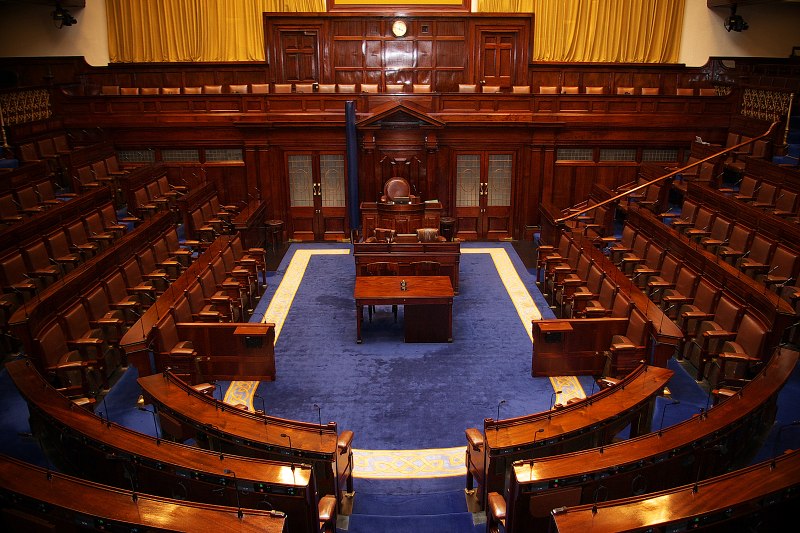


Composition and election
The chamber is made up of members known as Teachtaí Dála (TDs). TDs are chosen at general elections by eligible voters aged 18 and over. Elections use a proportional representation system (single transferable vote) in multi-member constituencies. A Dáil term may last up to five years, though the President may dissolve the Dáil earlier on the advice of the Taoiseach and after political developments.
Powers and functions
The Dáil's principal powers include passing legislation, approving the national budget, and nominating the Taoiseach (head of government). It holds the government to account through debates, question periods and formal motions of confidence or no confidence. Much of its work is also conducted in committee, where detailed scrutiny of bills and administration takes place.
Procedure and organisation
Business in the Dáil is presided over by the Ceann Comhairle (chairperson). Party groupings normally determine the organisation of business; governments are usually formed by the largest party or a coalition that can command a majority in the chamber. While most government measures originate in the Dáil, private members' proposals and constituency work by TDs are also part of its routine.
History and development
The assembly traces its modern origins to the revolutionary First Dáil of 1919, which met as a rival parliament while Ireland sought independence. Over the following decades parliamentary institutions evolved: after the 1922 Free State period and subsequent constitutional changes, the 1937 Constitution (Bunreacht na hÉireann) established the present Oireachtas structure, of which the Dáil is the lower house.
Significance and distinctions
- Name and terminology: "Dáil Éireann" is Irish-language in origin; members are often abbreviated as TDs, plural Teachtaí Dála.
- Relationship to other bodies: The Dáil works alongside the upper house, Seanad Éireann, and the President within the Oireachtas framework.
- Public engagement: Through elections, questions and debates the Dáil is the principal forum for public accountability; further information about the parliament of Ireland is available here.
For details about how members are elected see electoral procedures, and for voting eligibility consult citizenship and voting.
Questions and answers
Q: What is Dáil Éireann?
A: Dáil Éireann is the lower house of the parliament of Ireland.
Q: Who elects members of Dáil Éireann?
A: All Irish citizens who are of voting age (18) elect members of Dáil Éireann.
Q: What are members of Dáil Éireann called?
A: Members of Dáil Éireann are called Teachta Dala (TD).
Q: How old do you have to be to vote in Ireland?
A: In Ireland, you must be 18 years old or older to vote.
Q: What does "Dáil Éireann" mean in English?
A: In English, "Dáil Éireann" translates to "Assembly of Ireland".
Q: What is the purpose of the lower house in parliament?
A: The purpose of the lower house in parliament is to represent and debate on behalf of citizens.
Q: Is there an upper house in the Irish Parliament as well?
A: Yes, there is an upper house in addition to the lower house which is known as Seanad Éireann.
Related articles
Author
AlegsaOnline.com Dáil Éireann — the lower house of the Irish legislature Leandro Alegsa
URL: https://en.alegsaonline.com/art/25112
Sources
- oxforddictionaries.com : "Dáil: definition of Dáil in Oxford dictionary (British & World English). Meaning, pronunciation and origin of the word"
- historical-debates.oireachtas.ie : "Parliamentary Debates 16 August 1921"