
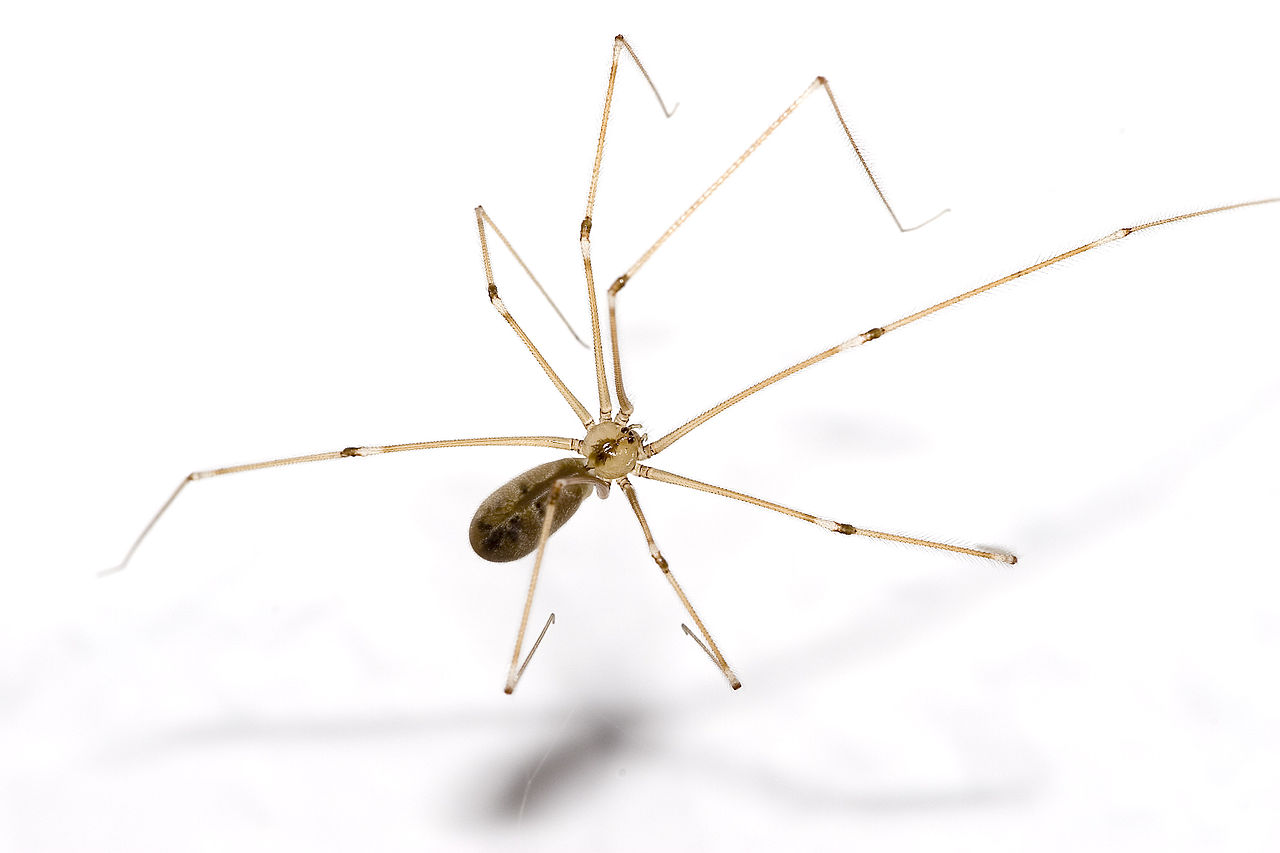
Daddy-long-legs spider (Pholcus phalangioides)
Small, long-legged spider (Pholcus phalangioides) common in houses worldwide; builds loose webs, vibrates when disturbed, feeds on insects and spiders, often called cellar spider and generally harmless to people.
Overview
The daddy-long-legs spider (Pholcus phalangioides) is a small, long-legged member of the family Pholcidae. Widely associated with human dwellings, it is known for an inconspicuous body paired with very long, thin legs and a tendency to occupy ceilings, corners, cellars and caves. The common name "daddy-long-legs" is applied to several unrelated animals; in this article it refers specifically to the pholcid spider.
Image gallery
5 Images



Physical characteristics
Adults have a compact, soft abdomen and a body length usually under 10 mm (females can reach about 9 mm; males are typically slightly smaller). Legs are proportionally long — often five to six times the body length — giving the spider a delicate, spidery appearance. Eye number and arrangement vary among pholcids but are reduced compared with many other spiders. Coloration ranges from pale grey to light brown with subtle patterning on the abdomen.
Behavior and diet
Pholcus phalangioides builds loose, irregular webs in sheltered, undisturbed places. When threatened the spider commonly vibrates its web rapidly; this defensive motion helps to blur the spider's outline and may confuse predators. Its diet is opportunistic and includes flies, mosquitoes, small insects and other spiders; it is notable for capturing and immobilizing larger spiders by chewing and entangling them in silk. Cannibalism can occur when food is scarce.
Reproduction and life cycle
Females carry an egg sac that typically contains a few dozen eggs. Instead of permanently affixing the sac to silk, the female may hold it near her jaws or keep it close to her body until the spiderlings hatch. Young spiders are translucent with shorter legs and pass through multiple molts (commonly five or six) before reaching maturity. In temperate indoor environments they may breed year-round.
Distribution, habitat and origin
Although probably of tropical origin, P. phalangioides is now cosmopolitan and commonly synanthropic — it spreads easily with human activity and establishes in houses, cellars, garages and caves around the world. It prefers stable, sheltered microhabitats where webs are undisturbed and prey is available.
Relationship with people and misconceptions
These spiders are generally harmless to humans and are often considered beneficial because they consume pest insects and other spiders. A persistent urban myth claims that "daddy-long-legs" are extremely venomous but cannot bite people; this confusion mixes different animals and is not supported by scientific evidence. Pholcid bites on humans are rare and, if they occur, typically produce little or no noticeable effect.
Similar species and distinctions
Several other long-legged pholcid species resemble P. phalangioides, including Crossopriza lyoni and Physocyclus globosus. It is important to distinguish true spiders (order Araneae) like pholcids from harvestmen (order Opiliones) and from non-arachnid insects sometimes called daddy long-legs. For an overview of the family classification see Pholcidae.
- Notable traits: very long legs, loose webs, web-vibrating defense.
- Typical habitat: ceilings, attics, basements, caves, and sheltered outdoors sites.
- Role: predator of small arthropods and other spiders; largely harmless to humans.
Questions and answers
Q: What family does the Daddy-Long-Legs Spider belong to?
A: The Daddy-Long-Legs Spider belongs to the Pholcidae family.
Q: How long are the Daddy-Long-Legs Spider's legs compared to its body?
A: The Daddy-Long-Legs Spider's legs are about 5 or 6 times the length of its body.
Q: What is the Daddy-Long-Legs Spider often confused with?
A: The Daddy-Long-Legs Spider is often confused with the daddy long-legs, which are not true spiders.
Q: What is the Daddy-Long-Legs Spider's habit when disturbed?
A: The Daddy-Long-Legs Spider's habit when disturbed is to shake the web violently, probably to blur the vision of a predator.
Q: What is the Daddy-Long-Legs Spider's diet?
A: The Daddy-Long-Legs Spider's diet consists of hairy house spiders, mosquitoes, and other insects. When food is scarce, they will prey on their own kind.
Q: From where did the Daddy-Long-Legs Spider originally come?
A: The Daddy-Long-Legs Spider originally came from the tropics.
Q: How many eggs does the female Daddy-Long-Legs Spider hold?
A: The female Daddy-Long-Legs Spider holds 20 to 30 eggs in her jaws.
Related articles
Author
AlegsaOnline.com Daddy-long-legs spider (Pholcus phalangioides) Leandro Alegsa
URL: https://en.alegsaonline.com/art/25041