
Cytoskeleton: cellular framework of structure, movement and transport
The cytoskeleton is a dynamic protein network in cells that provides shape, mechanical support, intracellular transport, motility and a scaffold for division and signaling.
The cytoskeleton is a dynamic, protein-based network that acts as the internal framework of cells. It functions as a kind of cellular scaffolding built from various proteins. Present in eukaryotic cells and in modified form in many prokaryotes, the cytoskeleton organizes the cytoplasm and links biochemical activity to mechanical properties. It helps cells keep their shape, resist deformation and coordinate movements of the cell surface and internal components.
Image gallery
7 Images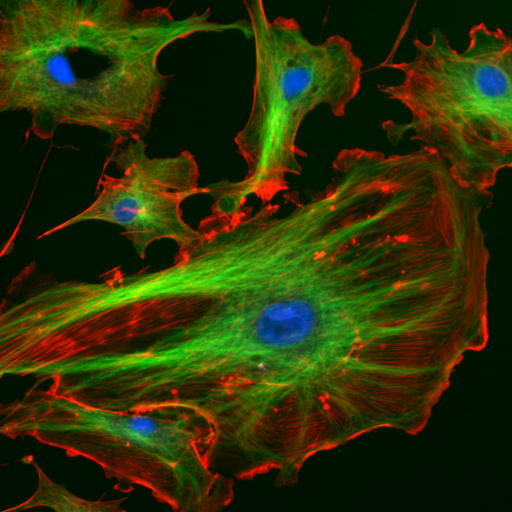


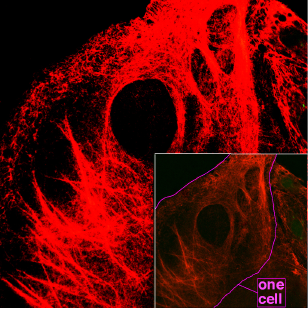
Major components
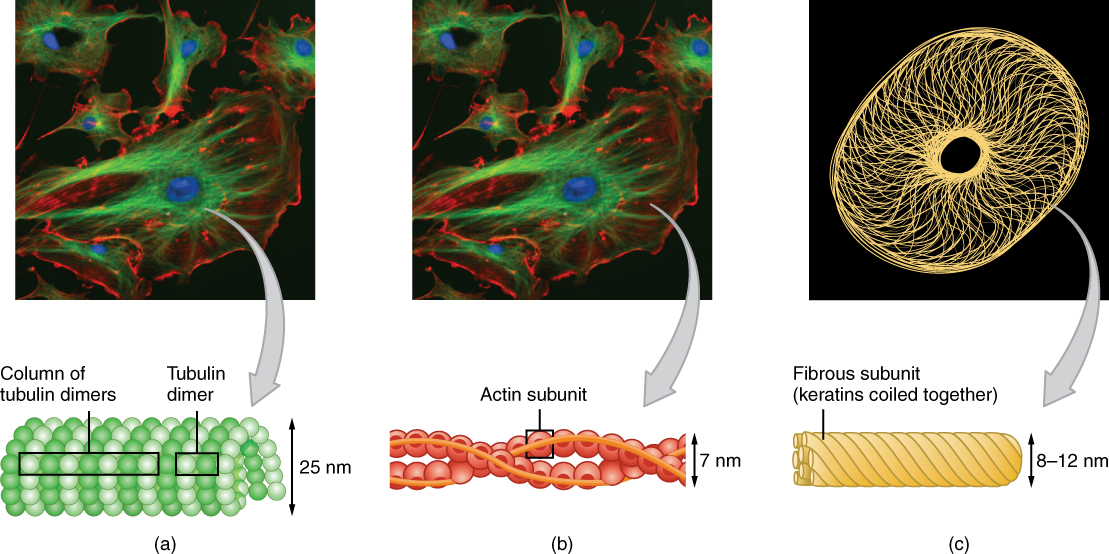
Eukaryotic cytoskeletons are composed mainly of three filament systems, each formed from a different type of protein subunit and having distinct properties:
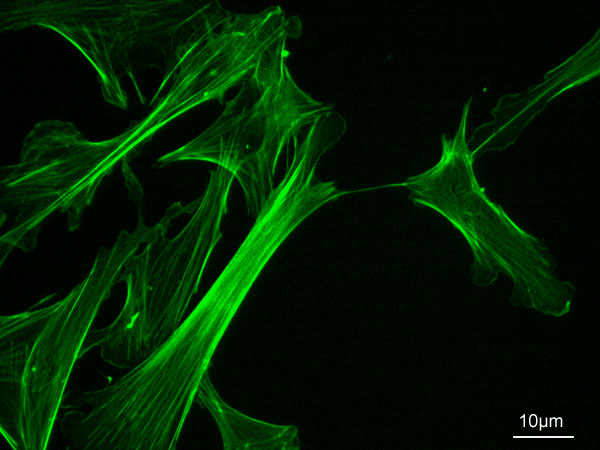
- Microfilaments (actin filaments) — thin, flexible filaments made of actin that concentrate beneath the cell membrane and drive changes in cell shape and short-range transport.
- Intermediate filaments — rope-like polymers that provide tensile strength and mechanical resilience in many cell types, especially in tissues subject to stress.
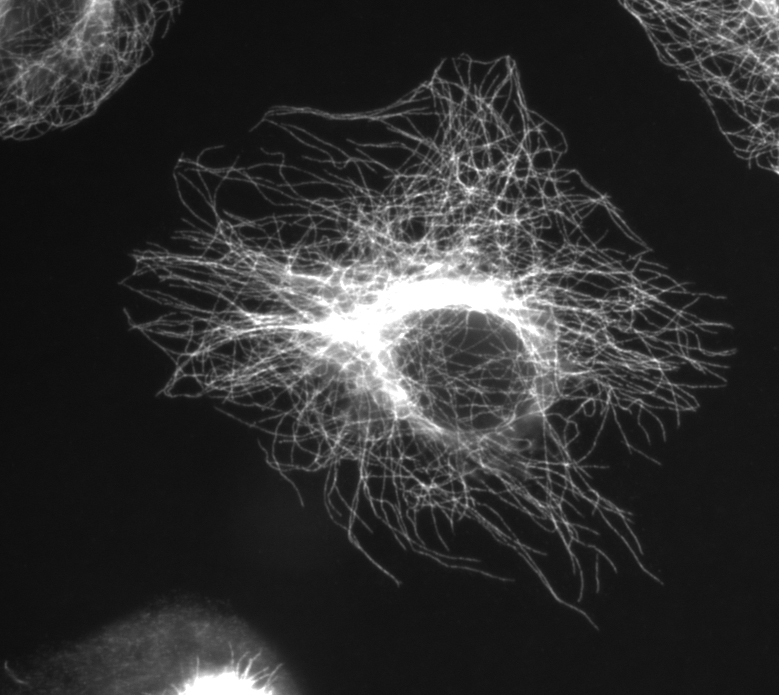
- Microtubules — hollow tubes of tubulin that form rigid tracks for long-distance transport, position organelles and build structures such as the mitotic spindle and axonemes of flagella and cilia.
Functions and examples
The cytoskeleton performs multiple roles essential to cell life. It supports cell shape and surface organization, anchors or moves organelles, and facilitates the flow of material through the cytoplasm. Molecular motors—myosin on actin, and kinesin or dynein on microtubules—carry vesicles and other cargo along cytoskeletal tracks. During division, microtubules assemble the mitotic spindle to segregate chromosomes and the actin cytoskeleton contributes to the cleavage of the cell during cytokinesis (cell division).
Dynamics, regulation and interactions
The cytoskeleton is not static: filaments polymerize and depolymerize in response to signals, producing rapid remodeling. Specialized binding proteins control filament growth, branching and cross-linking, and coordinate interactions with the cell membrane and organelles such as the endoplasmic reticulum. Small GTPases, kinases and other regulators tune cytoskeletal behavior during migration, endocytosis, cell division and development.
Origins, study and broader significance
The term cytoskeleton was introduced in the early 20th century to describe this cellular framework; subsequent advances in microscopy and biochemistry identified its molecular components and motor proteins. Prokaryotes were once thought to lack cytoskeletons, but bacterial and archaeal homologs of tubulin and actin show that filament systems are evolutionarily ancient. Cytoskeletal defects are implicated in many human conditions, from muscle and skin disorders to neurodegeneration and cancer, and researchers probe these systems with drugs and genetic tools to understand and treat disease.
Experimental tools and notable distinctions
Researchers manipulate the cytoskeleton using inhibitors that block filament assembly (for example, actin-targeting or microtubule-disrupting agents) and by imaging live cells to watch polymer dynamics. Distinctions among cytoskeletal elements—composition, diameter, mechanical role and partner proteins—help explain how a single integrated network supports diverse cellular processes. For further details see related resources: scaffolding overview, protein biology, basic descriptions of flagella, the cytoplasm, vesicle transport, organelle positioning at organelles, roles in cell division, eukaryotic specifics at eukaryote resources, interactions with the cell membrane and the endoplasmic reticulum.
Questions and answers
Q: What is the cytoskeleton?
A: The cytoskeleton is a scaffolding present in all cells made of protein.
Q: What are the functions of the cytoskeleton?
A: The cytoskeleton keeps cell shape, protects the cell, enables cells to move, helps transport inside the cytoplasm and in cell division.
Q: Who introduced the concept and term "cytosquelette"?
A: French embryologist Paul Wintrebert introduced the concept and term "cytosquelette" in 1931.
Q: How many main kinds of cytoskeletal filaments are present in eukaryote cells?
A: Eukaryote cells contain three main kinds of cytoskeletal filaments which are microfilaments (actin filaments), intermediate filaments, and microtubules.
Q: What do cytoskeletal elements interact closely with in cells?
A: Cytoskeletal elements interact closely with the cell membrane and the endoplasmic reticulum.
Q: What role does the cytoskeleton play in transporting inside the cytoplasm?
A: The cytoskeleton helps in the movement of vesicles and organelles inside the cytoplasm.
Q: What is the primary function of the cytoskeleton in cell division?
A: The cytoskeleton plays a role in cell division.
Related articles
Author
AlegsaOnline.com Cytoskeleton: cellular framework of structure, movement and transport Leandro Alegsa
URL: https://en.alegsaonline.com/art/24965
Sources
- doi.org : 10.1002/1097-0169(200006)46:2<73::AID-CM1>3.0.CO;2-0
- pubmed.ncbi.nlm.nih.gov : 10891854
- biophysj.org : "Confinement as a determinant of macromolecular structure and reactivity"
- doi.org : 10.1016/S0006-3495(92)81663-6
- ncbi.nlm.nih.gov : 1262248
- pubmed.ncbi.nlm.nih.gov : 1420928
- arjournals.annualreviews.org : "Mediation, modulation and consequences of membrane-cytoskeleton interactions"
- doi.org : 10.1146/annurev.biophys.37.032807.125912
- pubmed.ncbi.nlm.nih.gov : 18573073
- commons.wikimedia.org : Cytoskeleton