
Cysteine — sulfur-containing α‑amino acid
Cysteine is a sulfur-containing α-amino acid important in protein structure, enzyme catalysis and antioxidant biochemistry; it is semi‑essential and encoded by UGU and UGC.
Cysteine is a naturally occurring, sulfur-containing α‑amino acid that plays multiple roles in biochemistry and industry. Chemically it can be represented as HO2CCH(NH2)CH2SH and is commonly abbreviated as Cys or C. In living organisms cysteine is classed as a semi‑essential (or conditionally essential) amino acid: it can be synthesised by healthy adults but may become limiting in some diets or metabolic conditions.
Image gallery
8 Images
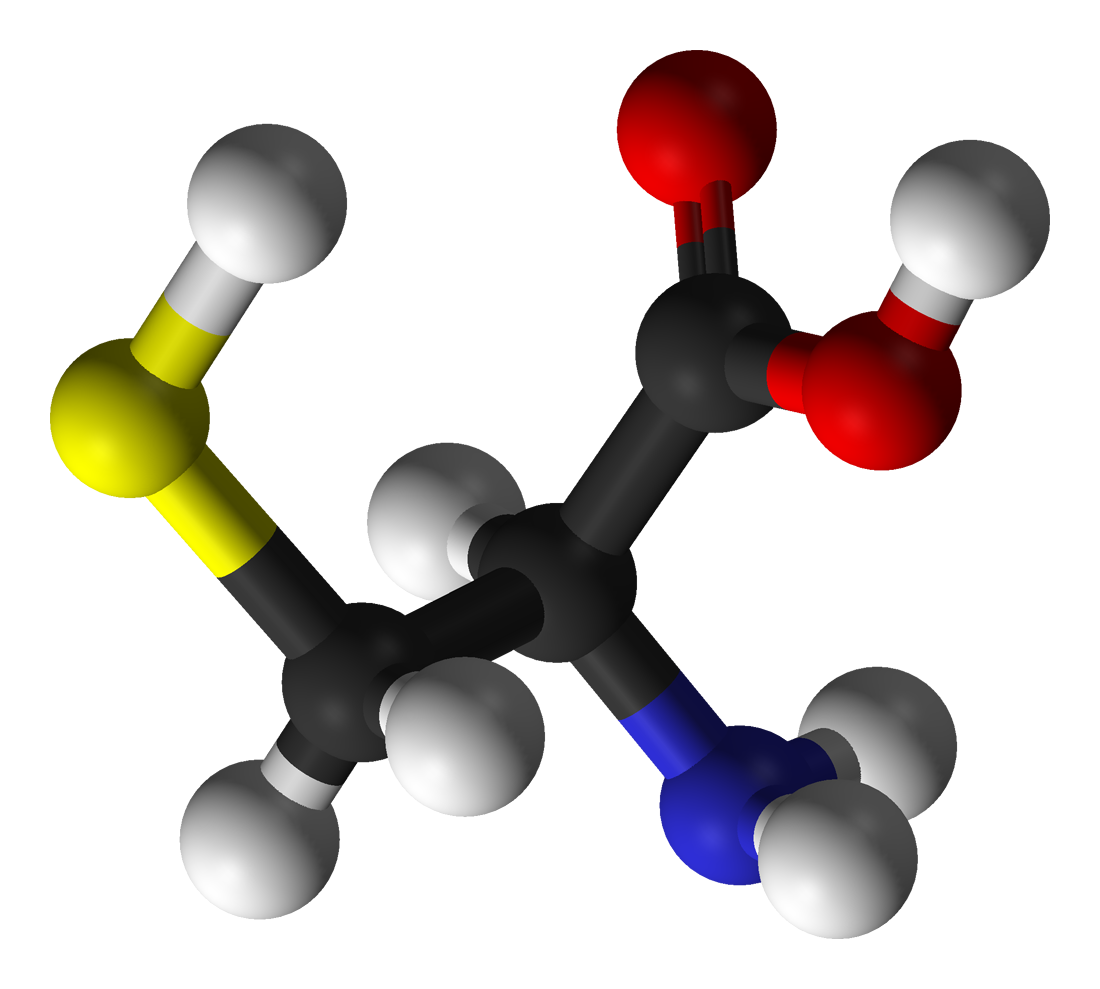


Chemical characteristics
The distinguishing feature of cysteine is its thiol (sulfhydryl) side chain (–SH), which gives the residue unique chemical reactivity compared with other amino acids. The thiol group is nucleophilic and can participate in redox chemistry, metal coordination and covalent bond formation. Because of this behavior cysteine frequently appears at enzyme active sites where the side chain participates directly in catalysis or substrate binding. For a general classification see alpha‑amino acid and for the thiol functional group see thiol.
Biological roles and metabolism
Cysteine is incorporated into proteins during translation, encoded by the mRNA codons UGU and UGC. Inside cells it has several central roles:
- Precursor for the tripeptide antioxidant glutathione, a major cellular redox buffer and detoxifying agent.
- Participant in sulfur metabolism and a source of reduced sulfur for biosynthetic reactions.
- Active site residue in many enzymes where the cysteine thiol acts as a nucleophile; see nucleophile and enzyme reactions.
Disulfide bonds and protein structure
When two cysteine residues are oxidized, their thiol groups form a covalent disulfide bond (cystine). These disulfide bridges stabilise the three‑dimensional fold of many extracellular and secreted proteins and can control protein activity by reversible redox switching. The importance of cysteine residues in folded polypeptides and assemblies is discussed in protein chemistry references; see protein resources for more.
Uses, applications and safety
Outside the body, cysteine is used in food and industry. As a food additive it may be listed under the code E920 and is sometimes used to modify dough properties and flavors. It is also produced for nutritional supplements and biotechnological applications where its reactivity is useful for modifying proteins or introducing crosslinks.
Clinically, cysteine supply affects glutathione levels and antioxidant capacity; deficiencies or altered metabolism can influence detoxification and redox balance. Cysteine's chemistry underpins many laboratory methods for studying protein structure and function, and its evolutionary conservation in active sites highlights its biochemical importance.
Questions and answers
Q: What is cysteine?
A: Cysteine is an α-amino acid with the chemical formula HO2CCH(NH2)CH2SH.
Q: Is cysteine an essential amino acid?
A: Cysteine is a semi-essential amino acid, which means that humans can make it.
Q: What are the codons that code for cysteine?
A: The codons UGU and UGC code for cysteine.
Q: What role does the thiol side chain in cysteine play?
A: The thiol side chain in cysteine often does enzyme reactions as a nucleophile.
Q: What happens when the thiol in cysteine oxidizes?
A: The thiol in cysteine oxidizes to give the disulfide derivative cystine, which is important in many protein structures.
Q: What is the E-number for cysteine when used as a food additive?
A: When used as a food additive, cysteine has the E-number E920.
Q: Is cysteine naturally found in foods?
A: Cysteine is naturally found in many foods, including meat, poultry, eggs, and dairy products.
Related articles
Author
AlegsaOnline.com Cysteine — sulfur-containing α‑amino acid Leandro Alegsa
URL: https://en.alegsaonline.com/art/24951
Sources
- microbiologytext.com : "The primary structure of proteins is the amino acid sequence"