
Cyclohexane
Cyclohexane is a colorless, flammable saturated cyclic hydrocarbon (C6H12) used as a solvent and as an industrial feedstock for producing adipic acid and caprolactam for nylon manufacture.
Cyclohexane is a saturated cyclic hydrocarbon: a cycloalkane molecule with the empirical formula C6H12. It consists of six carbon atoms arranged in a ring, each bonded to two hydrogen atoms and to two neighboring carbons; the ring as a whole is often represented simply as C6H12. Pure cyclohexane is a colorless, volatile liquid under normal conditions and is readily flammable.
Image gallery
4 Images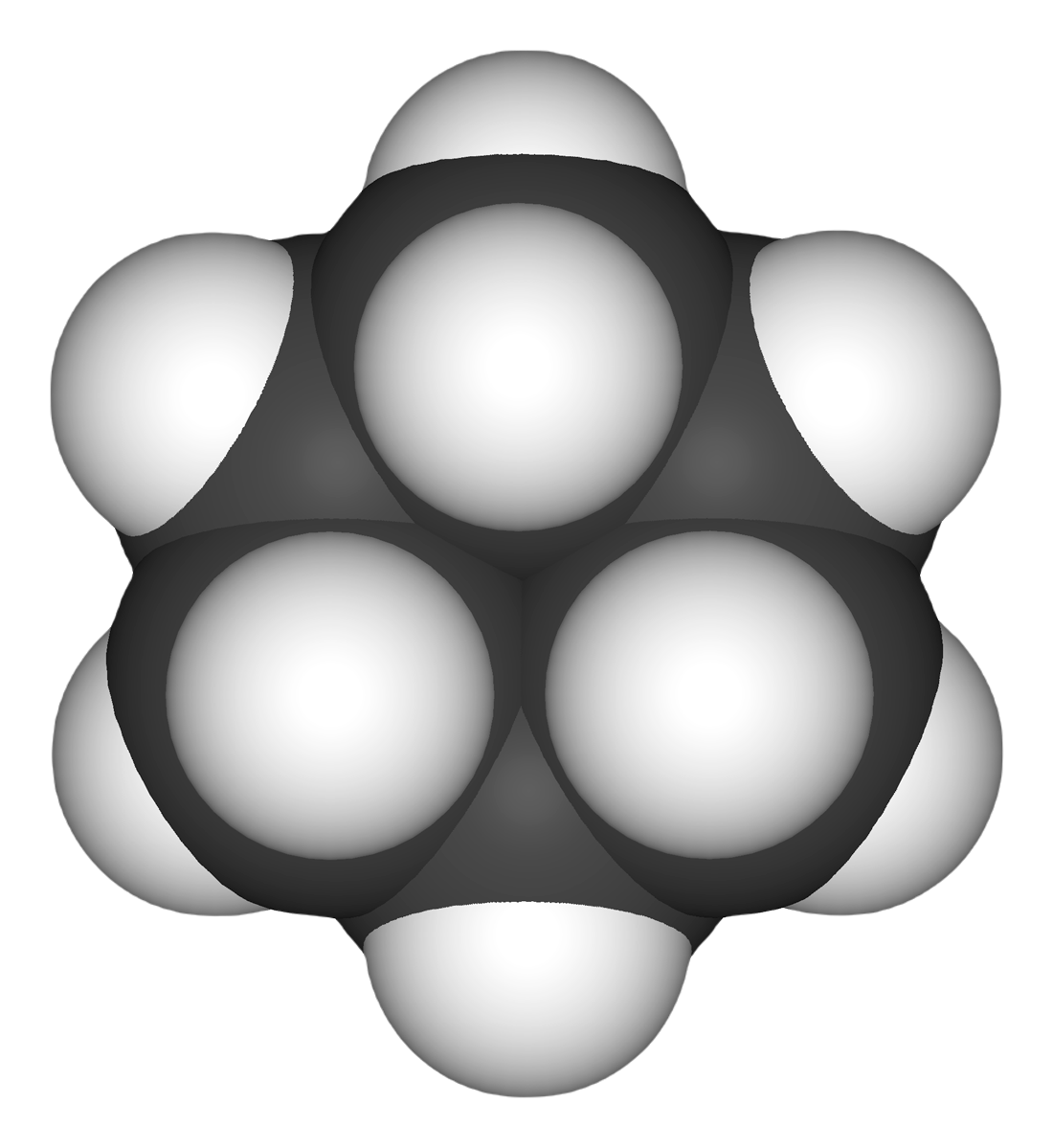


Characteristics
Cyclohexane is nonpolar and low in polarity compared with common oxygenated solvents, which makes it useful as a hydrocarbon solvent in laboratory and industrial settings. Chemically it is saturated (no double bonds) and relatively unreactive toward many reagents, though it can undergo combustion, halogenation under radical conditions, and catalytic dehydrogenation to form aromatic compounds. Physically, its liquid nature and volatility mean it evaporates easily and can act as a volatile organic compound (VOC) in the environment.
Conformations and structure
The three-dimensional geometry of cyclohexane is central to its chemistry. The most stable conformation is the chair, which minimizes torsional strain and places substituents in energetically preferred positions. A less stable boat conformation also exists but is higher in energy. In the chair form hydrogen atoms occupy two different types of positions, described as axial and equatorial, which affects reactivity and steric interactions for substituted cyclohexanes.
Production and uses
- Industrial production commonly involves hydrogenation of benzene or related processes; cyclohexane is produced on a large scale for chemical manufacture.
- The compound is an important intermediate and feedstock: it is oxidized and processed to give adipic acid and to produce caprolactam, precursors used in the manufacture of nylon (nylon).
- It also serves as a nonpolar solvent in chemical synthesis, extractions, and product testing in both laboratories and industry.
Safety and environmental considerations
Cyclohexane is flammable and should be handled away from ignition sources. It can cause central nervous system effects if inhaled in large amounts and may irritate skin or eyes on contact. As a volatile hydrocarbon it contributes to ground-level ozone formation when released to the atmosphere; industrial facilities manage emissions and use controls to limit environmental release.
Distinctions and notable facts
Cyclohexane differs from benzene in being saturated rather than aromatic, which gives it different chemical behavior and reactivity. It should not be confused with unsaturated cycloalkenes such as cyclohexene, which contain double bonds and are more reactive. For further general information about cyclic hydrocarbons and related terminology see resources on cycloalkanes and basic organic chemistry molecular introductions. Technical data sheets and safety summaries are typically available from suppliers and regulatory agencies C, 6 and H references and industrial chemical profiles carbon atom summaries.
Questions and answers
Q: What is cyclohexane?
A: Cyclohexane is a cycloalkane molecule with the chemical formula C6H12, consisting of 6 carbon atoms arranged in a ring shape and each connected to two hydrogen atoms.
Q: What is the use of cyclohexane?
A: Cyclohexane is used to produce adipic acid and caprolactam, which are used to make nylon.
Q: What is the physical appearance of cyclohexane?
A: Cyclohexane is colorless in nature.
Q: What are the properties of Cyclohexane?
A: Cyclohexane is flammable in nature.
Q: What is the molecular formula of cyclohexane?
A: The molecular formula of cyclohexane is C6H12.
Q: How many carbon atoms are present in cyclohexane?
A: There are 6 carbon atoms present in cyclohexane.
Q: How are the carbon atoms arranged in cyclohexane?
A: The carbon atoms in cyclohexane are arranged in a ring shape, where 6 carbon atoms are connected to each other in a ring shape.
Related articles
Author
AlegsaOnline.com Cyclohexane Leandro Alegsa
URL: https://en.alegsaonline.com/art/24868
Sources
- dictionary.com : Hexanaphthene · web.archive.org
- doi.org : 10.1039/9781849733069-FP001
- cdc.gov : "NIOSH Pocket Guide to Chemical Hazards #0163"